

"Hot Vent" and "Cold Seep" Communities
183
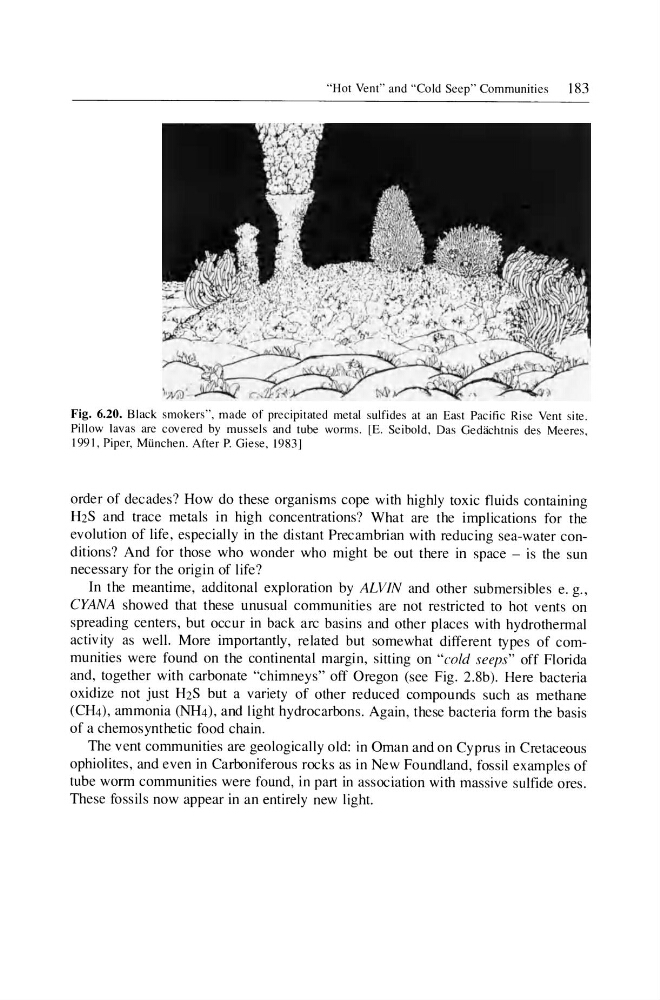
Fig. 6.20. Black smokers", made of precipitated metal sulfides at an East Pacific Rise Vent site.
Pillow lavas are covered by mussels and tube worms. IE. Seibold, Das Gedachtnis des Meeres,
1991, Piper, Miinchen. After P. Giese, 1983]
order of decades? How do these organisms cope with highly toxic fluids containing
H2S and trace metals in high concentrations? What are the implications for the
evolution of life, especially in the distant Precambrian with reducing sea-water conditions? And for those who wonder who might be out there in space - is the sun
necessary for the origin of life?
In the meantime, additonal exploration by ALVIN and other submersibles e. g.,
CYANA showed that these unusual communities are not restricted to hot vents on
spreading centers, but occur in back arc basins and other places with hydrothermal
activity as well. More importantly, related but somewhat different types of communities were found on the continental margin, sitting on "cold seeps" off Florida
and, together with carbonate "chimneys" off Oregon (see Fig. 2.8b). Here bacteria
oxidize not just H2S but a variety of other reduced compounds such as methane
(CH4), ammonia (NH4), and light hydrocarbons. Again, these bacteria form the basis
of a chemosynthetic food chain.
The vent communities are geologically old: in Oman and on Cyprus in Cretaceous
ophiolites, and even in Carboniferous rocks as in New Foundland, fossil examples of
tube worm communities were found, in part in association with massive sulfide ores.
These fossils now appear in an entirely new light.
183
Fig. 6.20. Black smokers", made of precipitated metal sulfides at an East Pacific Rise Vent site.
Pillow lavas are covered by mussels and tube worms. IE. Seibold, Das Gedachtnis des Meeres,
1991, Piper, Miinchen. After P. Giese, 1983]
order of decades? How do these organisms cope with highly toxic fluids containing
H2S and trace metals in high concentrations? What are the implications for the
evolution of life, especially in the distant Precambrian with reducing sea-water conditions? And for those who wonder who might be out there in space - is the sun
necessary for the origin of life?
In the meantime, additonal exploration by ALVIN and other submersibles e. g.,
CYANA showed that these unusual communities are not restricted to hot vents on
spreading centers, but occur in back arc basins and other places with hydrothermal
activity as well. More importantly, related but somewhat different types of communities were found on the continental margin, sitting on "cold seeps" off Florida
and, together with carbonate "chimneys" off Oregon (see Fig. 2.8b). Here bacteria
oxidize not just H2S but a variety of other reduced compounds such as methane
(CH4), ammonia (NH4), and light hydrocarbons. Again, these bacteria form the basis
of a chemosynthetic food chain.
The vent communities are geologically old: in Oman and on Cyprus in Cretaceous
ophiolites, and even in Carboniferous rocks as in New Foundland, fossil examples of
tube worm communities were found, in part in association with massive sulfide ores.
These fossils now appear in an entirely new light.