

176 Productivity and Benthic Organisms
sediments - the sediments from which we hope to extract the most complete and
accurate information about ancient climates (as discussed in Chap. 9) .
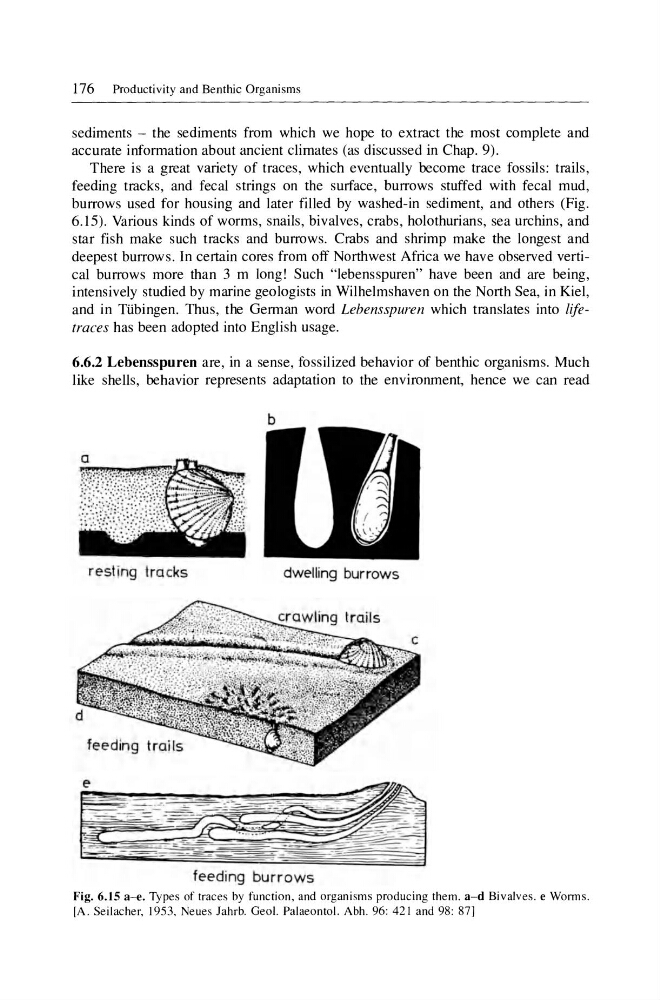
There is a great variety of traces, which eventually become trace fossils: trails,
feeding tracks, and fecal strings on the surface, burrows stuffed with fecal mud,
burrows used for housing and later filled by washed-in sediment, and others (Fig.
6.15). Various kinds of worms, snails, bivalves, crabs, holothurians, sea urchins, and
star fish make such tracks and burrows. Crabs and shrimp make the longest and
deepest burrows. In certain cores from off Northwest Africa we have observed vertical burrows more than 3 m long! Such "lebensspuren" have been and are being,
intensively studied by marine geologists in Wilhelmshaven on the North Sea, in Kiel,
and in Tiibingen. Thus, the German word Lebensspuren which translates into lifetraces has been adopted into English usage.
6.6.2 Lebensspuren are, in a sense, fossilized behavior of benthic organisms. Much
like shells, behavior represents adaptation to the environment, hence we can read
b
resting tracks
dwelling burrows
feeding
Er~~
feeding burrows
Fig. 6.15 a-e. Types of traces by function , and organisms producing them. a-d Bivalves. e Wonns.
[A. Seilacher, 1953, Neues lahrb. Geol. Palaeontol. Abh. 96: 421 and 98: 87]
sediments - the sediments from which we hope to extract the most complete and
accurate information about ancient climates (as discussed in Chap. 9) .
There is a great variety of traces, which eventually become trace fossils: trails,
feeding tracks, and fecal strings on the surface, burrows stuffed with fecal mud,
burrows used for housing and later filled by washed-in sediment, and others (Fig.
6.15). Various kinds of worms, snails, bivalves, crabs, holothurians, sea urchins, and
star fish make such tracks and burrows. Crabs and shrimp make the longest and
deepest burrows. In certain cores from off Northwest Africa we have observed vertical burrows more than 3 m long! Such "lebensspuren" have been and are being,
intensively studied by marine geologists in Wilhelmshaven on the North Sea, in Kiel,
and in Tiibingen. Thus, the German word Lebensspuren which translates into lifetraces has been adopted into English usage.
6.6.2 Lebensspuren are, in a sense, fossilized behavior of benthic organisms. Much
like shells, behavior represents adaptation to the environment, hence we can read
b
resting tracks
dwelling burrows
feeding
Er~~
feeding burrows
Fig. 6.15 a-e. Types of traces by function , and organisms producing them. a-d Bivalves. e Wonns.
[A. Seilacher, 1953, Neues lahrb. Geol. Palaeontol. Abh. 96: 421 and 98: 87]