

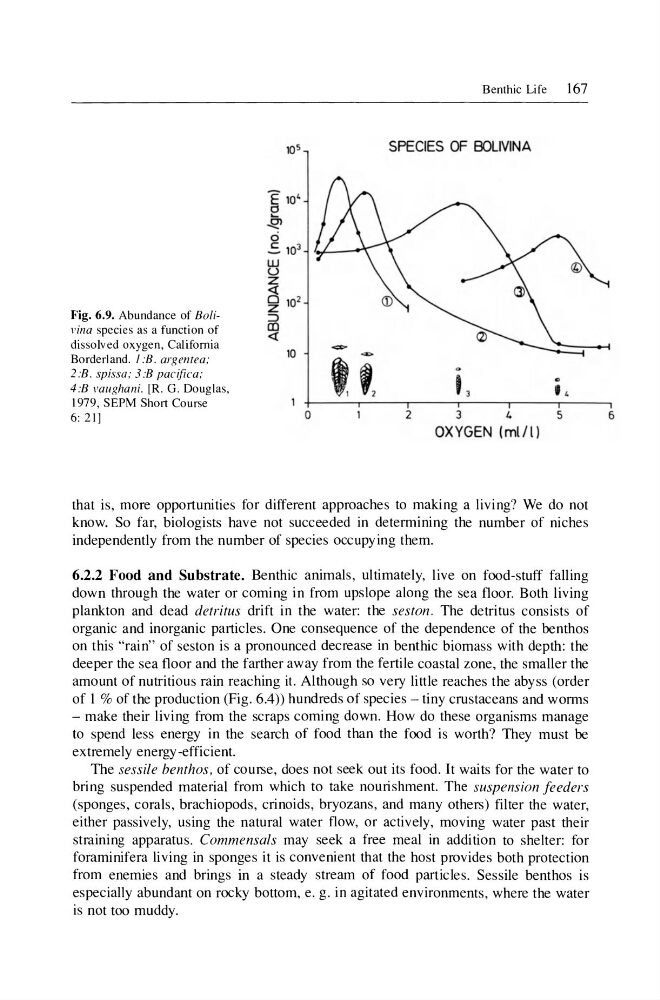
Fig. 6.9. Abundance of Bolivina species as a function of
dissolved oxygen, California
Borderland. I :B. argentea;
2 :B. spissa ; 3:B pacifica;
4:B I'aughani. [R. G. Douglas,
1979, SEPM Short Course
6: 21]
o
Benthic Life
167
SPECIES OF BOLIVINA
. .
, ,
2
3
4
5
OXYGEN (mill)
that is, more opportunities for different approaches to making a living? We do not
know. So far, biologists have not succeeded in determining the number of niches
independently from the number of species occupying them.
6.2.2 Food and Substrate. Benthic animals, ultimately, live on food-stuff falling
down through the water or coming in from upslope along the sea floor. Both living
plankton and dead detritus drift in the water: the seston . The detritus consists of
organic and inorganic particles. One consequence of the dependence of the benthos
on this "rain" of seston is a pronounced decrease in benthic biomass with depth: the
deeper the sea floor and the farther away from the fertile coastal zone, the smaller the
amount of nutritious rain reaching it. Although so very little reaches the abyss (order
of 1 % of the production (Fig. 6.4)) hundreds of species - tiny crustaceans and worms
- make their living from the scraps coming down. How do these organisms manage
to spend less energy in the search of food than the food is worth? They must be
extremely energy-efficient.
The sessile benthos, of course, does not seek out its food. It waits for the water to
bring suspended material from which to take nourishment. The suspension feeders
(sponges, corals, brachiopods, crinoids, bryozans, and many others) filter the water,
either passively, using the natural water flow, or actively, moving water past their
straining apparatus. Commensals may seek a free meal in addition to shelter: for
foraminifera living in sponges it is convenient that the host provides both protection
from enemies and brings in a steady stream of food particles. Sessile benthos is
especially abundant on rocky bottom, e. g. in agitated environments, where the water
is not too muddy.
6
dissolved oxygen, California
Borderland. I :B. argentea;
2 :B. spissa ; 3:B pacifica;
4:B I'aughani. [R. G. Douglas,
1979, SEPM Short Course
6: 21]
o
Benthic Life
167
SPECIES OF BOLIVINA
. .
, ,
2
3
4
5
OXYGEN (mill)
that is, more opportunities for different approaches to making a living? We do not
know. So far, biologists have not succeeded in determining the number of niches
independently from the number of species occupying them.
6.2.2 Food and Substrate. Benthic animals, ultimately, live on food-stuff falling
down through the water or coming in from upslope along the sea floor. Both living
plankton and dead detritus drift in the water: the seston . The detritus consists of
organic and inorganic particles. One consequence of the dependence of the benthos
on this "rain" of seston is a pronounced decrease in benthic biomass with depth: the
deeper the sea floor and the farther away from the fertile coastal zone, the smaller the
amount of nutritious rain reaching it. Although so very little reaches the abyss (order
of 1 % of the production (Fig. 6.4)) hundreds of species - tiny crustaceans and worms
- make their living from the scraps coming down. How do these organisms manage
to spend less energy in the search of food than the food is worth? They must be
extremely energy-efficient.
The sessile benthos, of course, does not seek out its food. It waits for the water to
bring suspended material from which to take nourishment. The suspension feeders
(sponges, corals, brachiopods, crinoids, bryozans, and many others) filter the water,
either passively, using the natural water flow, or actively, moving water past their
straining apparatus. Commensals may seek a free meal in addition to shelter: for
foraminifera living in sponges it is convenient that the host provides both protection
from enemies and brings in a steady stream of food particles. Sessile benthos is
especially abundant on rocky bottom, e. g. in agitated environments, where the water
is not too muddy.
6