

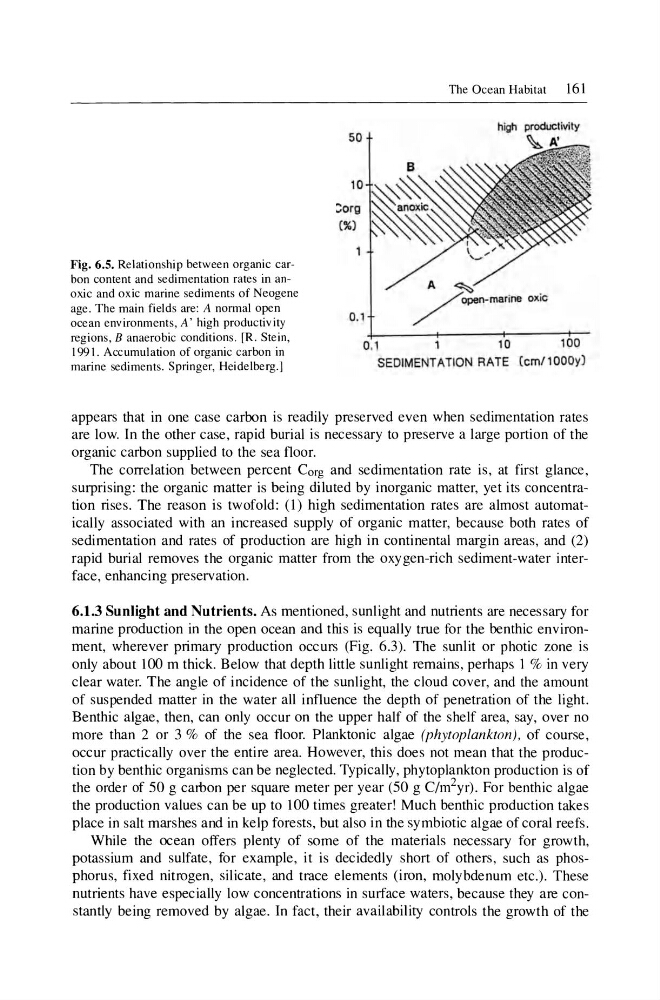
Fig. 6.5. Relationship between organic carbon content and sedimentation rates in anoxic and oxic marine sediments of Neogene
age. The main fields are: A normal open
ocean environments, A' high productivity
regions, B anaerobic conditions. [R. Stein,
1991. Accumulation of organic carbon in
marine sediments. Springer, Heidelberg.]
50
10
::org
(%)
The Ocean Habitat
161
0. 1
0 .1
1
10
1
SEDIMENTATION RATE (cm/1000y)
appears that in one case carbon is readily preserved even when sedimentation rates
are low. In the other case, rapid burial is necessary to preserve a large portion of the
organic carbon supplied to the sea floor.
The correlation between percent Corg and sedimentation rate is, at first glance,
surprising: the organic matter is being diluted by inorganic matter, yet its concentration rises. The reason is twofold: (1) high sedimentation rates are almost automatically associated with an increased supply of organic matter, because both rates of
sedimentation and rates of production are high in continental margin areas, and (2)
rapid burial removes the organic matter from the oxygen-rich sediment-water interface, enhancing preservation.
6.1.3 Sunlight and Nutrients. As mentioned, sunlight and nutrients are necessary for
marine production in the open ocean and this is equally true for the benthic environment, wherever primary production occurs (Fig. 6.3). The sunlit or photic zone is
only about 100m thick. Below that depth little sunlight remains, perhaps 1 % in very
clear water. The angle of incidence of the sunlight, the cloud cover, and the amount
of suspended matter in the water aU influence the depth of penetration of the light.
Benthic algae, then, can only occur on the upper half of the shelf area, say, over no
more than 2 or 3 % of the sea floor. Planktonic algae (phytoplankton), of course,
occur practically over the entire area. However, this does not mean that the production by benthic organisms can be neglected. Typically, phytoplankton production is of
the order of 50 g carbon per square meter per year (50 g C/m 2 yr). For benthic algae
the production values can be up to 100 times greater! Much benthic production takes
place in salt marshes and in kelp forests, but also in the symbiotic algae of coral reefs .
While the ocean offers plenty of some of the materials necessary for growth,
potassium and sulfate, for example, it is decidedly short of others, such as phosphorus, fixed nitrogen, silicate, and trace elements (iron, molybdenum etc.). These
nutrients have especially low concentrations in surface waters, because they are constantly being removed by algae. In fact, their availability controls the growth of the
age. The main fields are: A normal open
ocean environments, A' high productivity
regions, B anaerobic conditions. [R. Stein,
1991. Accumulation of organic carbon in
marine sediments. Springer, Heidelberg.]
50
10
::org
(%)
The Ocean Habitat
161
0. 1
0 .1
1
10
1
SEDIMENTATION RATE (cm/1000y)
appears that in one case carbon is readily preserved even when sedimentation rates
are low. In the other case, rapid burial is necessary to preserve a large portion of the
organic carbon supplied to the sea floor.
The correlation between percent Corg and sedimentation rate is, at first glance,
surprising: the organic matter is being diluted by inorganic matter, yet its concentration rises. The reason is twofold: (1) high sedimentation rates are almost automatically associated with an increased supply of organic matter, because both rates of
sedimentation and rates of production are high in continental margin areas, and (2)
rapid burial removes the organic matter from the oxygen-rich sediment-water interface, enhancing preservation.
6.1.3 Sunlight and Nutrients. As mentioned, sunlight and nutrients are necessary for
marine production in the open ocean and this is equally true for the benthic environment, wherever primary production occurs (Fig. 6.3). The sunlit or photic zone is
only about 100m thick. Below that depth little sunlight remains, perhaps 1 % in very
clear water. The angle of incidence of the sunlight, the cloud cover, and the amount
of suspended matter in the water aU influence the depth of penetration of the light.
Benthic algae, then, can only occur on the upper half of the shelf area, say, over no
more than 2 or 3 % of the sea floor. Planktonic algae (phytoplankton), of course,
occur practically over the entire area. However, this does not mean that the production by benthic organisms can be neglected. Typically, phytoplankton production is of
the order of 50 g carbon per square meter per year (50 g C/m 2 yr). For benthic algae
the production values can be up to 100 times greater! Much benthic production takes
place in salt marshes and in kelp forests, but also in the symbiotic algae of coral reefs .
While the ocean offers plenty of some of the materials necessary for growth,
potassium and sulfate, for example, it is decidedly short of others, such as phosphorus, fixed nitrogen, silicate, and trace elements (iron, molybdenum etc.). These
nutrients have especially low concentrations in surface waters, because they are constantly being removed by algae. In fact, their availability controls the growth of the