

Mangrove Swamps
143
a
b
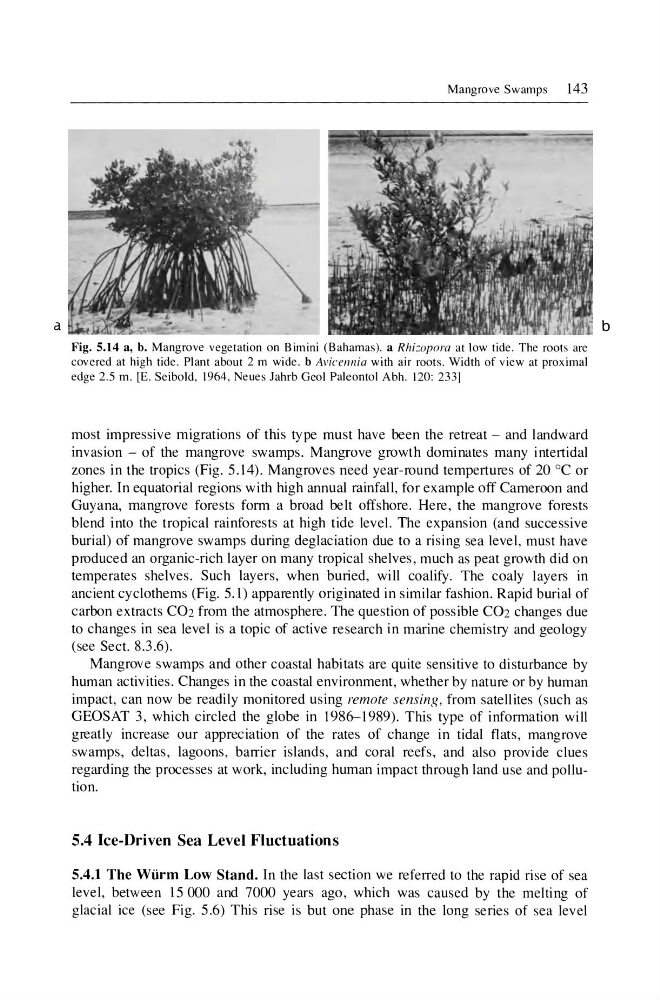
Fig. 5.14 a, b. Mangrove vegetation on Bimini (Bahamas). a Rhi:opora at low tide . The roots are
covered at high tide . Plant about 2 m wide. b Al'icennia with air roots. Width of view at proximal
edge 2.S m. [E. Seibold. 1964, Neues lahrb Geol Paleontol Abh. 120: 233]
most impressive migrations of this type must have been the retreat - and landward
invasion - of the mangrove swamps, Mangrove growth dominates many intertidal
zones in the tropics (Fig. 5.14). Mangroves need year-round tempertures of 20°C or
higher. In equatorial regions with high annual rainfall, for example off Cameroon and
Guyana, mangrove forests form a broad belt offshore. Here, the mangrove forests
blend into the tropical rainforests at high tide level. The expansion (and successive
burial) of mangrove swamps during deglaciation due to a rising sea level, must have
produced an organic-rich layer on many tropical shelves, much as peat growth did on
temperates shelves. Such layers, when buried, will coalify. The coaly layers in
ancient cyclothems (Fig. 5.1) apparently originated in similar fashion. Rapid burial of
carbon extracts C02 from the atmosphere. The question of possible C02 changes due
to changes in sea level is a topic of active research in marine chemistry and geology
(see Sect. 8.3.6).
Mangrove swamps and other coastal habitats are quite sensitive to disturbance by
human activities. Changes in the coastal environment, whether by nature or by human
impact, can now be readily monitored using remote sensing, from satellites (such as
GEOSAT 3, which circled the globe in 1986--1989). This type of information will
greatly increase our appreciation of the rates of change in tidal flats, mangrove
swamps, deltas , lagoons, barrier islands, and coral reefs , and also provide clues
regarding the processes at work, including human impact through land use and pollution.
5.4 Ice-Driven Sea Level Fluctuations
5.4.1 The Worm Low Stand. In the last section we referred to the rapid rise of sea
level, between 15 000 and 7000 years ago, which was caused by the melting of
glacial ice (see Fig. 5.6) This rise is but one phase in the long series of sea level
143
a
b
Fig. 5.14 a, b. Mangrove vegetation on Bimini (Bahamas). a Rhi:opora at low tide . The roots are
covered at high tide . Plant about 2 m wide. b Al'icennia with air roots. Width of view at proximal
edge 2.S m. [E. Seibold. 1964, Neues lahrb Geol Paleontol Abh. 120: 233]
most impressive migrations of this type must have been the retreat - and landward
invasion - of the mangrove swamps, Mangrove growth dominates many intertidal
zones in the tropics (Fig. 5.14). Mangroves need year-round tempertures of 20°C or
higher. In equatorial regions with high annual rainfall, for example off Cameroon and
Guyana, mangrove forests form a broad belt offshore. Here, the mangrove forests
blend into the tropical rainforests at high tide level. The expansion (and successive
burial) of mangrove swamps during deglaciation due to a rising sea level, must have
produced an organic-rich layer on many tropical shelves, much as peat growth did on
temperates shelves. Such layers, when buried, will coalify. The coaly layers in
ancient cyclothems (Fig. 5.1) apparently originated in similar fashion. Rapid burial of
carbon extracts C02 from the atmosphere. The question of possible C02 changes due
to changes in sea level is a topic of active research in marine chemistry and geology
(see Sect. 8.3.6).
Mangrove swamps and other coastal habitats are quite sensitive to disturbance by
human activities. Changes in the coastal environment, whether by nature or by human
impact, can now be readily monitored using remote sensing, from satellites (such as
GEOSAT 3, which circled the globe in 1986--1989). This type of information will
greatly increase our appreciation of the rates of change in tidal flats, mangrove
swamps, deltas , lagoons, barrier islands, and coral reefs , and also provide clues
regarding the processes at work, including human impact through land use and pollution.
5.4 Ice-Driven Sea Level Fluctuations
5.4.1 The Worm Low Stand. In the last section we referred to the rapid rise of sea
level, between 15 000 and 7000 years ago, which was caused by the melting of
glacial ice (see Fig. 5.6) This rise is but one phase in the long series of sea level