

2 Introduction
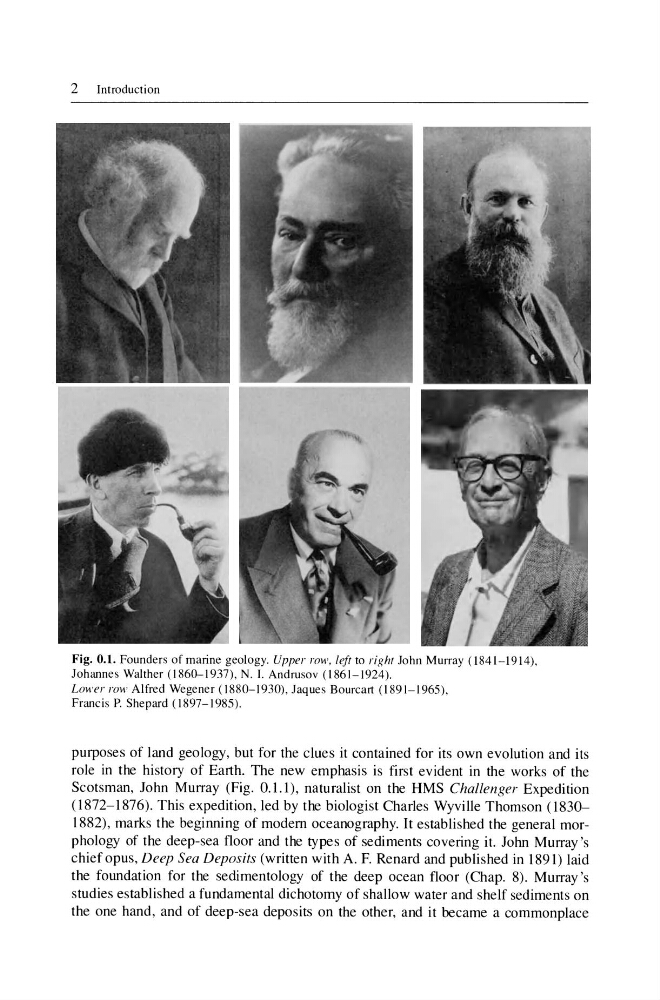
Fig. 0.1. Founders of marine geology. Upper row, left to right John Murray (\841-1914),
Johannes Walther (1860-1937), N. I. Andrusov (1861-1924).
Lower row Alfred Wegener (1880- 1930), Jaques Bourcart (1891-1965),
Francis P. Shepard (\ 897-1985).
purposes of land geology, but for the clues it contained for its own evolution and its
role in the history of Earth. The new emphasis is first evident in the works of the
Scotsman, John Murray (Fig. 0.1.1), naturalist on the HMS Challenger Expedition
(1872-1876). This expedition, led by the biologist Charles Wyville Thomson (18301882), marks the beginning of modem oceanography. It established the general morphology of the deep-sea floor and the types of sediments covering it. John Murray's
chief opus, Deep Sea Deposits (written with A. F. Renard and published in 1891) laid
the foundation for the sedimentology of the deep ocean floor (Chap. 8). Murray's
studies established a fundamental dichotomy of shaJlow water and shelf sediments on
the one hand, and of deep-sea deposits on the other, and it became a commonplace
Fig. 0.1. Founders of marine geology. Upper row, left to right John Murray (\841-1914),
Johannes Walther (1860-1937), N. I. Andrusov (1861-1924).
Lower row Alfred Wegener (1880- 1930), Jaques Bourcart (1891-1965),
Francis P. Shepard (\ 897-1985).
purposes of land geology, but for the clues it contained for its own evolution and its
role in the history of Earth. The new emphasis is first evident in the works of the
Scotsman, John Murray (Fig. 0.1.1), naturalist on the HMS Challenger Expedition
(1872-1876). This expedition, led by the biologist Charles Wyville Thomson (18301882), marks the beginning of modem oceanography. It established the general morphology of the deep-sea floor and the types of sediments covering it. John Murray's
chief opus, Deep Sea Deposits (written with A. F. Renard and published in 1891) laid
the foundation for the sedimentology of the deep ocean floor (Chap. 8). Murray's
studies established a fundamental dichotomy of shaJlow water and shelf sediments on
the one hand, and of deep-sea deposits on the other, and it became a commonplace