

136 Sea Level Processes and Effects of Sea Level Change
(I
0
m
b
20 +
20
~O
£0
:[
60
a; 60
1
01
1111
~
80
11111
100
14C ages
1211
120
m
0
10
15
6
12
I S
III
21
Thousands of years B. P.
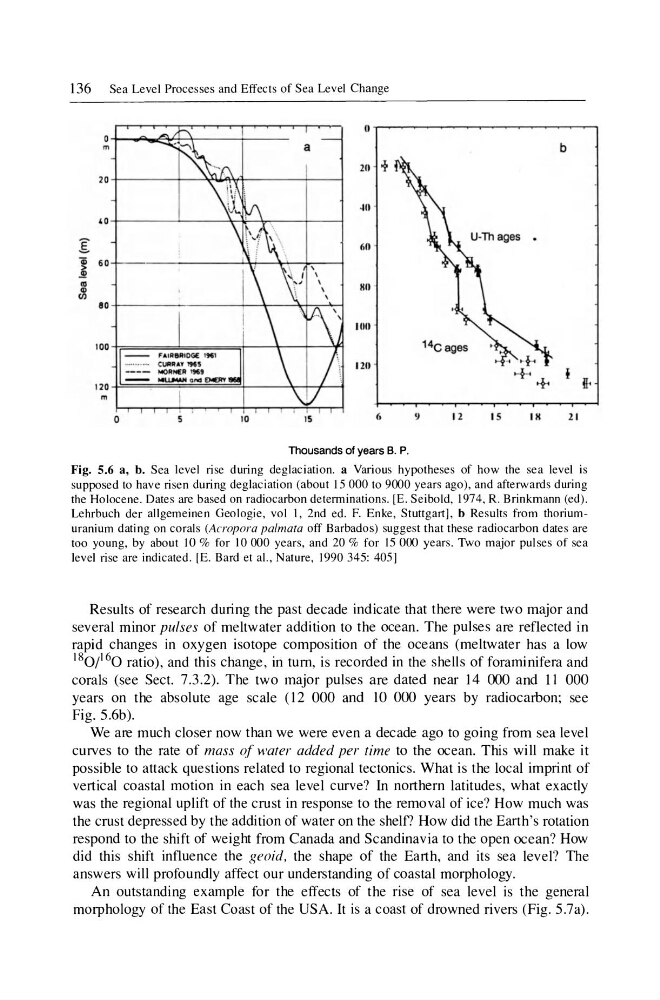
Fig. 5.6 a, b. Sea level rise during deglaciation. a Various hypotheses of how the sea level is
supposed to have risen during deglaciation (about 15000 to 9000 years ago), and afterwards during
the Holocene. Dates are based on radiocarbon determinations. [E. Seibold, 1974. R. Brinkmann (ed).
Lehrbuch der allgemeinen Geologie, vol I, 2nd ed. F. Enke, Stuttgart], b Results from thoriumuranium dating on corals (A cropora po/mota off Barbados) suggest that these radiocarbon dates are
too young, by about 10 % for 10000 years, and 20 % for 15000 years. Two major pulses of sea
level rise are indicated. [E. Bard et al.. Nature. 1990345: 405]
Results of research during the past decade indicate that there were two major and
several minor pulses of meltwater addition to the ocean. The pulses are reflected in
rapid changes in oxygen isotope composition of the oceans (meltwater has a low
18 0/ 16 0 ratio), and this change, in tum, is recorded in the shells of foraminifera and
corals (see Sect. 7.3.2). The two major pulses are dated near 14 000 and II 000
years on the absolute age scale (12 000 and 10 000 years by radiocarbon; see
Fig.5.6b).
We are much closer now than we were even a decade ago to going from sea level
curves to the rate of mass of water added per time to the ocean. This will make it
possible to attack questions related to regional tectonics. What is the local imprint of
vertical coastal motion in each sea level curve? In northern latitudes, what exactly
was the regional uplift of the crust in response to the removal of ice? How much was
the crust depressed by the addition of water on the shelf? How did the Earth's rotation
respond to the shift of weight from Canada and Scandinavia to the open ocean? How
did this shift influence the geoid, the shape of the Earth, and its sea level? The
answers will profoundly affect our understanding of coastal morphology.
An outstanding example for the effects of the rise of sea level is the general
morphology of the East Coast of the USA. It is a coast of drowned rivers (Fig. 5.7a).
(I
0
m
b
20 +
20
~O
£0
:[
60
a; 60
1
01
1111
~
80
11111
100
14C ages
1211
120
m
0
10
15
6
12
I S
III
21
Thousands of years B. P.
Fig. 5.6 a, b. Sea level rise during deglaciation. a Various hypotheses of how the sea level is
supposed to have risen during deglaciation (about 15000 to 9000 years ago), and afterwards during
the Holocene. Dates are based on radiocarbon determinations. [E. Seibold, 1974. R. Brinkmann (ed).
Lehrbuch der allgemeinen Geologie, vol I, 2nd ed. F. Enke, Stuttgart], b Results from thoriumuranium dating on corals (A cropora po/mota off Barbados) suggest that these radiocarbon dates are
too young, by about 10 % for 10000 years, and 20 % for 15000 years. Two major pulses of sea
level rise are indicated. [E. Bard et al.. Nature. 1990345: 405]
Results of research during the past decade indicate that there were two major and
several minor pulses of meltwater addition to the ocean. The pulses are reflected in
rapid changes in oxygen isotope composition of the oceans (meltwater has a low
18 0/ 16 0 ratio), and this change, in tum, is recorded in the shells of foraminifera and
corals (see Sect. 7.3.2). The two major pulses are dated near 14 000 and II 000
years on the absolute age scale (12 000 and 10 000 years by radiocarbon; see
Fig.5.6b).
We are much closer now than we were even a decade ago to going from sea level
curves to the rate of mass of water added per time to the ocean. This will make it
possible to attack questions related to regional tectonics. What is the local imprint of
vertical coastal motion in each sea level curve? In northern latitudes, what exactly
was the regional uplift of the crust in response to the removal of ice? How much was
the crust depressed by the addition of water on the shelf? How did the Earth's rotation
respond to the shift of weight from Canada and Scandinavia to the open ocean? How
did this shift influence the geoid, the shape of the Earth, and its sea level? The
answers will profoundly affect our understanding of coastal morphology.
An outstanding example for the effects of the rise of sea level is the general
morphology of the East Coast of the USA. It is a coast of drowned rivers (Fig. 5.7a).