

134 Sea Level Processes and Effects of Sea Level Change
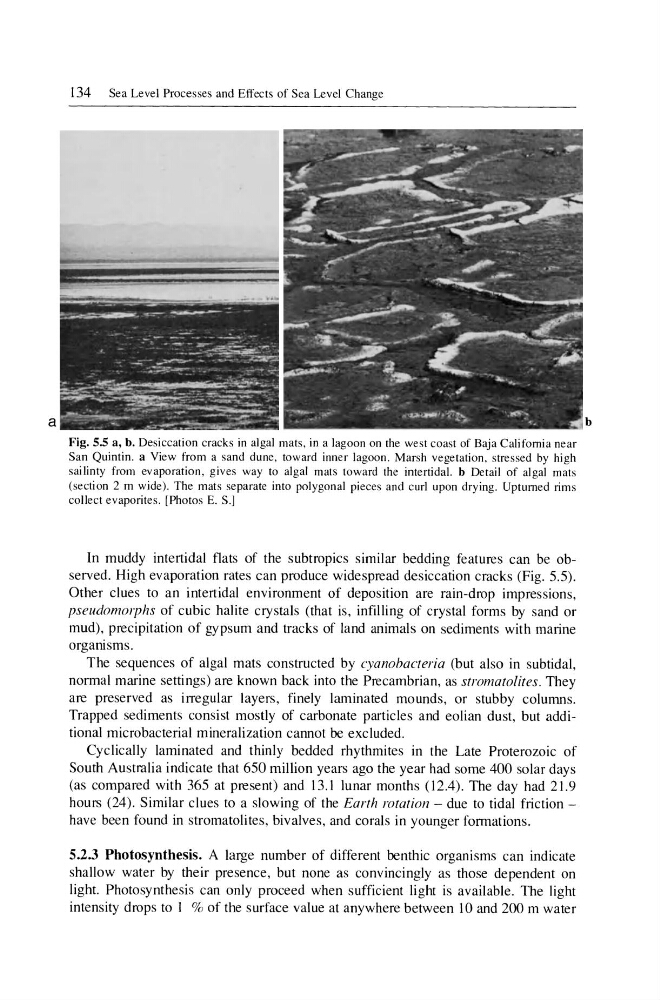
Fig. 5.5 a, b. Desiccation cracks in algal mats, in a lagoon on the west coast of Baja California near
San Quintin. a View from a sand dune, toward inner lagoon. Marsh vegetation, stressed by high
sailinty from evaporation , gives way to algal mats toward the intertidal. b Detail of algal mats
(section 2 m wide). The mats separate into polygonal pieces and curl upon drying. Upturned rims
collect evaporites. [Photos E. S.]
In muddy intertidal flats of the sUbtropics similar bedding features can be observed. High evaporation rates can produce widespread desiccation cracks (Fig. 5.5).
Other cIues to an intertidal environment of deposition are rain-drop impressions,
pseudomorphs of cubic halite crystals (that is, infilling of crystal forms by sand or
mud), precipitation of gypsum and tracks of land animals on sediments with marine
organisms.
The sequences of algal mats constructed by cyanohacteria (but also in subtidal,
normal marine settings) are known back into the Precambrian, as stromatolites. They
are preserved as irregular layers, finely laminated mounds, or stubby columns.
Trapped sediments consist mostly of carbonate particles and eolian dust, but additional microbacterial mineralization cannot be excluded.
Cyclically laminated and thinly bedded rhythmites in the Late Proterozoic of
South Australia indicate that 650 million years ago the year had some 400 solar days
(as compared with 365 at present) and 13.1 lunar months (12.4). The day had 21.9
hours (24). Similar clues to a slowing of the Earth rotation - due to tidal friction -
have been found in stromatolites, bivalves, and corals in younger formations.
5.2.3 Photosynthesis. A large number of different benthic organisms can indicate
shallow water by their presence, but none as convincingly as those dependent on
light. Photosynthesis can only proceed when sufficient light is available. The light
intensity drops to I % of the surface value at anywhere between 10 and 200 m water
b
Fig. 5.5 a, b. Desiccation cracks in algal mats, in a lagoon on the west coast of Baja California near
San Quintin. a View from a sand dune, toward inner lagoon. Marsh vegetation, stressed by high
sailinty from evaporation , gives way to algal mats toward the intertidal. b Detail of algal mats
(section 2 m wide). The mats separate into polygonal pieces and curl upon drying. Upturned rims
collect evaporites. [Photos E. S.]
In muddy intertidal flats of the sUbtropics similar bedding features can be observed. High evaporation rates can produce widespread desiccation cracks (Fig. 5.5).
Other cIues to an intertidal environment of deposition are rain-drop impressions,
pseudomorphs of cubic halite crystals (that is, infilling of crystal forms by sand or
mud), precipitation of gypsum and tracks of land animals on sediments with marine
organisms.
The sequences of algal mats constructed by cyanohacteria (but also in subtidal,
normal marine settings) are known back into the Precambrian, as stromatolites. They
are preserved as irregular layers, finely laminated mounds, or stubby columns.
Trapped sediments consist mostly of carbonate particles and eolian dust, but additional microbacterial mineralization cannot be excluded.
Cyclically laminated and thinly bedded rhythmites in the Late Proterozoic of
South Australia indicate that 650 million years ago the year had some 400 solar days
(as compared with 365 at present) and 13.1 lunar months (12.4). The day had 21.9
hours (24). Similar clues to a slowing of the Earth rotation - due to tidal friction -
have been found in stromatolites, bivalves, and corals in younger formations.
5.2.3 Photosynthesis. A large number of different benthic organisms can indicate
shallow water by their presence, but none as convincingly as those dependent on
light. Photosynthesis can only proceed when sufficient light is available. The light
intensity drops to I % of the surface value at anywhere between 10 and 200 m water
b