

Effects of Current
123
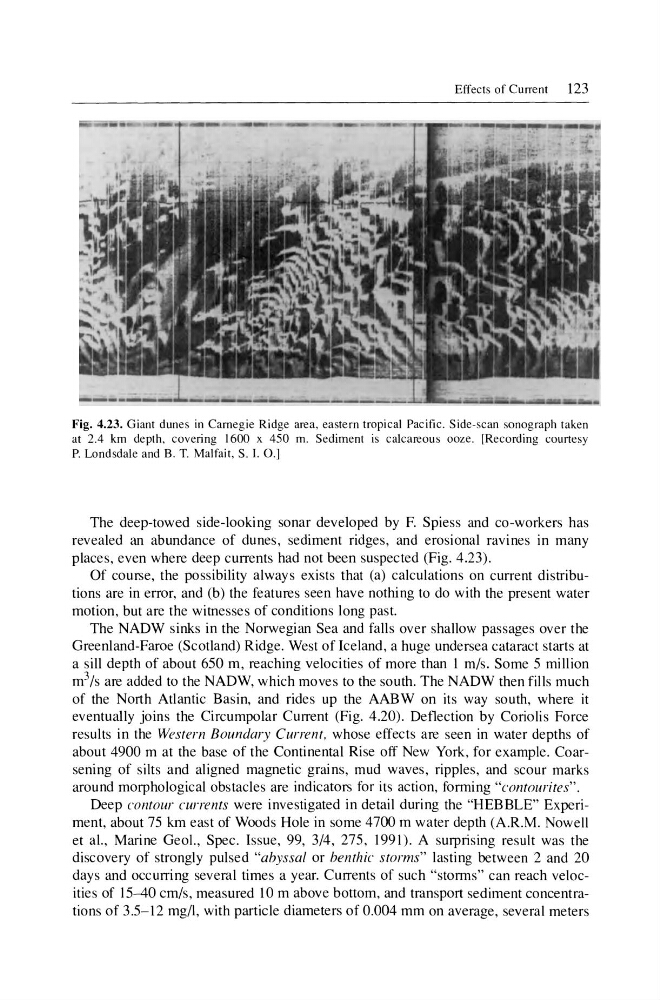
Fig. 4.23. Giant dunes in Carnegie Ridge area, eastern tropical Pacific. Side-scan sonograph taken
at 2.4 km depth , covering 1600 x 450 m. Sediment is calcareous ooze. [Recording courtesy
P. Londsdale and B. T. Malfait, S. 1. 0 .]
The deep-towed side-looking sonar developed by F. Spiess and co-workers has
revealed an abundance of dunes, sediment ridges , and erosional ravines in many
places, even where deep currents had not been suspected (Fig. 4.23).
Of course, the possibility always exists that (a) calculations on current distributions are in error, and (b) the features seen have nothing to do with the present water
motion, but are the witnesses of conditions long past.
The NADW sinks in the Norwegian Sea and falls over shallow passages over the
Greenland-Faroe (Scotland) Ridge. West of Iceland, a huge undersea cataract starts at
a sill depth of about 650 m, reaching velocities of more than 1 m/s. Some 5 million
m 3 /s are added to the NADW, which moves to the south. The NADW then fills much
of the North Atlantic Basin, and rides up the AABW on its way south, where it
eventually joins the Circumpolar Current (Fig. 4.20). Deflection by Corio lis Force
results in the Western Boundary Current, whose effects are seen in water depths of
about 4900 m at the base of the Continental Rise off New York, for example. Coarsening of silts and aligned magnetic grains, mud waves, ripples, and scour marks
around morphological obstacles are indicators for its action, forming "contourites".
Deep contour currents were investigated in detail during the "HEBBLE" Experiment, about 75 km east of Woods Hole in some 4700 m water depth (A.R.M. Nowell
et aI., Marine Geol., Spec. Issue, 99, 3/4, 275, 1991). A surprising result was the
discovery of strongly pulsed "abyssal or benthic storms" lasting between 2 and 20
days and occurring several times a year. Currents of such "storms" can reach velocities of 15--40 cm/s, measured 10m above bottom, and transport sediment concentrations of 3.5-12 mg/I, with particle diameters of 0.004 mm on average, several meters
123
Fig. 4.23. Giant dunes in Carnegie Ridge area, eastern tropical Pacific. Side-scan sonograph taken
at 2.4 km depth , covering 1600 x 450 m. Sediment is calcareous ooze. [Recording courtesy
P. Londsdale and B. T. Malfait, S. 1. 0 .]
The deep-towed side-looking sonar developed by F. Spiess and co-workers has
revealed an abundance of dunes, sediment ridges , and erosional ravines in many
places, even where deep currents had not been suspected (Fig. 4.23).
Of course, the possibility always exists that (a) calculations on current distributions are in error, and (b) the features seen have nothing to do with the present water
motion, but are the witnesses of conditions long past.
The NADW sinks in the Norwegian Sea and falls over shallow passages over the
Greenland-Faroe (Scotland) Ridge. West of Iceland, a huge undersea cataract starts at
a sill depth of about 650 m, reaching velocities of more than 1 m/s. Some 5 million
m 3 /s are added to the NADW, which moves to the south. The NADW then fills much
of the North Atlantic Basin, and rides up the AABW on its way south, where it
eventually joins the Circumpolar Current (Fig. 4.20). Deflection by Corio lis Force
results in the Western Boundary Current, whose effects are seen in water depths of
about 4900 m at the base of the Continental Rise off New York, for example. Coarsening of silts and aligned magnetic grains, mud waves, ripples, and scour marks
around morphological obstacles are indicators for its action, forming "contourites".
Deep contour currents were investigated in detail during the "HEBBLE" Experiment, about 75 km east of Woods Hole in some 4700 m water depth (A.R.M. Nowell
et aI., Marine Geol., Spec. Issue, 99, 3/4, 275, 1991). A surprising result was the
discovery of strongly pulsed "abyssal or benthic storms" lasting between 2 and 20
days and occurring several times a year. Currents of such "storms" can reach velocities of 15--40 cm/s, measured 10m above bottom, and transport sediment concentrations of 3.5-12 mg/I, with particle diameters of 0.004 mm on average, several meters