

a
108
Effects of Waves and Currents
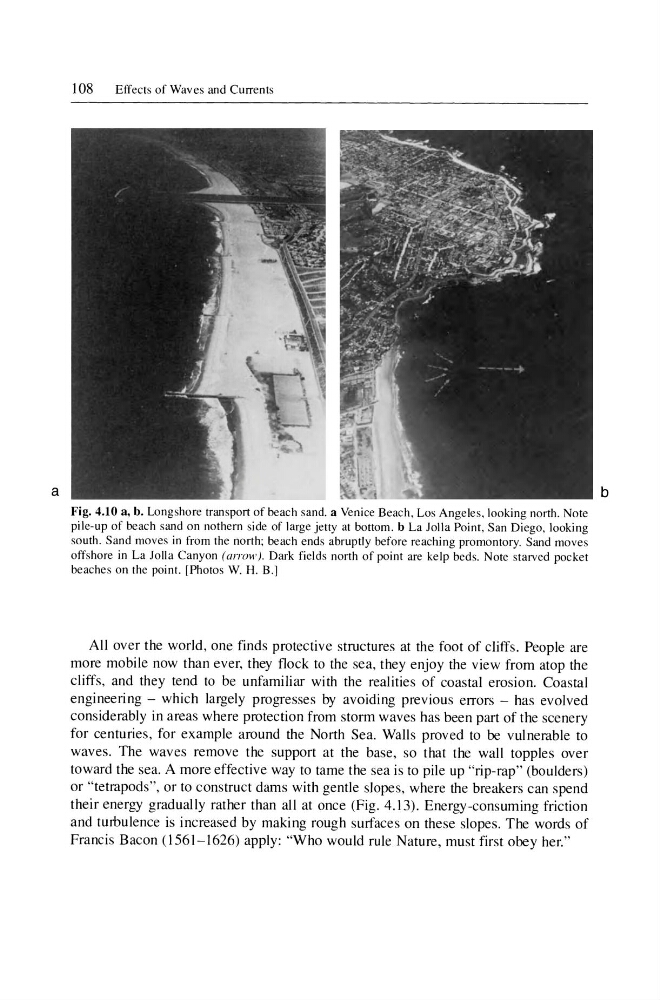
Fig. 4.10 a, b. Longshore transport of beach sand. a Venice Beach, Los Angeles , looking north. Note
pile-up of beach sand on nothern side of large jetty at bottom. b La Jolla Point. San Diego, looking
south. Sand moves in from the north; beach ends abruptly before reaching promontory. Sand moves
offshore in La Jolla Canyon (arrow) . Dark fields north of point are kelp beds. Note starved pocket
beaches on the point. [Photos W. H. B.)
All over the world, one finds protective structures at the foot of cliffs. People are
more mobile now than ever, they flock to the sea, they enjoy the view from atop the
cliffs, and they tend to be unfamiliar with the realities of coastal erosion, Coastal
engineering - which largely progresses by avoiding previous errors - has evolved
considerably in areas where protection from storm waves has been part of the scenery
for centuries, for example around the North Sea. Walls proved to be vulnerable to
waves. The waves remove the support at the base, so that the wall topples over
toward the sea. A more effective way to tame the sea is to pile up "rip-rap" (boulders)
or "tetrapods", or to construct dams with gentle slopes, where the breakers can spend
their energy gradually rather than all at once (Fig. 4.13). Energy-consuming friction
and turbulence is increased by making rough suIt'aces on these slopes. The words of
Francis Bacon (1561-1626) apply: "Who would rule Nature, must first obey her."
b
108
Effects of Waves and Currents
Fig. 4.10 a, b. Longshore transport of beach sand. a Venice Beach, Los Angeles , looking north. Note
pile-up of beach sand on nothern side of large jetty at bottom. b La Jolla Point. San Diego, looking
south. Sand moves in from the north; beach ends abruptly before reaching promontory. Sand moves
offshore in La Jolla Canyon (arrow) . Dark fields north of point are kelp beds. Note starved pocket
beaches on the point. [Photos W. H. B.)
All over the world, one finds protective structures at the foot of cliffs. People are
more mobile now than ever, they flock to the sea, they enjoy the view from atop the
cliffs, and they tend to be unfamiliar with the realities of coastal erosion, Coastal
engineering - which largely progresses by avoiding previous errors - has evolved
considerably in areas where protection from storm waves has been part of the scenery
for centuries, for example around the North Sea. Walls proved to be vulnerable to
waves. The waves remove the support at the base, so that the wall topples over
toward the sea. A more effective way to tame the sea is to pile up "rip-rap" (boulders)
or "tetrapods", or to construct dams with gentle slopes, where the breakers can spend
their energy gradually rather than all at once (Fig. 4.13). Energy-consuming friction
and turbulence is increased by making rough suIt'aces on these slopes. The words of
Francis Bacon (1561-1626) apply: "Who would rule Nature, must first obey her."
b