

88
Sources and Composition of Marine Sediments
materials during high stands, while yielding little during low stands. When platforms
are flooded, the growth of algae, foraminifers, mollusks, and corals, produces a large
amount of calcareous debris which is then available for transport down the flanks
(and also for making storm ramparts, in cases). In contrast, during low stands, the
platforms fall dry and, while soils or karst from carbonate dissolution mediated by
runoff may develop, there is little production of loose sediment.
3.7.3 Dolomite. Calcite may contain magnesium in different concentrations. "MgCalcites" are, in fact, the rule rather than the exception in the shelf environment.
Dolomite rCa, Mg (C03)z], however, is a different story, and poses many unsolved
problems.
One might expect that dolomite would precipitate from seawater because it is
much less soluble than aragonite. There is, after all, plenty of magnesium in seawater
(Table 3. 1). However, such precipitation has not been observed in today's ocean.
Dolomite apparently forms within calcareous sediments, either through partial replacement of Ca with Mg in preformed carbonate or possibly by precipitation
from pore waters. As mentioned, these processes are part of "diagenesis". A classic
area for the study of incipient dolomite formation is the southern margin of the
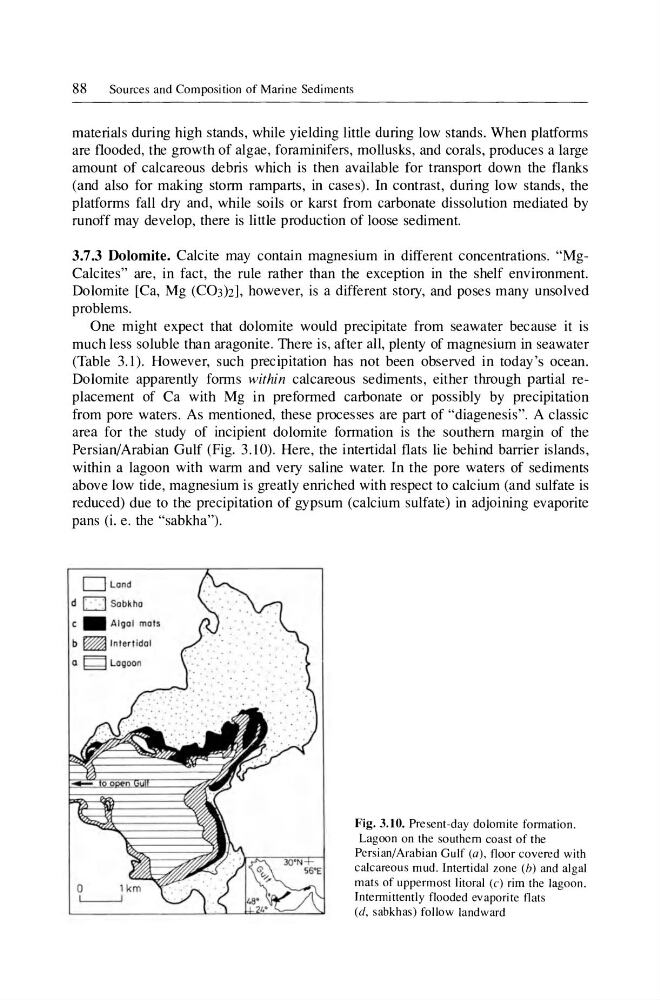
Persian/Arabian Gulf (Fig. 3.10). Here, the intertidal flats lie behind barrier islands,
within a lagoon with warm and very saline water. In the pore waters of sediments
above low tide, magnesium is greatly enriched with respect to calcium (and sulfate is
reduced) due to the precipitation of gypsum (calcium sulfate) in adjoining evaporite
pans (i. e. the "sabkha").
O Land
d D Sab kha
c
Algol mo ts
b ~ In lerlidal
Q bd Lagoon
Fig. 3.10. Present-day dolomite formation .
Lagoon on the southem coast of the
Persian/Arabian Gulf (a), floor covered with
calcareous mud. Intertidal zone (b) and algal
mats of uppermost Iitoral (c) rim the lagoon.
Intermittently flooded evaporite flats
(d, sabkhas) follow landward
Sources and Composition of Marine Sediments
materials during high stands, while yielding little during low stands. When platforms
are flooded, the growth of algae, foraminifers, mollusks, and corals, produces a large
amount of calcareous debris which is then available for transport down the flanks
(and also for making storm ramparts, in cases). In contrast, during low stands, the
platforms fall dry and, while soils or karst from carbonate dissolution mediated by
runoff may develop, there is little production of loose sediment.
3.7.3 Dolomite. Calcite may contain magnesium in different concentrations. "MgCalcites" are, in fact, the rule rather than the exception in the shelf environment.
Dolomite rCa, Mg (C03)z], however, is a different story, and poses many unsolved
problems.
One might expect that dolomite would precipitate from seawater because it is
much less soluble than aragonite. There is, after all, plenty of magnesium in seawater
(Table 3. 1). However, such precipitation has not been observed in today's ocean.
Dolomite apparently forms within calcareous sediments, either through partial replacement of Ca with Mg in preformed carbonate or possibly by precipitation
from pore waters. As mentioned, these processes are part of "diagenesis". A classic
area for the study of incipient dolomite formation is the southern margin of the
Persian/Arabian Gulf (Fig. 3.10). Here, the intertidal flats lie behind barrier islands,
within a lagoon with warm and very saline water. In the pore waters of sediments
above low tide, magnesium is greatly enriched with respect to calcium (and sulfate is
reduced) due to the precipitation of gypsum (calcium sulfate) in adjoining evaporite
pans (i. e. the "sabkha").
O Land
d D Sab kha
c
Algol mo ts
b ~ In lerlidal
Q bd Lagoon
Fig. 3.10. Present-day dolomite formation .
Lagoon on the southem coast of the
Persian/Arabian Gulf (a), floor covered with
calcareous mud. Intertidal zone (b) and algal
mats of uppermost Iitoral (c) rim the lagoon.
Intermittently flooded evaporite flats
(d, sabkhas) follow landward