

86
Peter Stille and Graham Shields
CONTINUOUS CONTRIBUTION.
E v , r " c o n s t .
Z o n e of s e d i m e n t a t i o n
9
V
w =Suso.
0 0 0 0
0 e'''O 0 0 9 0 0 0 0 9
l
l
a ....
o e~
o eo 0 9 Oo~ eOo~176176 l~V~
lWaterphase
9 o -
o - .
9
a s~ Susp.
~o.o.uu
I
:Mud
~
a Hxxr, xa-ret~c~
,~See
!
INTERMITTENT CONTRIBUTION
E, 'P const.
V
. ,~.o
~. o o o o oo o o o o ...:..1
] w.,,, 0 ~ . .
a t ,
r
~ 0 0 0 0 0 0
9
0 o - e
Vsea
Q~" g 0 9 0 -0 'a 0 0 0 u o 9 c o ,
S u s p .
i
~
,
w
.
,
-
,a~l
~ d l I
j i ~
~
~
w
~
:
d
~
w
~
c
,
w
~
.
|
'~
" cz"r
-_
t
o S u s p e n s i o n , non r a d i o a c t i v e
9 S u s p e n s i o n . r a d i o a c t i v e
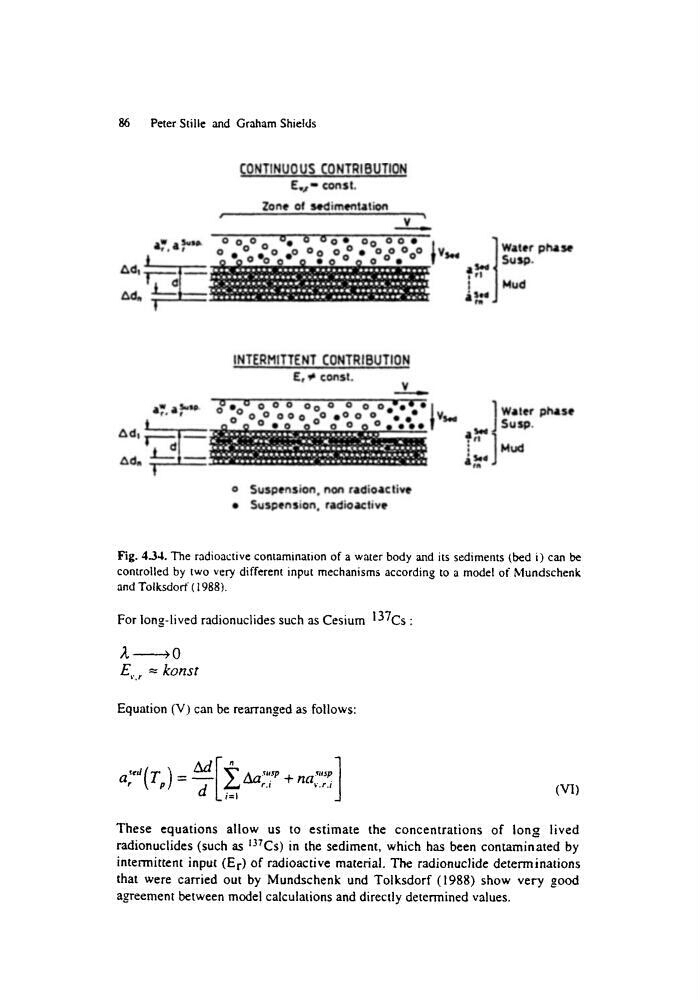
Fig. 4.34. The radioactive contamination of a water body and its sediments (bed i) can be
controlled by two very different input mechanisms according to a model of Mundschenk
and Tolksdorf (1988).
For long-lived radionuclides such as Cesium 137Cs :
/ 1 , ' - >0
E,.., = konst
Equation (V) can be rearranged as follows:
-"F
]
ay(Tp)=
-z__~'z~a':Pr., +na~'~
a I_i=,
(Vl)
These equations allow us to estimate the concentrations of long lived
radionuclides (such as lJTCs) in the sediment, which has been contaminated by
intermittent input (Er) of radioactive material. The radionuclide determinations
that were carried out by Mundschenk und Tolksdorf (1988) show very good
agreement between model calculations and directly determined values.
Peter Stille and Graham Shields
CONTINUOUS CONTRIBUTION.
E v , r " c o n s t .
Z o n e of s e d i m e n t a t i o n
9
V
w =Suso.
0 0 0 0
0 e'''O 0 0 9 0 0 0 0 9
l
l
a ....
o e~
o eo 0 9 Oo~ eOo~176176 l~V~
lWaterphase
9 o -
o - .
9
a s~ Susp.
~o.o.uu
I
:Mud
~
a Hxxr, xa-ret~c~
,~See
!
INTERMITTENT CONTRIBUTION
E, 'P const.
V
. ,~.o
~. o o o o oo o o o o ...:..1
] w.,,, 0 ~ . .
a t ,
r
~ 0 0 0 0 0 0
9
0 o - e
Vsea
Q~" g 0 9 0 -0 'a 0 0 0 u o 9 c o ,
S u s p .
i
~
,
w
.
,
-
,a~l
~ d l I
j i ~
~
~
w
~
:
d
~
w
~
c
,
w
~
.
|
'~
" cz"r
-_
t
o S u s p e n s i o n , non r a d i o a c t i v e
9 S u s p e n s i o n . r a d i o a c t i v e
Fig. 4.34. The radioactive contamination of a water body and its sediments (bed i) can be
controlled by two very different input mechanisms according to a model of Mundschenk
and Tolksdorf (1988).
For long-lived radionuclides such as Cesium 137Cs :
/ 1 , ' - >0
E,.., = konst
Equation (V) can be rearranged as follows:
-"F
]
ay(Tp)=
-z__~'z~a':Pr., +na~'~
a I_i=,
(Vl)
These equations allow us to estimate the concentrations of long lived
radionuclides (such as lJTCs) in the sediment, which has been contaminated by
intermittent input (Er) of radioactive material. The radionuclide determinations
that were carried out by Mundschenk und Tolksdorf (1988) show very good
agreement between model calculations and directly determined values.