

d. Isotope Geochemistry in the Environment
77
~ 10" t ~
-._
~ ~ ~ ,...Ru
106
~-,,,,,,,. ~,
........
Sb 125
~I: i
~Ce141 ~Ru103
,4~,~.. "
0
200
l 1986 '
t. b4ay 1986
10'
10~ ~-' ' ~'~'-~.~.S.~
10. 1
!i10-z
tO "~
I0 -~
400 600 800 lOOO 1200 I~.00 1600 1800 2000 Days
1987
1988
1989
1990
1991
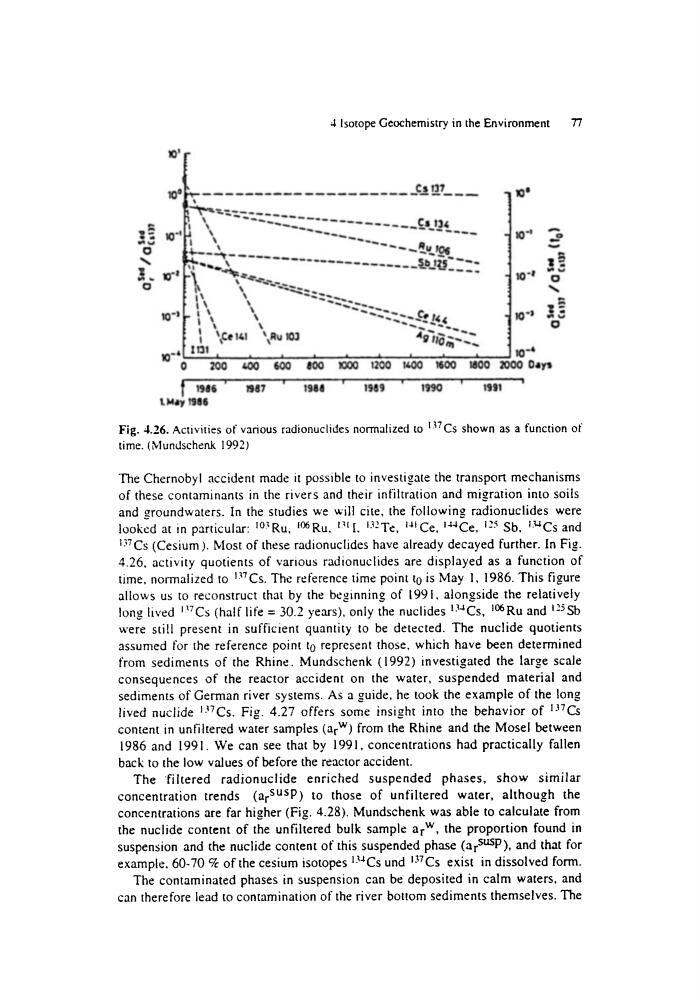
Fig. 4.26. Activities of various radionuclides normalized to t37Cs shown as a function of
time. (Mundschenk 1992)
The Chernobyl accident made it possible to investigate the transport mechanisms
of these contaminants in the rivers and their infiltration and migration into soils
and groundwaters. In the studies we will cite, the following radionuclides were
looked at in particular: 1~
IC~Ru. ~li. 132Te ' ~-UCe ' I-*4Ce ' 125 Sb, l-~Cs and
137Cs (Cesium). Most of these radionuclides have already decayed further. In Fig.
4.26, activity quotients of various radionuclides are displayed as a function of
time, normalized to 13"7Cs. The reference time point to is May 1, 1986. This figure
allows us to reconstruct that by the beginning of 1991, alongside the relatively
long lived 137Cs (half life = 30.2 years), only the nuclides 13"~Cs, ]~
and )25Sb
were still present in sufficient quantity to be detected. The nuclide quotients
assumed for the reference point to represent those, which have been determined
from sediments of the Rhine. Mundschenk (1992) investigated the large scale
consequences of the reactor accident on the water, suspended material and
sediments of German river systems. As a guide, he took the example of the long
lived nuclide ]-~TCs. Fig. 4.27 offers some insight into the behavior of 137Cs
content in unfiltered water samples (at w) from the Rhine and the Mosel between
1986 and 1991. We can see that by 1991, concentrations had practically fallen
back to the low values of before the reactor accident.
The-filtered radionuclide enriched suspended phases, show similar
concentration trends (arSUSp) to those of unfiltered water, although the
concentrations are far higher (Fig. 4.28). Mundscbenk was able to calculate from
the nuclide content of the unfiltered bulk sample ar w, the proportion found in
suspension and the nuclide content of this suspended phase (arSUSp), and that for
example. 60-70 % of the cesium isotopes lY*Cs und 137Cs exist in dissolved form.
The contaminated phases in suspension can be deposited in calm waters, and
can therefore lead to contamination of the river bottom sediments themselves. The
77
~ 10" t ~
-._
~ ~ ~ ,...Ru
106
~-,,,,,,,. ~,
........
Sb 125
~I: i
~Ce141 ~Ru103
,4~,~.. "
0
200
l 1986 '
t. b4ay 1986
10'
10~ ~-' ' ~'~'-~.~.S.~
10. 1
!i10-z
tO "~
I0 -~
400 600 800 lOOO 1200 I~.00 1600 1800 2000 Days
1987
1988
1989
1990
1991
Fig. 4.26. Activities of various radionuclides normalized to t37Cs shown as a function of
time. (Mundschenk 1992)
The Chernobyl accident made it possible to investigate the transport mechanisms
of these contaminants in the rivers and their infiltration and migration into soils
and groundwaters. In the studies we will cite, the following radionuclides were
looked at in particular: 1~
IC~Ru. ~li. 132Te ' ~-UCe ' I-*4Ce ' 125 Sb, l-~Cs and
137Cs (Cesium). Most of these radionuclides have already decayed further. In Fig.
4.26, activity quotients of various radionuclides are displayed as a function of
time, normalized to 13"7Cs. The reference time point to is May 1, 1986. This figure
allows us to reconstruct that by the beginning of 1991, alongside the relatively
long lived 137Cs (half life = 30.2 years), only the nuclides 13"~Cs, ]~
and )25Sb
were still present in sufficient quantity to be detected. The nuclide quotients
assumed for the reference point to represent those, which have been determined
from sediments of the Rhine. Mundschenk (1992) investigated the large scale
consequences of the reactor accident on the water, suspended material and
sediments of German river systems. As a guide, he took the example of the long
lived nuclide ]-~TCs. Fig. 4.27 offers some insight into the behavior of 137Cs
content in unfiltered water samples (at w) from the Rhine and the Mosel between
1986 and 1991. We can see that by 1991, concentrations had practically fallen
back to the low values of before the reactor accident.
The-filtered radionuclide enriched suspended phases, show similar
concentration trends (arSUSp) to those of unfiltered water, although the
concentrations are far higher (Fig. 4.28). Mundscbenk was able to calculate from
the nuclide content of the unfiltered bulk sample ar w, the proportion found in
suspension and the nuclide content of this suspended phase (arSUSp), and that for
example. 60-70 % of the cesium isotopes lY*Cs und 137Cs exist in dissolved form.
The contaminated phases in suspension can be deposited in calm waters, and
can therefore lead to contamination of the river bottom sediments themselves. The