

4 Isotope Geochemistry in the Environment
71
4.3 Anthropogenic Contamination in River Water Observed
Using Isotope Methods (R. Rhine)
More than 72 km 3 of the River Rhine flows into the North Sea annually making it
the fortieth greatest river in the World. However, it is one of the most polluted. Its
hydrochemical evolution through the years 1975-1984 was comprehensively
discussed by Van der Veijden and Middleburg (1989) on the basis of major and
trace element data. The evolution of the O, C and Sr isotopic systems from source
to mouth were not investigated any more closely until Bi.ihl et al. (1991) and
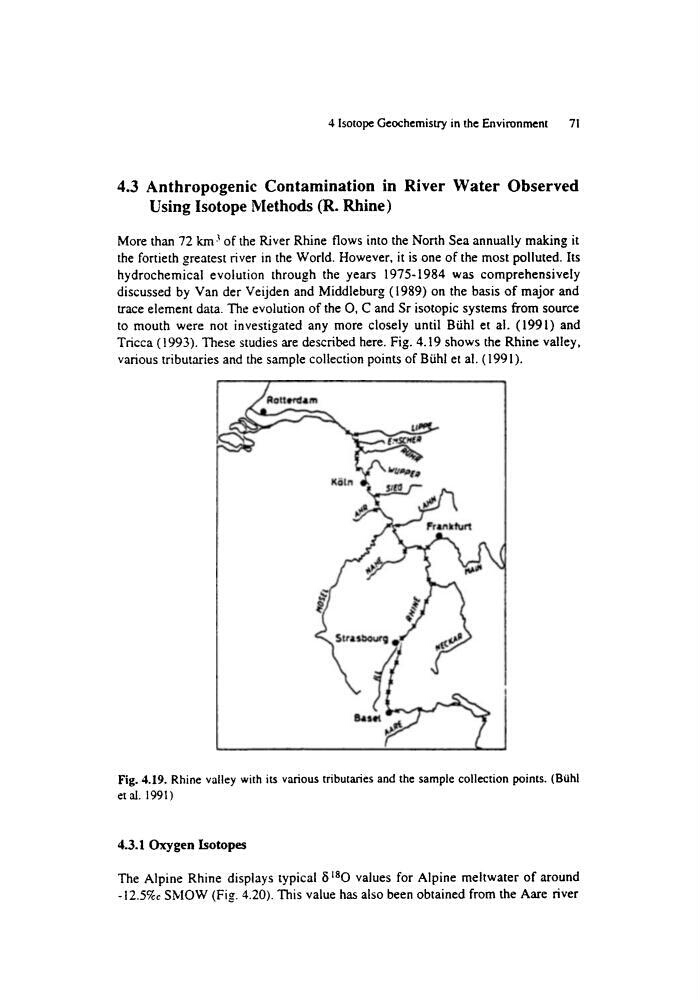
Tricca (1993). These studies are described here. Fig. 4.19 shows the Rhine valley,
various tributaries and the sample collection points of BLihl et al. (1991).
K~tn
Frankfurt
Strasloourg
Baset
Fig. 4.19. Rhine valley with its various tributaries and the sample collection points. (Btlhl
etal. 1991)
4.3.1 Oxygen Isotopes
The Alpine Rhine displays typical ~il80 values for Alpine meltwater of around
-12.5%c SMOW (Fig. 4.20). This value has also been obtained from the Aare river
71
4.3 Anthropogenic Contamination in River Water Observed
Using Isotope Methods (R. Rhine)
More than 72 km 3 of the River Rhine flows into the North Sea annually making it
the fortieth greatest river in the World. However, it is one of the most polluted. Its
hydrochemical evolution through the years 1975-1984 was comprehensively
discussed by Van der Veijden and Middleburg (1989) on the basis of major and
trace element data. The evolution of the O, C and Sr isotopic systems from source
to mouth were not investigated any more closely until Bi.ihl et al. (1991) and
Tricca (1993). These studies are described here. Fig. 4.19 shows the Rhine valley,
various tributaries and the sample collection points of BLihl et al. (1991).
K~tn
Frankfurt
Strasloourg
Baset
Fig. 4.19. Rhine valley with its various tributaries and the sample collection points. (Btlhl
etal. 1991)
4.3.1 Oxygen Isotopes
The Alpine Rhine displays typical ~il80 values for Alpine meltwater of around
-12.5%c SMOW (Fig. 4.20). This value has also been obtained from the Aare river