

44
Peter Stille and Graham Shields
0.721
0.719
fJ) 0.717
0.715
0.713
o .7 t I
SL 2 /
ore experiment
9 After
/
L: Leach,ate
L I
/
L~/JA/
SL: Suspended load
1
/
I
I
I
I
1
1
~
t
1
3
5
7
9
1 / S r
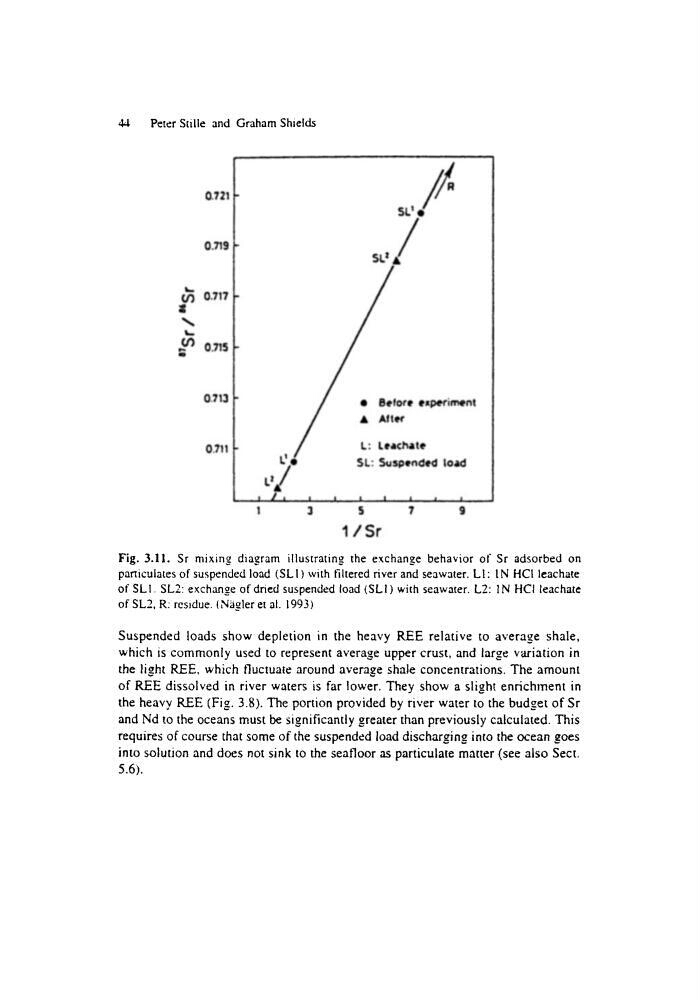
Fig. 3.11. Sr mixing diagram illustrating the exchange behavior of Sr adsorbed on
particulates of suspended load (SLI) with filtered river and seawater. LI: 1N HCI leachate
of SLI. SL2: exchange of dried suspended load (SLI) with seawater. L2: IN HCI leachate
of SL2, R: residue. (N~igler et al. 1993)
Suspended loads show depletion in the heavy REE relative to average shale,
which is commonly used to represent average upper crust, and large variation in
the light REE, which fluctuate around average shale concentrations. The amount
of REE dissolved in river waters is far lower. They show a slight enrichment in
the heavy REE (Fig. 3.8). The portion provided by river water to the budget of Sr
and Nd to the oceans must be significantly greater than previously calculated. This
requires of course that some of the suspended load discharging into the ocean goes
into solution and does not sink to the seafloor as particulate matter (see also Sect.
5.6).
Peter Stille and Graham Shields
0.721
0.719
fJ) 0.717
0.715
0.713
o .7 t I
SL 2 /
ore experiment
9 After
/
L: Leach,ate
L I
/
L~/JA/
SL: Suspended load
1
/
I
I
I
I
1
1
~
t
1
3
5
7
9
1 / S r
Fig. 3.11. Sr mixing diagram illustrating the exchange behavior of Sr adsorbed on
particulates of suspended load (SLI) with filtered river and seawater. LI: 1N HCI leachate
of SLI. SL2: exchange of dried suspended load (SLI) with seawater. L2: IN HCI leachate
of SL2, R: residue. (N~igler et al. 1993)
Suspended loads show depletion in the heavy REE relative to average shale,
which is commonly used to represent average upper crust, and large variation in
the light REE, which fluctuate around average shale concentrations. The amount
of REE dissolved in river waters is far lower. They show a slight enrichment in
the heavy REE (Fig. 3.8). The portion provided by river water to the budget of Sr
and Nd to the oceans must be significantly greater than previously calculated. This
requires of course that some of the suspended load discharging into the ocean goes
into solution and does not sink to the seafloor as particulate matter (see also Sect.
5.6).