

3 Isotope Geochemistry of River Water
35
10000
A
C3~
"~ I00
L_
lOOO
lO
1.o
5
0
0
0
@
O0
I
OOQ 0 ~ 0
0
9
9
9
9 ~:~ab
0 0
9
9
%o
i
6
7
8
9
10
pH
I
I
!
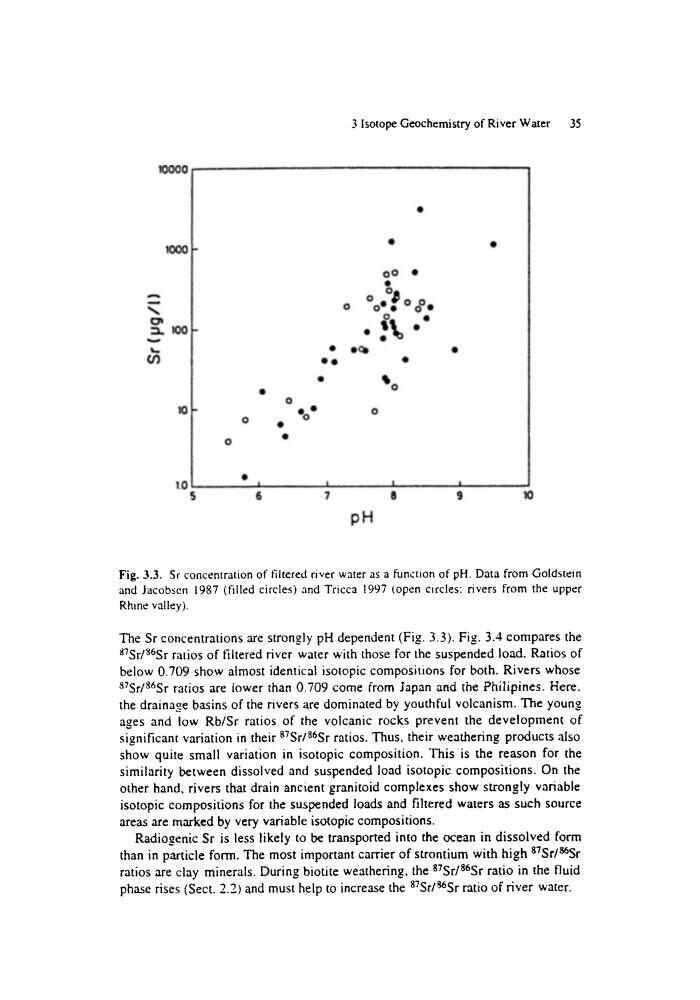
Fig. 3,3, Sr concentration of filtered river water as a function of pH. Data from Goldslein
and Jacobsen 1987 (filled circles) and Tricca 1997 (open circles: rivers from the upper
Rhine valley).
The Sr concentrations are strongly pH dependent (Fig, 3.3). Fig. 3.4 compares the
STSr/S6Sr ratios of filtered river water with those for the suspended load, Ratios of
below 0.709 show almost identical isotopic compositions for both. Rivers whose
STSr/S6Sr ratios are lower than 0.709 come from Japan and the Philipines. Here,
the drainage basins of the rivers are dominated by youthful volcanism. The young
ages and low Rb/Sr ratios of the volcanic rocks prevent the development of
significant variation in their STSr/S6Sr ratios. Thus, their weathering products also
show quite small variation in isotopic composition. This is the reason for the
similarity between dissolved and suspended load isotopic compositions. On the
other hand, rivers that drain ancient granitoid complexes show strongly variable
isotopic compositions for the suspended loads and filtered waters as such source
areas are marked by very variable isotopic compositions.
Radiogenic Sr is less likely to be transported into the ocean in dissolved form
than in particle form. The most important carrier of strontium with high SVSr/SSSr
ratios are clay minerals. During biotite weathering, the STSr/S6Sr ratio in the fluid
phase rises (Sect. 2.2) and must help to increase the sTSr/S6Sr ratio of river water.
35
10000
A
C3~
"~ I00
L_
lOOO
lO
1.o
5
0
0
0
@
O0
I
OOQ 0 ~ 0
0
9
9
9
9 ~:~ab
0 0
9
9
%o
i
6
7
8
9
10
pH
I
I
!
Fig. 3,3, Sr concentration of filtered river water as a function of pH. Data from Goldslein
and Jacobsen 1987 (filled circles) and Tricca 1997 (open circles: rivers from the upper
Rhine valley).
The Sr concentrations are strongly pH dependent (Fig, 3.3). Fig. 3.4 compares the
STSr/S6Sr ratios of filtered river water with those for the suspended load, Ratios of
below 0.709 show almost identical isotopic compositions for both. Rivers whose
STSr/S6Sr ratios are lower than 0.709 come from Japan and the Philipines. Here,
the drainage basins of the rivers are dominated by youthful volcanism. The young
ages and low Rb/Sr ratios of the volcanic rocks prevent the development of
significant variation in their STSr/S6Sr ratios. Thus, their weathering products also
show quite small variation in isotopic composition. This is the reason for the
similarity between dissolved and suspended load isotopic compositions. On the
other hand, rivers that drain ancient granitoid complexes show strongly variable
isotopic compositions for the suspended loads and filtered waters as such source
areas are marked by very variable isotopic compositions.
Radiogenic Sr is less likely to be transported into the ocean in dissolved form
than in particle form. The most important carrier of strontium with high SVSr/SSSr
ratios are clay minerals. During biotite weathering, the STSr/S6Sr ratio in the fluid
phase rises (Sect. 2.2) and must help to increase the sTSr/S6Sr ratio of river water.