

3 Isotope Geochemistry of River Water
Weathering is accompanied by the transport of erosion products by wind and
water. Rivers and streams are responsible for removing the larger part of these
erosion products in either dissolved or particular form and, for their eventual
discharge into the world's ocean basins. The isotopic composition of particles and
dissolved ions in rivers is determined by the average isotopic composition of the
source region. The isotopic composition of the ocean is also partly governed by
the constant influx of river or wind transported material (Goldstein et al. 1984).
However, knowledge of the geochemical and isotopic characteristics does not just
allow us to calculate mass balances for the ocean but also to identify specific river
systems as sources for toxic elements (see also Chap. 4).
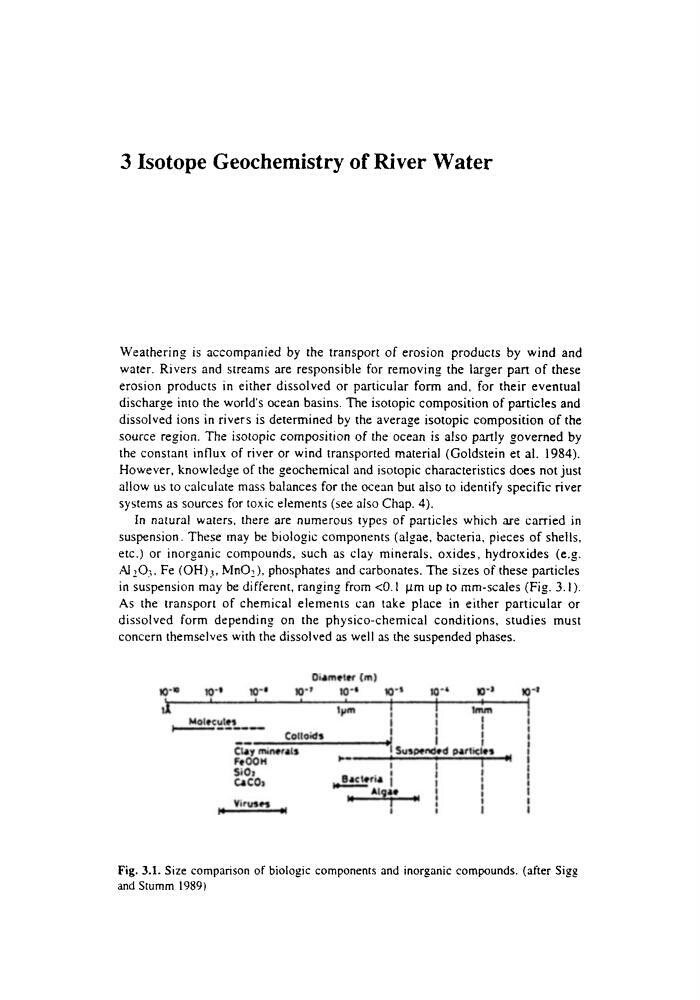
In natural waters, there are numerous types of particles which are carried in
suspension. These may be biologic components (algae, bacteria, pieces of shells,
etc.) or inorganic compounds, such as clay minerals, oxides, hydroxides (e.g.
AI _,03, Fe (OH) 3, MnO2), phosphates and carbonates. The sizes of these particles
in suspension may be different, ranging from <0. I ~m up to mm-scales (Fig. 3. I).
As the transport of chemical elements can take place in either particular or
dissolved form depending on the physico-chemical conditions, studies must
concern themselves with the dissolved as well as the suspended phases.
Oiameler (ml
~0-10
lO-t
lO-I
10-7
|O-S
lO-S
10-4
10-)
t
|
i
t
9
Tram
i
Molecules
I
I
I
Collolds
I
I
It
- -
~
I
I
Clay minerals
I SusDended
I~articles
.
FeOOH
p.
i I
i
r.
5i0~
i
I
CaCOs
8~ria
I
I
I~
Algae
i
i
I
Viruses
K
=:
~0-~
Fig. 3.1. Size comparison of biologic components and inorganic compounds. (after Sigg
and Stumm 19891
Weathering is accompanied by the transport of erosion products by wind and
water. Rivers and streams are responsible for removing the larger part of these
erosion products in either dissolved or particular form and, for their eventual
discharge into the world's ocean basins. The isotopic composition of particles and
dissolved ions in rivers is determined by the average isotopic composition of the
source region. The isotopic composition of the ocean is also partly governed by
the constant influx of river or wind transported material (Goldstein et al. 1984).
However, knowledge of the geochemical and isotopic characteristics does not just
allow us to calculate mass balances for the ocean but also to identify specific river
systems as sources for toxic elements (see also Chap. 4).
In natural waters, there are numerous types of particles which are carried in
suspension. These may be biologic components (algae, bacteria, pieces of shells,
etc.) or inorganic compounds, such as clay minerals, oxides, hydroxides (e.g.
AI _,03, Fe (OH) 3, MnO2), phosphates and carbonates. The sizes of these particles
in suspension may be different, ranging from <0. I ~m up to mm-scales (Fig. 3. I).
As the transport of chemical elements can take place in either particular or
dissolved form depending on the physico-chemical conditions, studies must
concern themselves with the dissolved as well as the suspended phases.
Oiameler (ml
~0-10
lO-t
lO-I
10-7
|O-S
lO-S
10-4
10-)
t
|
i
t
9
Tram
i
Molecules
I
I
I
Collolds
I
I
It
- -
~
I
I
Clay minerals
I SusDended
I~articles
.
FeOOH
p.
i I
i
r.
5i0~
i
I
CaCOs
8~ria
I
I
I~
Algae
i
i
I
Viruses
K
=:
~0-~
Fig. 3.1. Size comparison of biologic components and inorganic compounds. (after Sigg
and Stumm 19891