

28
Peter Stille and Graham Shields
However, this is a special case and is seldom observed in nature. The different
physico-chemical characteristics of Rb and Sr, their incorporation into different
lattice sites and chemical inhomogeneities in the crystal lattice all induce
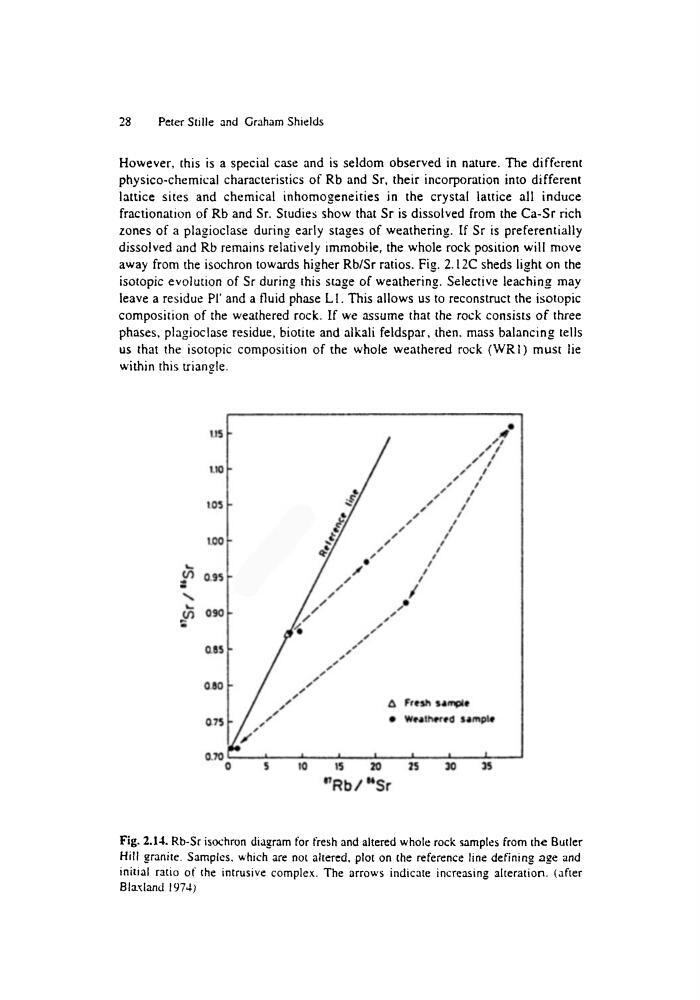
fractionation of Rb and Sr. Studies show that Sr is dissolved from the Ca-St rich
zones of a plagioclase during early stages of weathering. If Sr is preferentially
dissolved and Rb remains relatively immobile, the whole rock position will move
away from the isochron towards higher Rb/Sr ratios. Fig. 2.12C sheds light on the
isotopic evolution of Sr during this stage of weathering. Selective leaching may
leave a residue PI' and a fluid phase LI. This allows us to reconstruct the isotopic
composition of the weathered rock. If we assume that the rock consists of three
phases, plagioclase residue, biotite and alkali feldspar, then, mass balancing tells
us that the isotopic composition of the whole weathered rock (WRI) must lie
within this triangle.
tt5
t l o
105
IO0
0.95
090
0.85
0.80
075
0 . 7 0 -
o
-I
~7
J
/
/ /
!
f
!
j
!
j
" ,
0
/
/
I
/
/
7
I
e /
/
/
, ./,"
/
/
l""
~
J
f
f
/ i
-
. J r
/ /
f /
,,
& Fresh sample
/
/ /
9 WeathereO sample
s
to
is
2o
2s
30
as
~ R b / " S r
Fig. 2.14. Rb-Sr isochron diagram for fresh and altered whole rock samples from the Butler
Hill granite. Samples. which are not altered, plot on the reference line defining age and
initial ratio of the intrusive complex. The arrows indicate increasing alteration, (after
Bla_xland 1974)
Peter Stille and Graham Shields
However, this is a special case and is seldom observed in nature. The different
physico-chemical characteristics of Rb and Sr, their incorporation into different
lattice sites and chemical inhomogeneities in the crystal lattice all induce
fractionation of Rb and Sr. Studies show that Sr is dissolved from the Ca-St rich
zones of a plagioclase during early stages of weathering. If Sr is preferentially
dissolved and Rb remains relatively immobile, the whole rock position will move
away from the isochron towards higher Rb/Sr ratios. Fig. 2.12C sheds light on the
isotopic evolution of Sr during this stage of weathering. Selective leaching may
leave a residue PI' and a fluid phase LI. This allows us to reconstruct the isotopic
composition of the weathered rock. If we assume that the rock consists of three
phases, plagioclase residue, biotite and alkali feldspar, then, mass balancing tells
us that the isotopic composition of the whole weathered rock (WRI) must lie
within this triangle.
tt5
t l o
105
IO0
0.95
090
0.85
0.80
075
0 . 7 0 -
o
-I
~7
J
/
/ /
!
f
!
j
!
j
" ,
0
/
/
I
/
/
7
I
e /
/
/
, ./,"
/
/
l""
~
J
f
f
/ i
-
. J r
/ /
f /
,,
& Fresh sample
/
/ /
9 WeathereO sample
s
to
is
2o
2s
30
as
~ R b / " S r
Fig. 2.14. Rb-Sr isochron diagram for fresh and altered whole rock samples from the Butler
Hill granite. Samples. which are not altered, plot on the reference line defining age and
initial ratio of the intrusive complex. The arrows indicate increasing alteration, (after
Bla_xland 1974)