

2 Weathering
25
mechanisms are also involved during the sedimentation and diagenesis of
sediments.
Of the St-rich minerals, apatite and the feldspars (particularly plagioclase)
weather more rapidly than biotite and muscovite, making it possible to reconstruct
the ideal, near consecutive weathering of a rock.
Let us start with the Rb-Sr mineral isochron of a granite. The minerals should
lie on one isochron, providing they all crystallized out at the same time from the
same magma, having incorporated the same initial ~TSr/S6Sc ratio as the magma
body (Fig. 2.12A). Due to its high Sr and low Rb content, plagioclase (PI) lies to
the left of the whole rock (WR), whereas alkali feldspar (Kf) and biotite (B) with
their relatively low Sr contents and high Rb contents lie to the right of WR, The
position of whole rock, which must lie between the two end-member mineral
components, arises from the law of mass balance.
Every chemical weathering process can be compared to a leaching experiment
whereby chemical elements from various minerals of the bulk rock are
sequentially leached. For the sake of simplicity, we assume that our whole rock
has remained a closed system during weathering and no element has been
introduced from outside, We also assume that weathering attacks only the
plagioclase first.
- 40
to
-120
-1GO
- 2 0
-10
0
10
2aO
eteornr Water Line
aa(~,oN ," .
~ ..........
C,u-urOa~w ~(I)ma NEve, OA
. . . . . . . . . . . . . . . . . . . .
I'~r~$Ou
.
- . . . . . . .
w ~l[mm* xEvaoA
" 9 ....
~.
CO,.O~.,.OO.
. . . . . . .
..c_,,_~j,.,A.
[
~ : ~
//.,-" :.o/
.__..r
/
" " 0 " * '
6 ~0 %o Icatculatedl
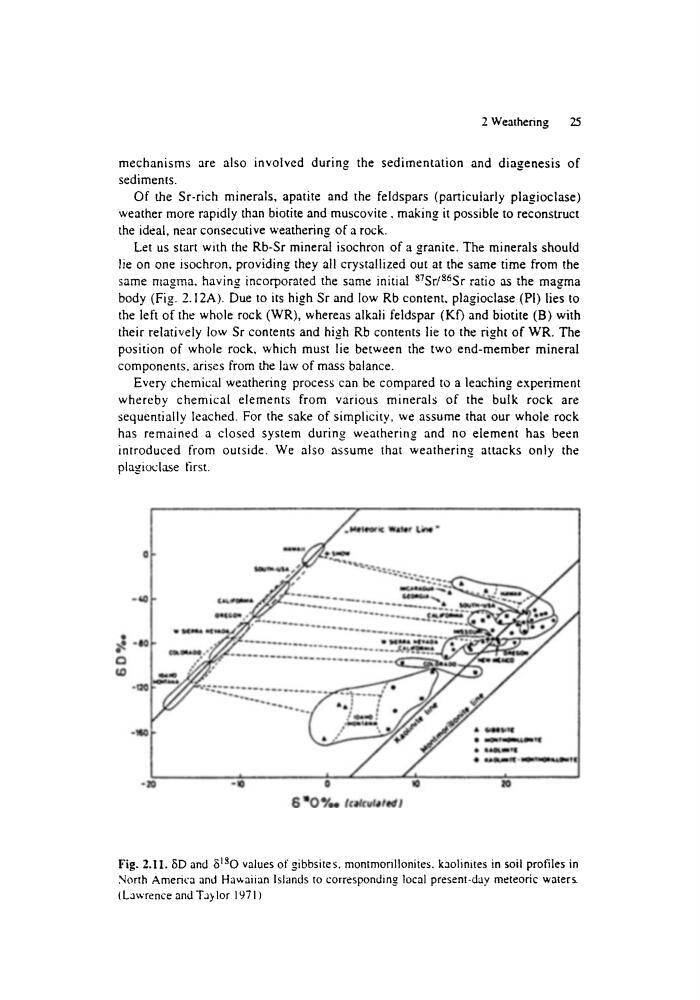
Fig. 2.11.8D and <31SO values of gibbsites, montmorillonites, kaolinites in soil profiles in
North America and Hav, aiian Islands to corresponding local present-day meteoric waters.
(Lawrence and Ta~ Ior 1971 )
25
mechanisms are also involved during the sedimentation and diagenesis of
sediments.
Of the St-rich minerals, apatite and the feldspars (particularly plagioclase)
weather more rapidly than biotite and muscovite, making it possible to reconstruct
the ideal, near consecutive weathering of a rock.
Let us start with the Rb-Sr mineral isochron of a granite. The minerals should
lie on one isochron, providing they all crystallized out at the same time from the
same magma, having incorporated the same initial ~TSr/S6Sc ratio as the magma
body (Fig. 2.12A). Due to its high Sr and low Rb content, plagioclase (PI) lies to
the left of the whole rock (WR), whereas alkali feldspar (Kf) and biotite (B) with
their relatively low Sr contents and high Rb contents lie to the right of WR, The
position of whole rock, which must lie between the two end-member mineral
components, arises from the law of mass balance.
Every chemical weathering process can be compared to a leaching experiment
whereby chemical elements from various minerals of the bulk rock are
sequentially leached. For the sake of simplicity, we assume that our whole rock
has remained a closed system during weathering and no element has been
introduced from outside, We also assume that weathering attacks only the
plagioclase first.
- 40
to
-120
-1GO
- 2 0
-10
0
10
2aO
eteornr Water Line
aa(~,oN ," .
~ ..........
C,u-urOa~w ~(I)ma NEve, OA
. . . . . . . . . . . . . . . . . . . .
I'~r~$Ou
.
- . . . . . . .
w ~l[mm* xEvaoA
" 9 ....
~.
CO,.O~.,.OO.
. . . . . . .
..c_,,_~j,.,A.
[
~ : ~
//.,-" :.o/
.__..r
/
" " 0 " * '
6 ~0 %o Icatculatedl
Fig. 2.11.8D and <31SO values of gibbsites, montmorillonites, kaolinites in soil profiles in
North America and Hav, aiian Islands to corresponding local present-day meteoric waters.
(Lawrence and Ta~ Ior 1971 )