

7 Sm-Nd Isotope Geochemistry of Ar~llaceous Sediments 199
Let us return to the diagenetic development of these rocks. It was already
mentioned that the formation of the new clay minerals and organo-metallic
complexes can have the consequence that the Sm/Nd ratios of the diagenetic fluid
phase are fractionated. The formation of illite seems to be related to the presence
and abundance of potassium-rich mineral phases and organic carbon in the clay
shales.
Whole rocks and coarse clay fractions approach the horizontal equilibrium lines
of the newly formed mineral phases along the mixing line AB with decreasing
Sm/Nd ratios and increasing K and Corg contents (Fig. 7.8A). Provided the
147 Sm/~,~ Nd ratios reflect the previous presence of alkali feldspar in these rocks at
the point of junction with the horizontal lines, then it is probable that the newly
formed chlorite, illite, bitumen and the whole rock with the highest K and TOC
contents all record the Nd isotopic composition of this feldspar on the basis of
their identical Nd isotopic ratios. The close genetic relationship between chlorite,
illite and K-feldspar has already been mentioned (see Fig. 7.3C).
The diagenetic mineral reactions discussed in Chap. 6.1 show that organic acids
play an important role during diagenesis. Changes in the partial pressure of CO2
and the concentration of organic acids control dissolution and replacement
reactions and the secondary porosity of a rock. Dissolution of carbonates and
aluminium silicates takes place predominantly under acidic conditions, whereby
etching and oxidation will lead to the release of organic carbon (CH,O).
(J
O3 <
Z
Q..
E E~
03
I0
0.1 I~
La
.--.-...
I
1
I
I
I
1
t
I
|
I
I
/
1
Ce Pr hid Sm Eu C,-d
HO Er Tm Yb Lu
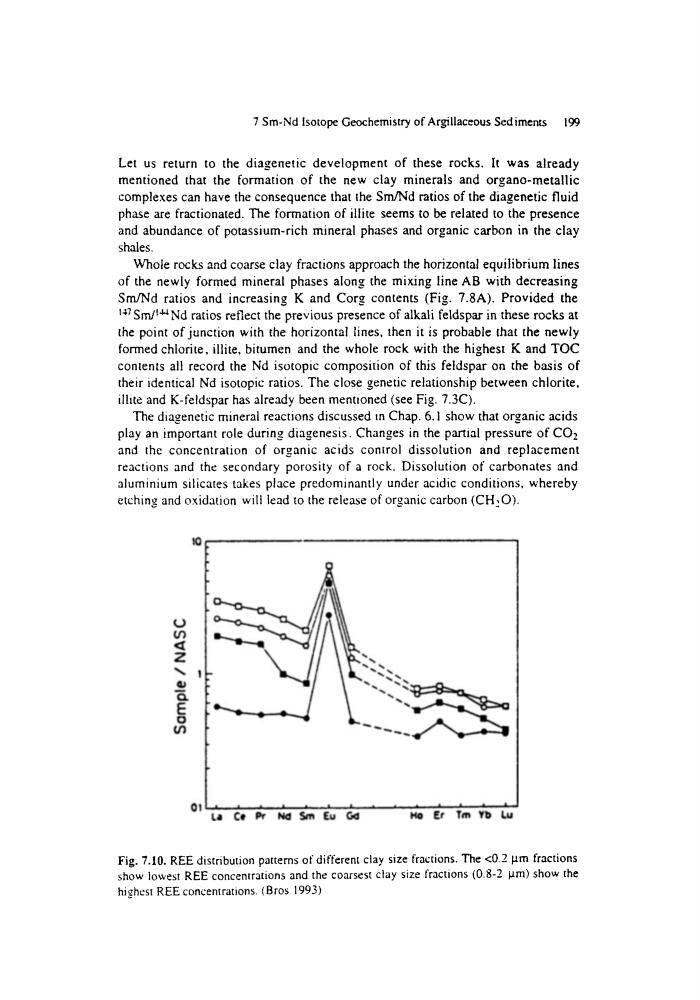
Fig. 7.10. REE distribution patterns of different clay size fractions. The <0.2 I.trn fractions
show lowest REE concentrations and the coarsest clay size fractions (0.8-2 lam) show the
highest REE concentrations. (Bros 1993)
Let us return to the diagenetic development of these rocks. It was already
mentioned that the formation of the new clay minerals and organo-metallic
complexes can have the consequence that the Sm/Nd ratios of the diagenetic fluid
phase are fractionated. The formation of illite seems to be related to the presence
and abundance of potassium-rich mineral phases and organic carbon in the clay
shales.
Whole rocks and coarse clay fractions approach the horizontal equilibrium lines
of the newly formed mineral phases along the mixing line AB with decreasing
Sm/Nd ratios and increasing K and Corg contents (Fig. 7.8A). Provided the
147 Sm/~,~ Nd ratios reflect the previous presence of alkali feldspar in these rocks at
the point of junction with the horizontal lines, then it is probable that the newly
formed chlorite, illite, bitumen and the whole rock with the highest K and TOC
contents all record the Nd isotopic composition of this feldspar on the basis of
their identical Nd isotopic ratios. The close genetic relationship between chlorite,
illite and K-feldspar has already been mentioned (see Fig. 7.3C).
The diagenetic mineral reactions discussed in Chap. 6.1 show that organic acids
play an important role during diagenesis. Changes in the partial pressure of CO2
and the concentration of organic acids control dissolution and replacement
reactions and the secondary porosity of a rock. Dissolution of carbonates and
aluminium silicates takes place predominantly under acidic conditions, whereby
etching and oxidation will lead to the release of organic carbon (CH,O).
(J
O3 <
Z
Q..
E E~
03
I0
0.1 I~
La
.--.-...
I
1
I
I
I
1
t
I
|
I
I
/
1
Ce Pr hid Sm Eu C,-d
HO Er Tm Yb Lu
Fig. 7.10. REE distribution patterns of different clay size fractions. The <0.2 I.trn fractions
show lowest REE concentrations and the coarsest clay size fractions (0.8-2 lam) show the
highest REE concentrations. (Bros 1993)