

I Introduction
9
; ^
b.
ql IIo
.,,
~ ~:
Cb
c u
.~ ,a
01d
4 ~
Z >
~ ~
crustal rOCkS
i i i i
0.7'00_
'
I
,
0.710
0.720
STSr / a~Sr
Crust
Mantle
Seawater
~N
_
er
4,
l
~
#
I
I
|
f
/
0.5110
05120
0.5130
1'3Nd / ~'~Nd
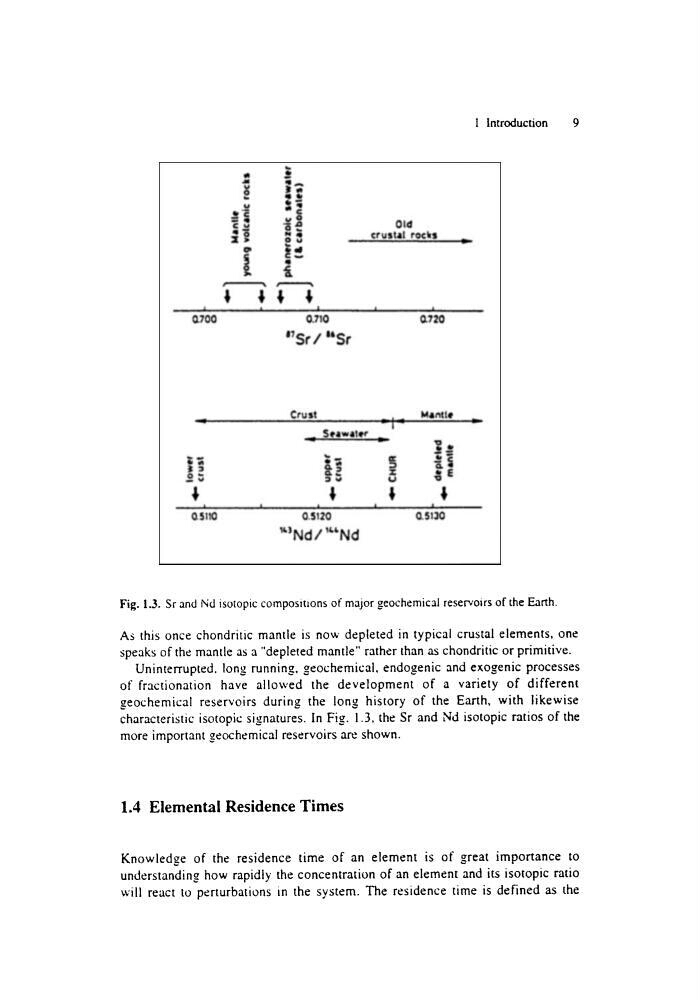
Fig. 1.3. Sr and Nd isotopic compositions of major geochemical reservoirs of the Earth.
As this once chondritic mantle is now depleted in typical crustal elements, one
speaks of the mantle as a "depleted mantle" rather than as chondritic or primitive.
Uninterrupted. long running, geochemical, endogenic and exogenic processes
of fractionation have allowed the development of a variety of different
geochemical reservoirs during the long history of the Earth, with likewise
characteristic isotopic signatures. In Fig. 1.3, the Sr and Nd isotopic ratios of the
more important geochemical reservoirs are shown.
1.4 Elemental Residence Times
Knowledge of the residence time of an element is of great importance to
understanding how rapidly the concentration of an element and its isotopic ratio
will react to perturbations in the system. The residence time is defined as the
9
; ^
b.
ql IIo
.,,
~ ~:
Cb
c u
.~ ,a
01d
4 ~
Z >
~ ~
crustal rOCkS
i i i i
0.7'00_
'
I
,
0.710
0.720
STSr / a~Sr
Crust
Mantle
Seawater
~N
_
er
4,
l
~
#
I
I
|
f
/
0.5110
05120
0.5130
1'3Nd / ~'~Nd
Fig. 1.3. Sr and Nd isotopic compositions of major geochemical reservoirs of the Earth.
As this once chondritic mantle is now depleted in typical crustal elements, one
speaks of the mantle as a "depleted mantle" rather than as chondritic or primitive.
Uninterrupted. long running, geochemical, endogenic and exogenic processes
of fractionation have allowed the development of a variety of different
geochemical reservoirs during the long history of the Earth, with likewise
characteristic isotopic signatures. In Fig. 1.3, the Sr and Nd isotopic ratios of the
more important geochemical reservoirs are shown.
1.4 Elemental Residence Times
Knowledge of the residence time of an element is of great importance to
understanding how rapidly the concentration of an element and its isotopic ratio
will react to perturbations in the system. The residence time is defined as the