

186 Peter Stille and Graham Shields
Proterozoic Gunflint "Banded-[ron Formation" in Canada using not only isotopic
methods but also various geochemical and mineralogic approaches.
The formation stretches from the north coast of Lake Superior over 180 km
westwards along the border between Minnesota und Ontario. This sedimentary
succession is not only famous due to its rich iron deposits but also because of the
appearance of ancient, primitive organisms. The microflora that has been found
here has provided information about the early chemical evolution of the
atmosphere and the nature and origins of the earliest organisms. Deposition of the
sediments that alternate with the iron ores took place in a slowly subsiding
shallow water basin, perhaps comparable to the depositional environment of
evaporites and phosphorites in the Phanerozoic. The basin formed around 2100
million years ago. The exact time of deposition and formation is not yet known
and is the focal point of several discussions. Isotopic age data from the literature
are contradictory. Already in 1966, Peterman suggested that the Rb-Sr and K-Ar
systems had not remained closed for some of these sedimentary rocks.
Z
Z
0.5115Z
0.51144
051136
0.51128
0.51120
I
0.100
0.120
jl0.50985 " 18
I
I
I
It
I
I
|
I| ,,
0.104
g.lOa
0.112
(11 6
1~75m / :"~Nd
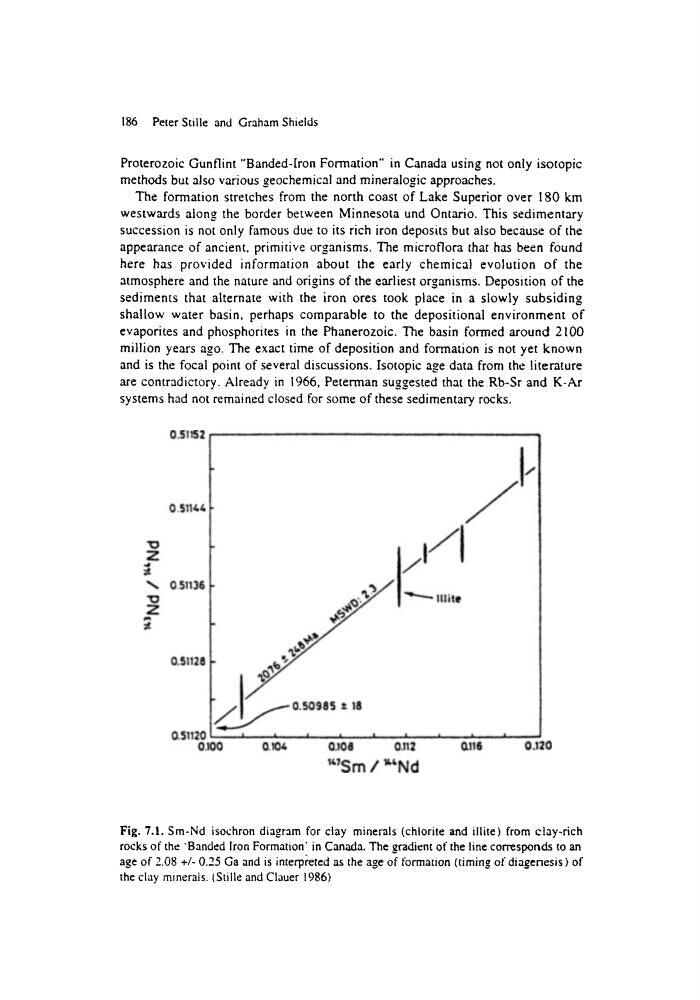
Fig. 7.1. Sm-Nd isochron diagram for clay minerals (chlorite and illite) from clay-rich
rocks of the "Banded Iron Formation' in Canada. The gradient of the line corresponds to an
age of 2.08 +/- 0.25 Ga and is interpreted as the age of tbrmation (timing of diagenesis) of
the clay minerals. (Stille and Clauer 1986)
Proterozoic Gunflint "Banded-[ron Formation" in Canada using not only isotopic
methods but also various geochemical and mineralogic approaches.
The formation stretches from the north coast of Lake Superior over 180 km
westwards along the border between Minnesota und Ontario. This sedimentary
succession is not only famous due to its rich iron deposits but also because of the
appearance of ancient, primitive organisms. The microflora that has been found
here has provided information about the early chemical evolution of the
atmosphere and the nature and origins of the earliest organisms. Deposition of the
sediments that alternate with the iron ores took place in a slowly subsiding
shallow water basin, perhaps comparable to the depositional environment of
evaporites and phosphorites in the Phanerozoic. The basin formed around 2100
million years ago. The exact time of deposition and formation is not yet known
and is the focal point of several discussions. Isotopic age data from the literature
are contradictory. Already in 1966, Peterman suggested that the Rb-Sr and K-Ar
systems had not remained closed for some of these sedimentary rocks.
Z
Z
0.5115Z
0.51144
051136
0.51128
0.51120
I
0.100
0.120
jl0.50985 " 18
I
I
I
It
I
I
|
I| ,,
0.104
g.lOa
0.112
(11 6
1~75m / :"~Nd
Fig. 7.1. Sm-Nd isochron diagram for clay minerals (chlorite and illite) from clay-rich
rocks of the "Banded Iron Formation' in Canada. The gradient of the line corresponds to an
age of 2.08 +/- 0.25 Ga and is interpreted as the age of tbrmation (timing of diagenesis) of
the clay minerals. (Stille and Clauer 1986)