

6
Peter Stille and Graham Shields
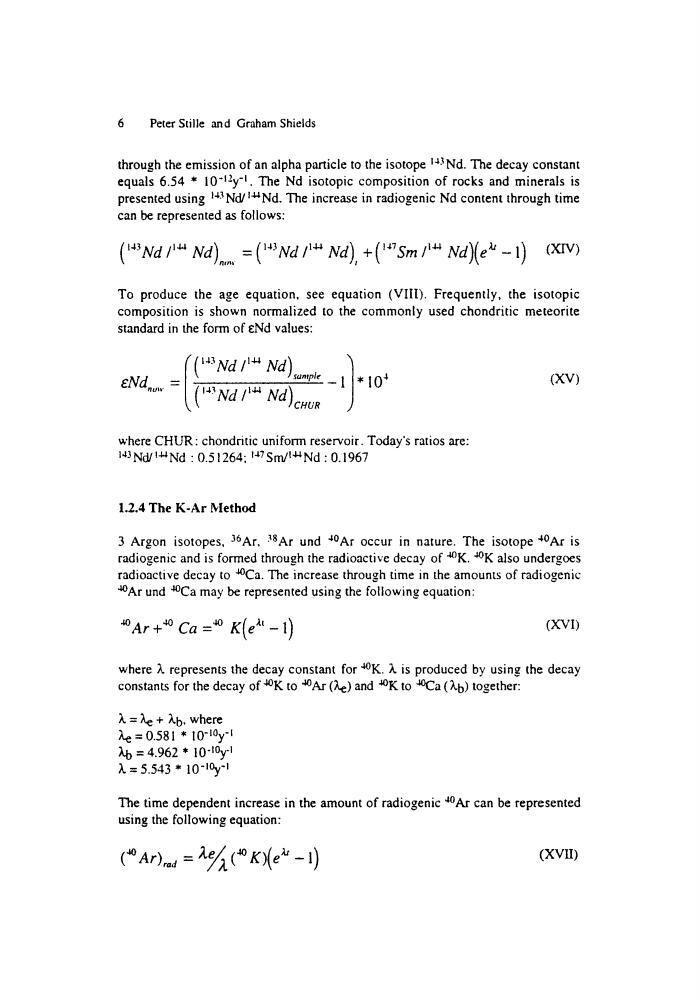
through the emission of an alpha particle to the isotope 143Nd. The decay constant
equals 6.54 * 10"t2y -I. The Nd isotopic composition of rocks and minerals is
presented using 143Nd/I~Nd. The increase in radiogenic Nd content through time
can be represented as follows:
(raNd~ TM Nd).,,,, = ( ' 4 3 N d f l ~ Nd) +("~TSm/''~ Nd)(ea~-l) (XIV)
To produce the age equation, see equation (VIII). Frequently, the isotopic
composition is shown normalized to the commonly used chondritic meteorite
standard in the form of eNd values:
eNd..,,. =
(lZ3Nd/l.t.* Nd),,~,,,ea,
(i.~3Nd/I,~ Nd)cnu k 13 * 10 ~
(XV)
where CHUR: chondritic uniform reservoir. Today's ratios are:
1.,3 Nd/14.* Nd " 0.51264; l-t7 Sm/144 Nd : 0.1967
1.2.4 The K-Ar Method
3 Argon isotopes, 36Ar, 38Ar und 4~ occur in nature. The isotope 4~ is
radiogenic and is formed through the radioactive decay of *oK. *oK also undergoes
radioactive decay to *oCa. The increase through time in the amounts of radiogenic
*oAr und *oCa may be represented using the following equation:
*oAr +40 Ca =*o K(e ~tt - 1)
(XVI)
where Z represents the decay constant for *~ ~. is produced by using the decay
constants for the decay of~~ to *oAr (Xe) and *oK to *oCa (~-b) together:
k = ~e + kb, where
~e = 0.581 * lO-tOy-I
~o = 4.962 * lO-t~ "j
L = 5.543 * 10"10y "1
The time dependent increase in the amount of radiogenic *oAr can be represented
using the following equation:
: ar ro, -
:
_ i)
•
Peter Stille and Graham Shields
through the emission of an alpha particle to the isotope 143Nd. The decay constant
equals 6.54 * 10"t2y -I. The Nd isotopic composition of rocks and minerals is
presented using 143Nd/I~Nd. The increase in radiogenic Nd content through time
can be represented as follows:
(raNd~ TM Nd).,,,, = ( ' 4 3 N d f l ~ Nd) +("~TSm/''~ Nd)(ea~-l) (XIV)
To produce the age equation, see equation (VIII). Frequently, the isotopic
composition is shown normalized to the commonly used chondritic meteorite
standard in the form of eNd values:
eNd..,,. =
(lZ3Nd/l.t.* Nd),,~,,,ea,
(i.~3Nd/I,~ Nd)cnu k 13 * 10 ~
(XV)
where CHUR: chondritic uniform reservoir. Today's ratios are:
1.,3 Nd/14.* Nd " 0.51264; l-t7 Sm/144 Nd : 0.1967
1.2.4 The K-Ar Method
3 Argon isotopes, 36Ar, 38Ar und 4~ occur in nature. The isotope 4~ is
radiogenic and is formed through the radioactive decay of *oK. *oK also undergoes
radioactive decay to *oCa. The increase through time in the amounts of radiogenic
*oAr und *oCa may be represented using the following equation:
*oAr +40 Ca =*o K(e ~tt - 1)
(XVI)
where Z represents the decay constant for *~ ~. is produced by using the decay
constants for the decay of~~ to *oAr (Xe) and *oK to *oCa (~-b) together:
k = ~e + kb, where
~e = 0.581 * lO-tOy-I
~o = 4.962 * lO-t~ "j
L = 5.543 * 10"10y "1
The time dependent increase in the amount of radiogenic *oAr can be represented
using the following equation:
: ar ro, -
:
_ i)
•