

5 Isotopic Composition of Seawater 141
.
_,-'#'
- . - o ,
t
"-e'--.,>>is
P
e
a - -
t
CHA r,~'$8-1~
'~ .
r
.,
- % )
LeA
,,0.
-:0,,
Y
Q'7,#,'-r-<-.'<:.s, ........... ;,..,,,r
. . . . . . . . . . { ....... ~ % . . . . . ~ E t , - - - - ' ? ' - - 7
t
"
~
,i} t
i > W ?
L
i
VMr;-40T ~" j,s ~
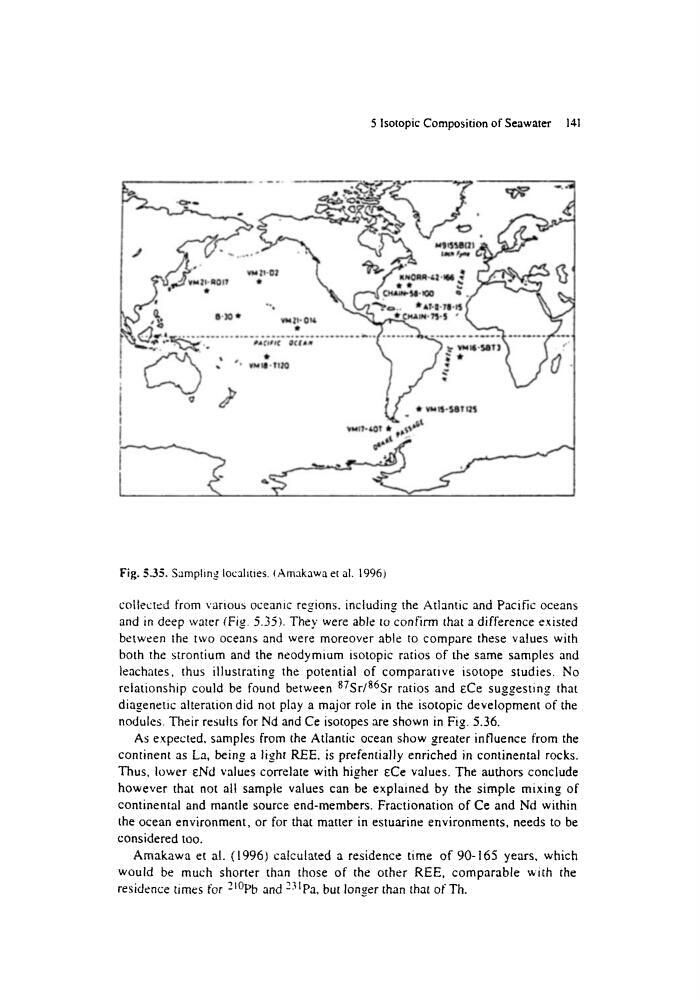
Fig. 535. Sampling localities. r
et al. 1996)
collected from various oceanic regions, including the Atlantic and Pacific oceans
and in deep water (Fig. 5.35). They were able to confirm that a difference existed
between the two oceans and were moreover able to compare these values with
both the strontium and the neodymium isotopic ratios of the same samples and
leachates, thus illustrating the potential of comparative isotope studies. No
relationship could be found between 87Sr/86Sr ratios and ~:Ce suggesting that
diagenetic alteration did not play a major role in the isotopic development of the
nodules. Their results for Nd and Ce isotopes are shown in Fig. 5.36.
As expected, samples from the Atlantic ocean show greater influence from the
continent as La, being a light REE, is prefentially enriched in continental rocks.
Thus, lower ENd values correlate with higher ECe values. The authors conclude
however that not all sample values can be explained by the simple mixing of
continental and mantle source end-members. Fractionation of Ce and Nd within
the ocean environment, or for that matter in estuarine environments, needs to be
considered too.
Amakawa et al. (1996) calculated a residence time of 90-165 years, which
would be much shorter than those of the other REE, comparable with the
residence times tbr 210pb and 231pa, but longer than that of Th.
.
_,-'#'
- . - o ,
t
"-e'--.,>>is
P
e
a - -
t
CHA r,~'$8-1~
'~ .
r
.,
- % )
LeA
,,0.
-:0,,
Y
Q'7,#,'-r-<-.'<:.s, ........... ;,..,,,r
. . . . . . . . . . { ....... ~ % . . . . . ~ E t , - - - - ' ? ' - - 7
t
"
~
,i} t
i > W ?
L
i
VMr;-40T ~" j,s ~
Fig. 535. Sampling localities. r
et al. 1996)
collected from various oceanic regions, including the Atlantic and Pacific oceans
and in deep water (Fig. 5.35). They were able to confirm that a difference existed
between the two oceans and were moreover able to compare these values with
both the strontium and the neodymium isotopic ratios of the same samples and
leachates, thus illustrating the potential of comparative isotope studies. No
relationship could be found between 87Sr/86Sr ratios and ~:Ce suggesting that
diagenetic alteration did not play a major role in the isotopic development of the
nodules. Their results for Nd and Ce isotopes are shown in Fig. 5.36.
As expected, samples from the Atlantic ocean show greater influence from the
continent as La, being a light REE, is prefentially enriched in continental rocks.
Thus, lower ENd values correlate with higher ECe values. The authors conclude
however that not all sample values can be explained by the simple mixing of
continental and mantle source end-members. Fractionation of Ce and Nd within
the ocean environment, or for that matter in estuarine environments, needs to be
considered too.
Amakawa et al. (1996) calculated a residence time of 90-165 years, which
would be much shorter than those of the other REE, comparable with the
residence times tbr 210pb and 231pa, but longer than that of Th.