

5 Isotopic Composition of Seawater 139
this region comes largely from the A-Pacific and flows through the Drake passage
towards the East and flows northward into the A_,'gentinian basin.
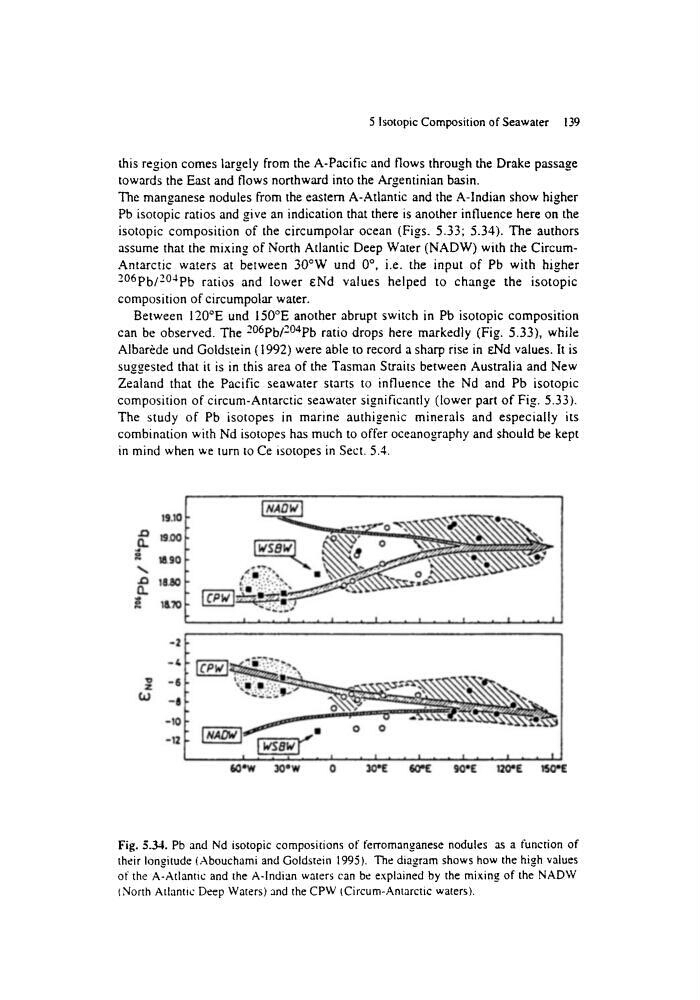
The manganese nodules from the eastern A-Atlantic and the A-Indian show higher
Pb isotopic ratios and give an indication that there is another influence here on the
isotopic composition of the circumpolar ocean (Figs. 5.33; 5.34). The authors
assume that the mixing of North Atlantic Deep Water (NADW) with the CircumAntarctic waters at between 30~ und 0 ~ i.e. the input of Pb with higher
2~176
ratios and lower ~:Nd values helped to change the isotopic
composition of circumpolar water.
Between 120~ und 150~ another abrupt switch in Pb isotopic composition
can be observed. The 2~176
ratio drops here markedly (Fig. 5.33), while
AlbarEde und Goldstein (1992) were able to record a sharp rise in ENd values. It is
suggested that it is in this area of the Tasman Straits between Australia and New
Zealand that the Pacific seawater starts to influence the Nd and Pb isotopic
composition of circum-Antarctic seawater significantly (lower part of Fig. 5.33).
The study of Pb isotopes in marine authigenic minerals and especially its
combination with Nd isotopes has much to offer oceanography and should be kept
in mind when we turn to Ce isotopes in Sect. 5.4.
1g.lo
r~ 19.00
13..
;8so
9 -Q
18.80
r~
I
~
I
I
.
I
I
I
i
I
,
J
I
Z
-2
-4
-6
- 8
-10
-12
I
,
9
t
9
9
I
I
I
I
I
9
"
*
I
I
I
A
60~
30~
0
30~
~:~E
90~
120aE
150eE
Fig. 5.34. Pb and Nd isotopic compositions of ferromanganese nodules as a /'unction of
their longitude (Abouchami and Goldstein 1995). The dia~am shows how the high values
of the A-Atlantic and the A-Indian waters can be explained by the mixing of the NADW
(North Atlantic Deep Waters) and the CPW (Circum-Antarctic waters).
this region comes largely from the A-Pacific and flows through the Drake passage
towards the East and flows northward into the A_,'gentinian basin.
The manganese nodules from the eastern A-Atlantic and the A-Indian show higher
Pb isotopic ratios and give an indication that there is another influence here on the
isotopic composition of the circumpolar ocean (Figs. 5.33; 5.34). The authors
assume that the mixing of North Atlantic Deep Water (NADW) with the CircumAntarctic waters at between 30~ und 0 ~ i.e. the input of Pb with higher
2~176
ratios and lower ~:Nd values helped to change the isotopic
composition of circumpolar water.
Between 120~ und 150~ another abrupt switch in Pb isotopic composition
can be observed. The 2~176
ratio drops here markedly (Fig. 5.33), while
AlbarEde und Goldstein (1992) were able to record a sharp rise in ENd values. It is
suggested that it is in this area of the Tasman Straits between Australia and New
Zealand that the Pacific seawater starts to influence the Nd and Pb isotopic
composition of circum-Antarctic seawater significantly (lower part of Fig. 5.33).
The study of Pb isotopes in marine authigenic minerals and especially its
combination with Nd isotopes has much to offer oceanography and should be kept
in mind when we turn to Ce isotopes in Sect. 5.4.
1g.lo
r~ 19.00
13..
;8so
9 -Q
18.80
r~
I
~
I
I
.
I
I
I
i
I
,
J
I
Z
-2
-4
-6
- 8
-10
-12
I
,
9
t
9
9
I
I
I
I
I
9
"
*
I
I
I
A
60~
30~
0
30~
~:~E
90~
120aE
150eE
Fig. 5.34. Pb and Nd isotopic compositions of ferromanganese nodules as a /'unction of
their longitude (Abouchami and Goldstein 1995). The dia~am shows how the high values
of the A-Atlantic and the A-Indian waters can be explained by the mixing of the NADW
(North Atlantic Deep Waters) and the CPW (Circum-Antarctic waters).