

5 Isotopic Composition of Seawater 137
Nd and Pb isotope determinations of more or less recent, hydrogenous ironmanganese crusts have shown that their isotopic ratios have varied as a
consequence of today's deep ocean currents (Albar~de and Goldstein 1992;
Abouchami and Goldstein 1995). The Nd isotopic ratios reflect not only these
deep sea currents but also the geology of the sea floor itself. In the Atlantic,
maximum eNd values are characteristic of the region of the mid-oceanic ridge,
which differentiates the western and eastern deep sea basins from each other.
The work of Abouchami und Goldstein (1995) showed clearly that Pb isotopes
reflects the changing behaviour of ocean currents far more sensitively than Nd
isotopes by virtue of the short residence time of Pb in seawater. The authors
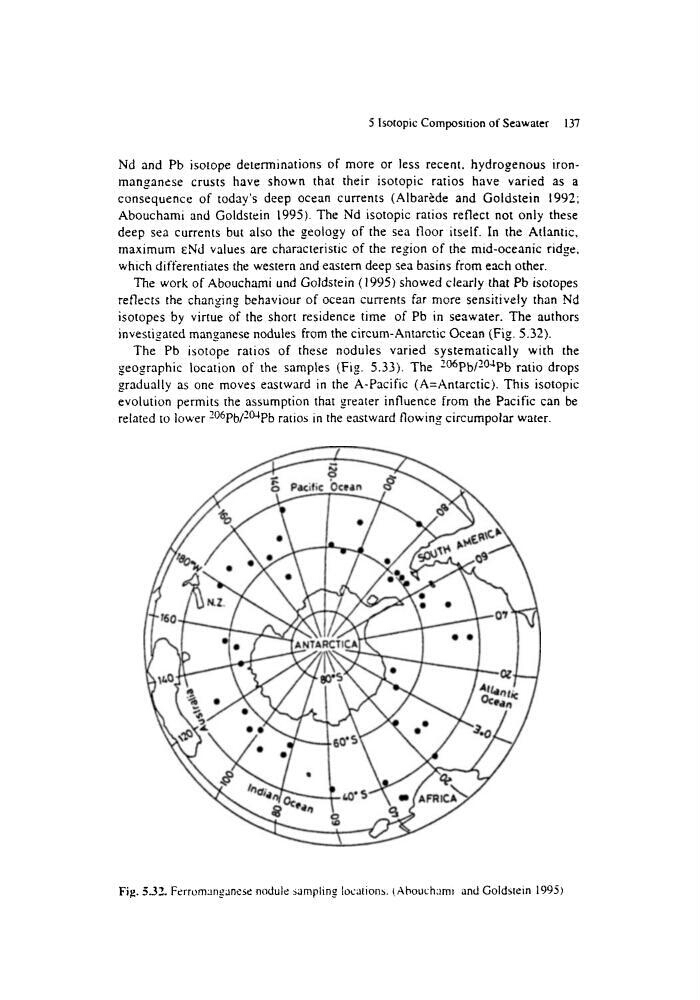
investigated manganese nodules from the circum-Antarctic Ocean (Fig. 5.32).
The Pb isotope ratios of these nodules varied systematically with the
geographic location of the samples (Fig. 5.33). The 2~
ratio drops
gradually as one moves eastward in the A-Pacific (A=Antarctic). This isotopic
evolution permits the assumption that greater influence from the Pacific can be
related to lower 2~176
ratios in the eastward flowing circumpolar water.
Fig. 5.32, Ferromang;anese nodule sampling locations. ~,Abouchumi and Goldstein 1995)
Nd and Pb isotope determinations of more or less recent, hydrogenous ironmanganese crusts have shown that their isotopic ratios have varied as a
consequence of today's deep ocean currents (Albar~de and Goldstein 1992;
Abouchami and Goldstein 1995). The Nd isotopic ratios reflect not only these
deep sea currents but also the geology of the sea floor itself. In the Atlantic,
maximum eNd values are characteristic of the region of the mid-oceanic ridge,
which differentiates the western and eastern deep sea basins from each other.
The work of Abouchami und Goldstein (1995) showed clearly that Pb isotopes
reflects the changing behaviour of ocean currents far more sensitively than Nd
isotopes by virtue of the short residence time of Pb in seawater. The authors
investigated manganese nodules from the circum-Antarctic Ocean (Fig. 5.32).
The Pb isotope ratios of these nodules varied systematically with the
geographic location of the samples (Fig. 5.33). The 2~
ratio drops
gradually as one moves eastward in the A-Pacific (A=Antarctic). This isotopic
evolution permits the assumption that greater influence from the Pacific can be
related to lower 2~176
ratios in the eastward flowing circumpolar water.
Fig. 5.32, Ferromang;anese nodule sampling locations. ~,Abouchumi and Goldstein 1995)