

5 Isotopic Composition of Seawater I_-r7
seawater of the later Precambrian or the Phanerozoic. It remains, however, unclear
to what extent erosion of isotopically variable continental crust (with mantle
isotopic signatures) or enhanced hydothermal activity may have influenced the
isotopic signature of Archean seawater. The Sr isotopic system was not yet
decoupled from that of the Nd isotopic system and yields isotopically identical
information (Fig. 5.24)
Palaeozoic
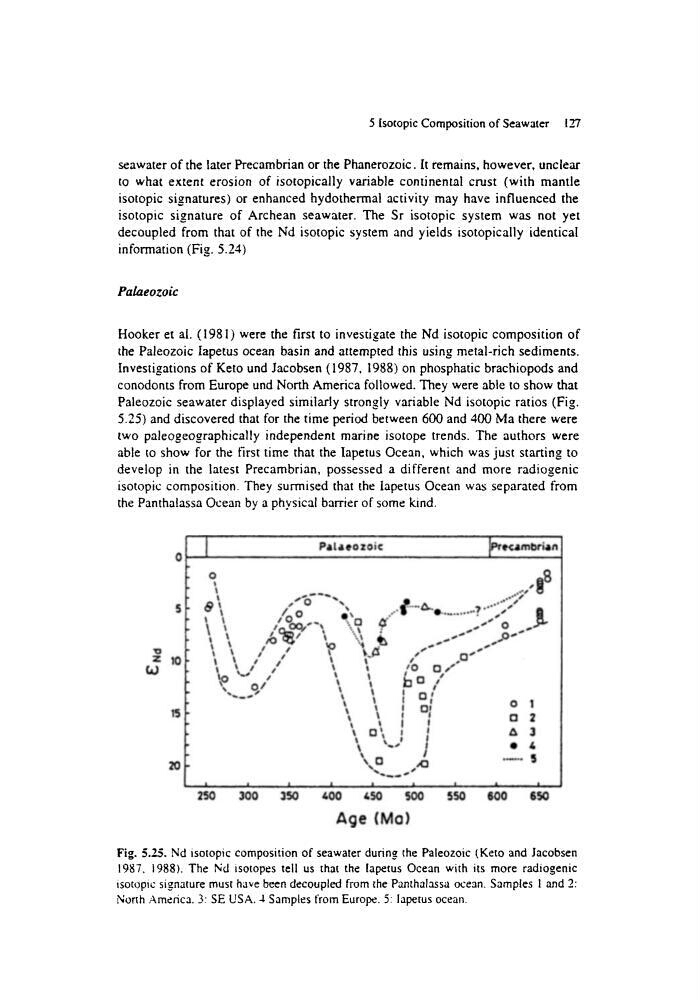
Hooker et al. (1981) were the first to investigate the Nd isotopic composition of
the Paleozoic Iapetus ocean basin and attempted this using metal-rich sediments.
Investigations of Keto und Jacobsen (1987, 1988) on phosphatic brachiopods and
conodonts from Europe und North America followed. They were able to show that
Paleozoic seawater displayed similarly strongly variable Nd isotopic ratios (Fig.
5.25) and discovered that for the time period between 600 and 400 Ma there were
two paleogeographically independent marine isotope trends. The authors were
able to show for the first time that the lapetus Ocean, which was just starting to
develop in the latest Precambrian, possessed a different and more radiogenic
isotopic composition. They surmised that the Iapetus Ocean was separated from
the Panthalassa Ocean by a physical barrier of some kind.
0
5'
10
z 10
OJ
15
20
I
Pata eo z oic
IPrecambrian
o
\
:p,"
/ o
. . ' | c"e .....
/ o
'..~u 6"
"'"
--""
, \
.:
..
/
~
('"
/
0 "~"
I
\
/
/
~
I
t O
1"3 J "
l
~.s I
I
'I
~] 0 s z
o
I
~
f
0
2
I
......
5
I
I
I
1
1
L
lI.
I
250
300
350
z, O0
450
500
550
600
650
Age (Ma)
Fig. 5.25. Nd isotopic composition of seawater during the Paleozoic (Keto and Jacobsen
1987. 1988). The Nd isotopes tell us that the Iapetus Ocean with its more radiogenic
isotopic signature must have been decoupled from the Panthalassa ocean. Samples 1 and 2:
North America. 3: SE USA. -t Samples from Europe. 5: lapetus ocean.
seawater of the later Precambrian or the Phanerozoic. It remains, however, unclear
to what extent erosion of isotopically variable continental crust (with mantle
isotopic signatures) or enhanced hydothermal activity may have influenced the
isotopic signature of Archean seawater. The Sr isotopic system was not yet
decoupled from that of the Nd isotopic system and yields isotopically identical
information (Fig. 5.24)
Palaeozoic
Hooker et al. (1981) were the first to investigate the Nd isotopic composition of
the Paleozoic Iapetus ocean basin and attempted this using metal-rich sediments.
Investigations of Keto und Jacobsen (1987, 1988) on phosphatic brachiopods and
conodonts from Europe und North America followed. They were able to show that
Paleozoic seawater displayed similarly strongly variable Nd isotopic ratios (Fig.
5.25) and discovered that for the time period between 600 and 400 Ma there were
two paleogeographically independent marine isotope trends. The authors were
able to show for the first time that the lapetus Ocean, which was just starting to
develop in the latest Precambrian, possessed a different and more radiogenic
isotopic composition. They surmised that the Iapetus Ocean was separated from
the Panthalassa Ocean by a physical barrier of some kind.
0
5'
10
z 10
OJ
15
20
I
Pata eo z oic
IPrecambrian
o
\
:p,"
/ o
. . ' | c"e .....
/ o
'..~u 6"
"'"
--""
, \
.:
..
/
~
('"
/
0 "~"
I
\
/
/
~
I
t O
1"3 J "
l
~.s I
I
'I
~] 0 s z
o
I
~
f
0
2
I
......
5
I
I
I
1
1
L
lI.
I
250
300
350
z, O0
450
500
550
600
650
Age (Ma)
Fig. 5.25. Nd isotopic composition of seawater during the Paleozoic (Keto and Jacobsen
1987. 1988). The Nd isotopes tell us that the Iapetus Ocean with its more radiogenic
isotopic signature must have been decoupled from the Panthalassa ocean. Samples 1 and 2:
North America. 3: SE USA. -t Samples from Europe. 5: lapetus ocean.