

116 Peter Stille and Graham Shields
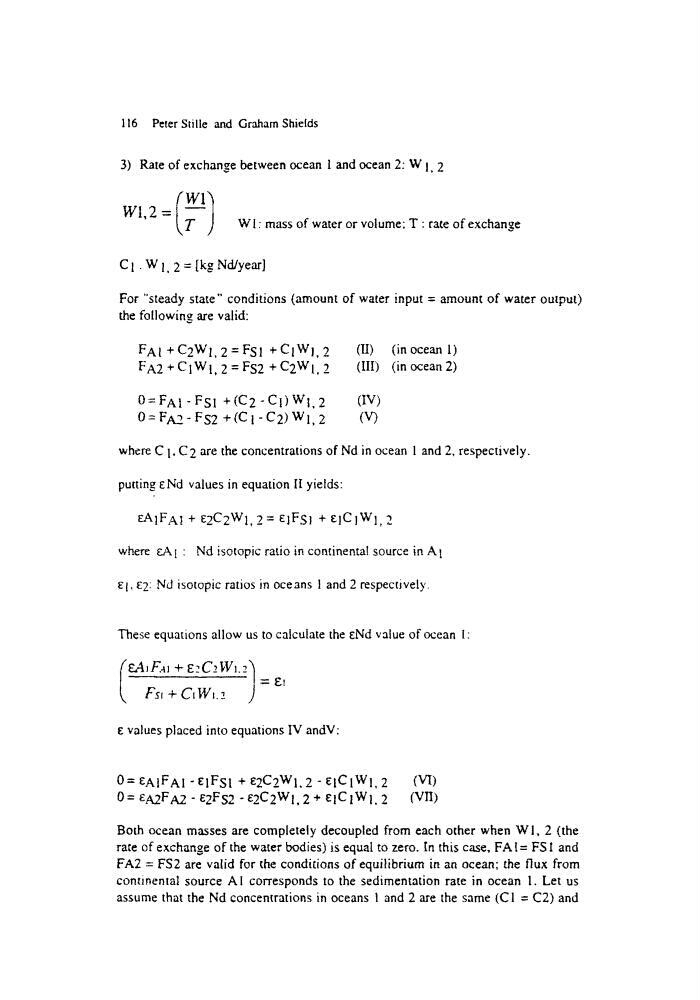
3) Rate of exchange between ocean 1 and ocean 2: W 1, 2
WI'2 = (~ --~ ) Wl : mass of water or volume; T : rate of exchange
C 1 - W 1, 2 = [kg Nd/year]
For "steady state" conditions (amount of water input = amount of water output)
the following are valid:
F A I + C 2 W I , 2 = F s I
+ C l W l , 2
FA2 + C I W 1, 2 = FS2 + C2W 1, 2
O= FAI - FSI + (C2 - CI) WI, 2
O = F A 2 - F S 2 + ( C I - C 2 )
W l , 2
(II) (in ocean 1)
(III) (in ocean 2)
(IV)
(v)
where C 1. C2 are the concentrations of Nd in ocean 1 and 2, respectively.
putting ENd values in equation II yields:
EA1FAI + E:2C2WI, 2 = EIFsI + E I C I W 1 , 2
where e..A t : Nd isotopic ratio in continental source in A 1
El, E2: Nd isotopic ratios in oceans 1 and 2 respectively.
These equations allow us to calculate the ENd value of ocean I:
21 -
Fsf + CtWt."
)
E values placed into equations IV andV:
0 = t~AIFAI- EIFSI + e2C2WI, 2 - g l C l W l , 2
(VI)
0 = ~A2FA2 - E2Fs2 - E2C2WI. 2 + el C IWI, 2
(VII)
Both ocean masses are completely decoupled from each other when W I , 2 (the
rate of exchange of the water bodies) is equal to zero. In this case, F A [ = FS I and
FA2 = FS2 are valid for the conditions of equilibrium in an ocean; the flux from
continental source A I corresponds to the sedimentation rate in ocean 1. Let us
assume that the Nd concentrations in oceans I and 2 are the same (CI = C2) and
3) Rate of exchange between ocean 1 and ocean 2: W 1, 2
WI'2 = (~ --~ ) Wl : mass of water or volume; T : rate of exchange
C 1 - W 1, 2 = [kg Nd/year]
For "steady state" conditions (amount of water input = amount of water output)
the following are valid:
F A I + C 2 W I , 2 = F s I
+ C l W l , 2
FA2 + C I W 1, 2 = FS2 + C2W 1, 2
O= FAI - FSI + (C2 - CI) WI, 2
O = F A 2 - F S 2 + ( C I - C 2 )
W l , 2
(II) (in ocean 1)
(III) (in ocean 2)
(IV)
(v)
where C 1. C2 are the concentrations of Nd in ocean 1 and 2, respectively.
putting ENd values in equation II yields:
EA1FAI + E:2C2WI, 2 = EIFsI + E I C I W 1 , 2
where e..A t : Nd isotopic ratio in continental source in A 1
El, E2: Nd isotopic ratios in oceans 1 and 2 respectively.
These equations allow us to calculate the ENd value of ocean I:
21 -
Fsf + CtWt."
)
E values placed into equations IV andV:
0 = t~AIFAI- EIFSI + e2C2WI, 2 - g l C l W l , 2
(VI)
0 = ~A2FA2 - E2Fs2 - E2C2WI. 2 + el C IWI, 2
(VII)
Both ocean masses are completely decoupled from each other when W I , 2 (the
rate of exchange of the water bodies) is equal to zero. In this case, F A [ = FS I and
FA2 = FS2 are valid for the conditions of equilibrium in an ocean; the flux from
continental source A I corresponds to the sedimentation rate in ocean 1. Let us
assume that the Nd concentrations in oceans I and 2 are the same (CI = C2) and