

5 Isotopic Composition of Seawater
91
t_
03
g
0.710
0.708
0306
0.70t.
0.702
Temperature (*C)
100
200
300
. /
Seawat~
Sea
%,
Basalt
I
I
I
I
i
|
200
~00
600
I
Mg / Sr ( m o l a r )
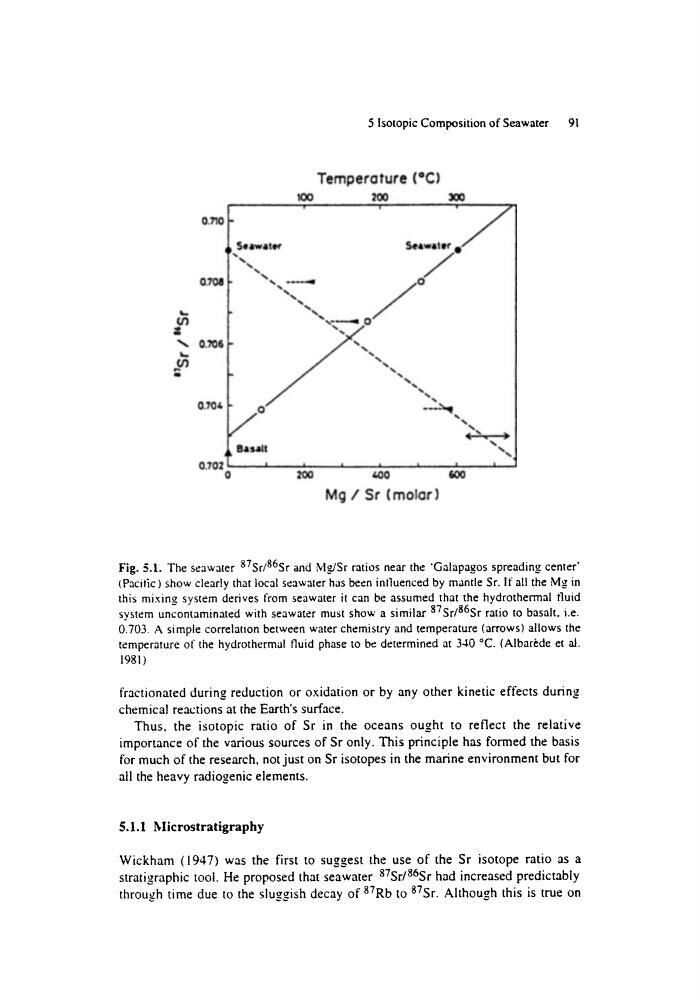
Fig. 5.1. The seawater 87Sr/86Sr and MffSr ratios near the "Galapagos spreading center'
(Pacific) show clearly that local seawater has been influenced by mantle Sr. If all the Mg in
this mixing system derives from seawater it can be assumed that the hydrothermal fluid
system uncontaminated with seawater must show a similar 87Sr/86Sr ratio to basalt, i.e.
0.703. A simple correlation between water chemistry and temperature (arrows) allows the
temperature of the hydrothermal fluid phase to be determined at 340 ~ (Albar~de et al.
1981)
fractionated during reduction or oxidation or by any other kinetic effects during
chemical reactions at the Earth's surface.
Thus, the isotopic ratio of Sr in the oceans ought to reflect the relative
importance of the various sources of Sr only. This principle has formed the basis
for much of the research, not just on Sr isotopes in the marine environment but for
all the heavy radiogenic elements.
5.1.1 Microstratigraphy
Wickham (1947) was the first to suggest the use of the Sr isotope ratio as a
stratigraphic tool. He proposed that seawater 87Sr/86Sr had increased predictably
through time due to the sluggish decay of 87Rb to 87Sr. Although this is true on
91
t_
03
g
0.710
0.708
0306
0.70t.
0.702
Temperature (*C)
100
200
300
. /
Seawat~
Sea
%,
Basalt
I
I
I
I
i
|
200
~00
600
I
Mg / Sr ( m o l a r )
Fig. 5.1. The seawater 87Sr/86Sr and MffSr ratios near the "Galapagos spreading center'
(Pacific) show clearly that local seawater has been influenced by mantle Sr. If all the Mg in
this mixing system derives from seawater it can be assumed that the hydrothermal fluid
system uncontaminated with seawater must show a similar 87Sr/86Sr ratio to basalt, i.e.
0.703. A simple correlation between water chemistry and temperature (arrows) allows the
temperature of the hydrothermal fluid phase to be determined at 340 ~ (Albar~de et al.
1981)
fractionated during reduction or oxidation or by any other kinetic effects during
chemical reactions at the Earth's surface.
Thus, the isotopic ratio of Sr in the oceans ought to reflect the relative
importance of the various sources of Sr only. This principle has formed the basis
for much of the research, not just on Sr isotopes in the marine environment but for
all the heavy radiogenic elements.
5.1.1 Microstratigraphy
Wickham (1947) was the first to suggest the use of the Sr isotope ratio as a
stratigraphic tool. He proposed that seawater 87Sr/86Sr had increased predictably
through time due to the sluggish decay of 87Rb to 87Sr. Although this is true on