

61
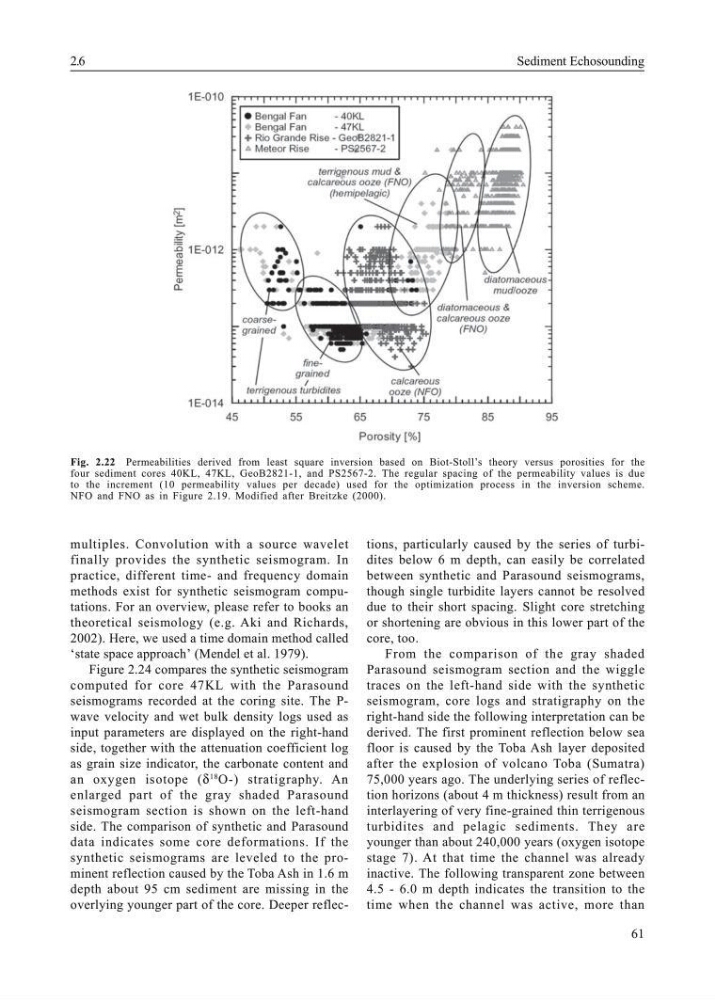
Fig. 2.22 Permeabilities derived from least square inversion based on Biot-Stoll’s theory versus porosities for the
four sediment cores 40KL, 47KL, GeoB2821-1, and PS2567-2. The regular spacing of the permeability values is due
to the increment (10 permeability values per decade) used for the optimization process in the inversion scheme.
NFO and FNO as in Figure 2.19. Modified after Breitzke (2000).
multiples. Convolution with a source wavelet
finally provides the synthetic seismogram. In
practice, different time- and frequency domain
methods exist for synthetic seismogram computations. For an overview, please refer to books an
theoretical seismology (e.g. Aki and Richards,
2002). Here, we used a time domain method called
‘state space approach’ (Mendel et al. 1979).
Figure 2.24 compares the synthetic seismogram
computed for core 47KL with the Parasound
seismograms recorded at the coring site. The Pwave velocity and wet bulk density logs used as
input parameters are displayed on the right-hand
side, together with the attenuation coefficient log
as grain size indicator, the carbonate content and
an oxygen isotope (δ
18
O-) stratigraphy. An
enlarged part of the gray shaded Parasound
seismogram section is shown on the left-hand
side. The comparison of synthetic and Parasound
data indicates some core deformations. If the
synthetic seismograms are leveled to the prominent reflection caused by the Toba Ash in 1.6 m
depth about 95 cm sediment are missing in the
overlying younger part of the core. Deeper reflections, particularly caused by the series of turbidites below 6 m depth, can easily be correlated
between synthetic and Parasound seismograms,
though single turbidite layers cannot be resolved
due to their short spacing. Slight core stretching
or shortening are obvious in this lower part of the
core, too.
From the comparison of the gray shaded
Parasound seismogram section and the wiggle
traces on the left-hand side with the synthetic
seismogram, core logs and stratigraphy on the
right-hand side the following interpretation can be
derived. The first prominent reflection below sea
floor is caused by the Toba Ash layer deposited
after the explosion of volcano Toba (Sumatra)
75,000 years ago. The underlying series of reflection horizons (about 4 m thickness) result from an
interlayering of very fine-grained thin terrigenous
turbidites and pelagic sediments. They are
younger than about 240,000 years (oxygen isotope
stage 7). At that time the channel was already
inactive. The following transparent zone between
4.5 - 6.0 m depth indicates the transition to the
time when the channel was active, more than
2.6
Sediment Echosounding
Fig. 2.22 Permeabilities derived from least square inversion based on Biot-Stoll’s theory versus porosities for the
four sediment cores 40KL, 47KL, GeoB2821-1, and PS2567-2. The regular spacing of the permeability values is due
to the increment (10 permeability values per decade) used for the optimization process in the inversion scheme.
NFO and FNO as in Figure 2.19. Modified after Breitzke (2000).
multiples. Convolution with a source wavelet
finally provides the synthetic seismogram. In
practice, different time- and frequency domain
methods exist for synthetic seismogram computations. For an overview, please refer to books an
theoretical seismology (e.g. Aki and Richards,
2002). Here, we used a time domain method called
‘state space approach’ (Mendel et al. 1979).
Figure 2.24 compares the synthetic seismogram
computed for core 47KL with the Parasound
seismograms recorded at the coring site. The Pwave velocity and wet bulk density logs used as
input parameters are displayed on the right-hand
side, together with the attenuation coefficient log
as grain size indicator, the carbonate content and
an oxygen isotope (δ
18
O-) stratigraphy. An
enlarged part of the gray shaded Parasound
seismogram section is shown on the left-hand
side. The comparison of synthetic and Parasound
data indicates some core deformations. If the
synthetic seismograms are leveled to the prominent reflection caused by the Toba Ash in 1.6 m
depth about 95 cm sediment are missing in the
overlying younger part of the core. Deeper reflections, particularly caused by the series of turbidites below 6 m depth, can easily be correlated
between synthetic and Parasound seismograms,
though single turbidite layers cannot be resolved
due to their short spacing. Slight core stretching
or shortening are obvious in this lower part of the
core, too.
From the comparison of the gray shaded
Parasound seismogram section and the wiggle
traces on the left-hand side with the synthetic
seismogram, core logs and stratigraphy on the
right-hand side the following interpretation can be
derived. The first prominent reflection below sea
floor is caused by the Toba Ash layer deposited
after the explosion of volcano Toba (Sumatra)
75,000 years ago. The underlying series of reflection horizons (about 4 m thickness) result from an
interlayering of very fine-grained thin terrigenous
turbidites and pelagic sediments. They are
younger than about 240,000 years (oxygen isotope
stage 7). At that time the channel was already
inactive. The following transparent zone between
4.5 - 6.0 m depth indicates the transition to the
time when the channel was active, more than
2.6
Sediment Echosounding