

2
Physical Properties of Marine Sediments
44
by sediment echosounder and multi-channel
seismic surveys (Sect. 2.6).
In this section first Biot’s viscoelastic model is
summarized which simulates high- and lowfrequency wave propagation in water-saturated
sediments by computing phase velocity and
attenuation curves. Subsequently, analysis
techniques are introduced which derive P-wave
velocities and attenuation coefficients from
ultrasonic signals transmitted radially across
sediment cores. Additional physical properties like
S-wave velocity, elastic moduli and permeability
are estimated by an inversion scheme.
2.4.1
Biot-Stoll Model
To describe wave propagation in marine sediments
mathematically, various simple to complex models
have been developed which approximate the
sediment by a dilute suspension (Wood 1946) or
an elastic, water-saturated frame (Gassmann 1951;
Biot 1956a, b). The most common model which
considers the microstructure of the sediment and
simulates frequency-dependent wave propagation
is based on Biot’s theory (Biot 1956a, b). It includes
Wood’s suspension and Gassmann’s elastic frame
model as low-frequency approximations and
combines acoustic and elastic parameters - P- and
S-wave velocity and attenuation and elastic moduli
- with physical and sedimentological parameters
like mean grain size, porosity, density and permeability.
Based on Biot’s fundamental work Stoll (e.g.
1974, 1977, 1989) reformulated the mathematical
background of this theory with a simplified
uniform nomenclature. Here, only the main physical principles and equations are summarized. For a
detailed description please refer to one of Stoll’s
publications or Biot’s original papers.
The theory starts with a description of the
microstructure by 11 parameters. The sediment
grains are characterized by their grain density (ρ g )
and bulk modulus (K g ), the pore fluid by its
density (ρ f ), bulk modulus (K f ) and viscosity (η).
The porosity (φ) quantifies the amount of pore
space. Its shape and distribution are specified by
the permeability (κ), a pore size parameter
a=d m /3⋅φ/(1-φ), d m = mean grain size (Hovem and
Ingram 1979; Courtney and Mayer 1993), and
structure factor a’=1-r 0 (1-φ
-1
) (0 ≤ r 0 ≤ 1) indicating
a tortuosity of the pore space (Berryman 1980).
The elasticity of the sediment frame is considered
by its bulk and shear modulus (K m and µ m ).
An elastic wave propagating in water-saturated sediments causes different displacements of
the pore fluid and sediment frame due to their
different elastic properties. As a result (global)
fluid motion relative to the frame occurs and can
approximately be described as Poiseuille’s flow.
The flow rate follows Darcy’s law and depends on
the permeability and viscosity of the pore fluid.
Viscous losses due to an interstitial pore water
flow are the dominant damping mechanism. Intergranular friction or local fluid flow can additionally be included but are of minor importance in
the frequency range considered here.
Based on generalized Hooke’s law and
Newton’s 2. Axiom two equations of motions are
necessary to quantify the different displacements
of the sediment frame and pore fluid. For P-waves
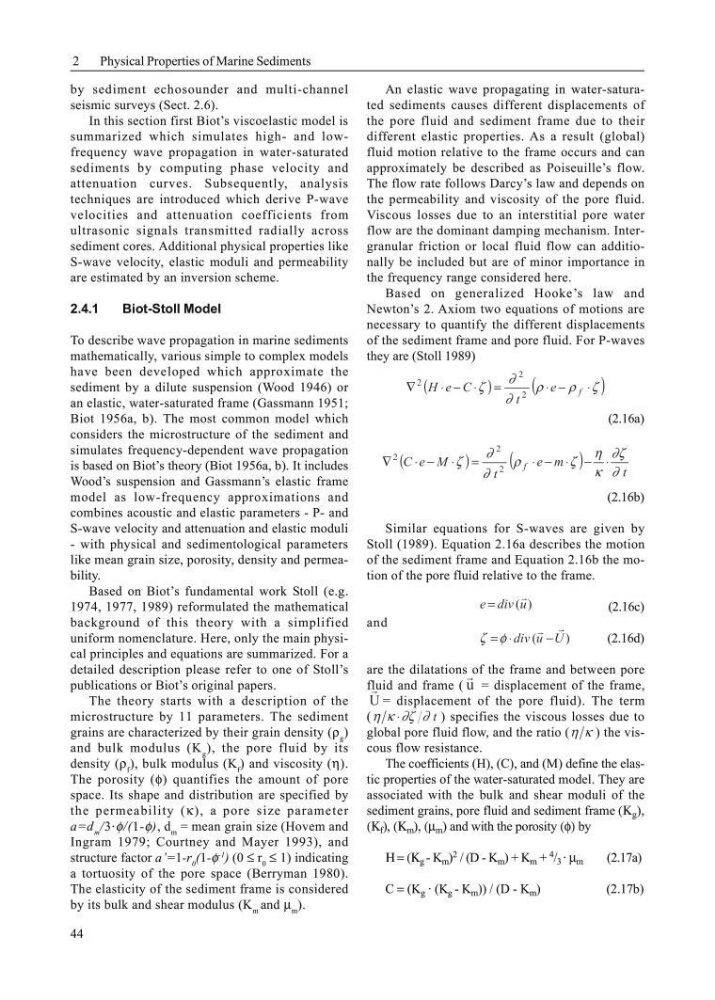
they are (Stoll 1989)
(
)
(
)
ζ
ρ
ρ
∂
∂
ζ
⋅
−
⋅
=
⋅
−
⋅
∇
f
e
t
C
e
H
2
2
2
(2.16a)
(
)
(
)
t
m
e
t
M
e
C
f
∂
∂ζ
κ
η
ζ
ρ
∂
∂
ζ
⋅
−
⋅
−
⋅
=
⋅
−
⋅
∇
2
2
2
(2.16b)
Similar equations for S-waves are given by
Stoll (1989). Equation 2.16a describes the motion
of the sediment frame and Equation 2.16b the motion of the pore fluid relative to the frame.
)
(u
div
e
=
(2.16c)
and
)
( U
u
div
−
⋅
=φ
ζ
(2.16d)
are the dilatations of the frame and between pore
fluid and frame (
u = displacement of the frame,
U = displacement of the pore fluid). The term
(
t
∂
∂ζ
κ
η ⋅
) specifies the viscous losses due to
global pore fluid flow, and the ratio ( κ
η ) the viscous flow resistance.
The coefficients (H), (C), and (M) define the elastic properties of the water-saturated model. They are
associated with the bulk and shear moduli of the
sediment grains, pore fluid and sediment frame (Κ g ),
(Κ f ), (Κ m ), (µ m ) and with the porosity (φ) by
Η = (Κ g - K m ) 2 / (D - K m ) + K m + 4 / 3 · µ m
(2.17a)
C = (K g · (K g - K m )) / (D - K m )
(2.17b)
Physical Properties of Marine Sediments
44
by sediment echosounder and multi-channel
seismic surveys (Sect. 2.6).
In this section first Biot’s viscoelastic model is
summarized which simulates high- and lowfrequency wave propagation in water-saturated
sediments by computing phase velocity and
attenuation curves. Subsequently, analysis
techniques are introduced which derive P-wave
velocities and attenuation coefficients from
ultrasonic signals transmitted radially across
sediment cores. Additional physical properties like
S-wave velocity, elastic moduli and permeability
are estimated by an inversion scheme.
2.4.1
Biot-Stoll Model
To describe wave propagation in marine sediments
mathematically, various simple to complex models
have been developed which approximate the
sediment by a dilute suspension (Wood 1946) or
an elastic, water-saturated frame (Gassmann 1951;
Biot 1956a, b). The most common model which
considers the microstructure of the sediment and
simulates frequency-dependent wave propagation
is based on Biot’s theory (Biot 1956a, b). It includes
Wood’s suspension and Gassmann’s elastic frame
model as low-frequency approximations and
combines acoustic and elastic parameters - P- and
S-wave velocity and attenuation and elastic moduli
- with physical and sedimentological parameters
like mean grain size, porosity, density and permeability.
Based on Biot’s fundamental work Stoll (e.g.
1974, 1977, 1989) reformulated the mathematical
background of this theory with a simplified
uniform nomenclature. Here, only the main physical principles and equations are summarized. For a
detailed description please refer to one of Stoll’s
publications or Biot’s original papers.
The theory starts with a description of the
microstructure by 11 parameters. The sediment
grains are characterized by their grain density (ρ g )
and bulk modulus (K g ), the pore fluid by its
density (ρ f ), bulk modulus (K f ) and viscosity (η).
The porosity (φ) quantifies the amount of pore
space. Its shape and distribution are specified by
the permeability (κ), a pore size parameter
a=d m /3⋅φ/(1-φ), d m = mean grain size (Hovem and
Ingram 1979; Courtney and Mayer 1993), and
structure factor a’=1-r 0 (1-φ
-1
) (0 ≤ r 0 ≤ 1) indicating
a tortuosity of the pore space (Berryman 1980).
The elasticity of the sediment frame is considered
by its bulk and shear modulus (K m and µ m ).
An elastic wave propagating in water-saturated sediments causes different displacements of
the pore fluid and sediment frame due to their
different elastic properties. As a result (global)
fluid motion relative to the frame occurs and can
approximately be described as Poiseuille’s flow.
The flow rate follows Darcy’s law and depends on
the permeability and viscosity of the pore fluid.
Viscous losses due to an interstitial pore water
flow are the dominant damping mechanism. Intergranular friction or local fluid flow can additionally be included but are of minor importance in
the frequency range considered here.
Based on generalized Hooke’s law and
Newton’s 2. Axiom two equations of motions are
necessary to quantify the different displacements
of the sediment frame and pore fluid. For P-waves
they are (Stoll 1989)
(
)
(
)
ζ
ρ
ρ
∂
∂
ζ
⋅
−
⋅
=
⋅
−
⋅
∇
f
e
t
C
e
H
2
2
2
(2.16a)
(
)
(
)
t
m
e
t
M
e
C
f
∂
∂ζ
κ
η
ζ
ρ
∂
∂
ζ
⋅
−
⋅
−
⋅
=
⋅
−
⋅
∇
2
2
2
(2.16b)
Similar equations for S-waves are given by
Stoll (1989). Equation 2.16a describes the motion
of the sediment frame and Equation 2.16b the motion of the pore fluid relative to the frame.
)
(u
div
e
=
(2.16c)
and
)
( U
u
div
−
⋅
=φ
ζ
(2.16d)
are the dilatations of the frame and between pore
fluid and frame (
u = displacement of the frame,
U = displacement of the pore fluid). The term
(
t
∂
∂ζ
κ
η ⋅
) specifies the viscous losses due to
global pore fluid flow, and the ratio ( κ
η ) the viscous flow resistance.
The coefficients (H), (C), and (M) define the elastic properties of the water-saturated model. They are
associated with the bulk and shear moduli of the
sediment grains, pore fluid and sediment frame (Κ g ),
(Κ f ), (Κ m ), (µ m ) and with the porosity (φ) by
Η = (Κ g - K m ) 2 / (D - K m ) + K m + 4 / 3 · µ m
(2.17a)
C = (K g · (K g - K m )) / (D - K m )
(2.17b)