

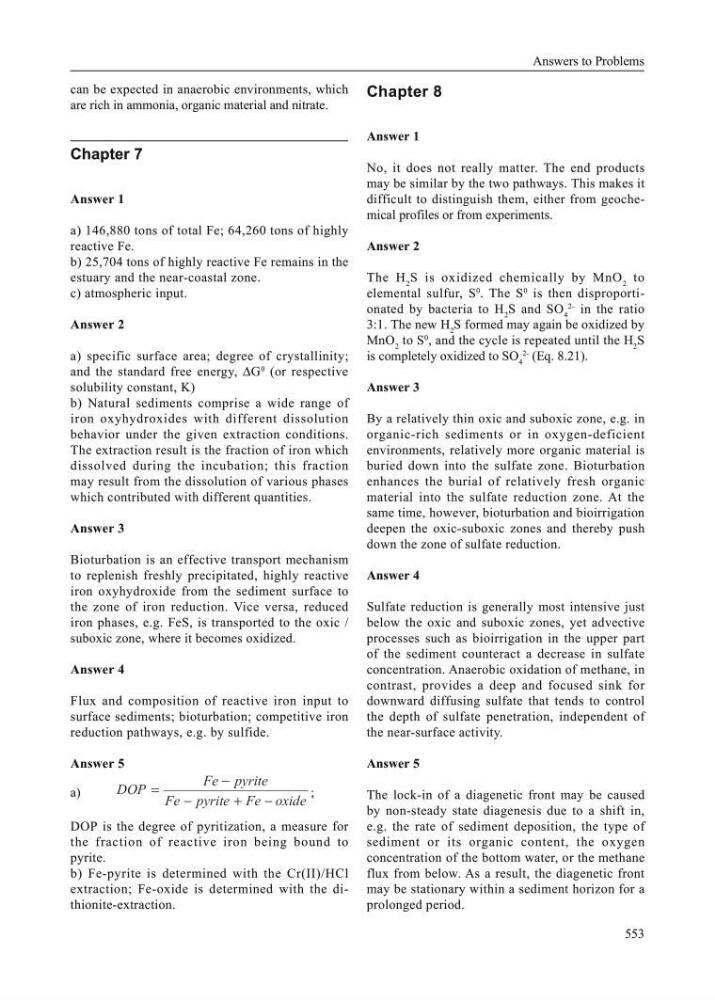
553
Answers to Problems
can be expected in anaerobic environments, which
are rich in ammonia, organic material and nitrate.
Chapter 7
Answer 1
a) 146,880 tons of total Fe; 64,260 tons of highly
reactive Fe.
b) 25,704 tons of highly reactive Fe remains in the
estuary and the near-coastal zone.
c) atmospheric input.
Answer 2
a) specific surface area; degree of crystallinity;
and the standard free energy, ∆G
0
(or respective
solubility constant, K)
b) Natural sediments comprise a wide range of
iron oxyhydroxides with different dissolution
behavior under the given extraction conditions.
The extraction result is the fraction of iron which
dissolved during the incubation; this fraction
may result from the dissolution of various phases
which contributed with different quantities.
Answer 3
Bioturbation is an effective transport mechanism
to replenish freshly precipitated, highly reactive
iron oxyhydroxide from the sediment surface to
the zone of iron reduction. Vice versa, reduced
iron phases, e.g. FeS, is transported to the oxic /
suboxic zone, where it becomes oxidized.
Answer 4
Flux and composition of reactive iron input to
surface sediments; bioturbation; competitive iron
reduction pathways, e.g. by sulfide.
Answer 5
a)
oxide
Fe
pyrite
Fe
pyrite
Fe
DOP
−
+
−
−
=
;
DOP is the degree of pyritization, a measure for
the fraction of reactive iron being bound to
pyrite.
b) Fe-pyrite is determined with the Cr(II)/HCl
extraction; Fe-oxide is determined with the dithionite-extraction.
Chapter 8
Answer 1
No, it does not really matter. The end products
may be similar by the two pathways. This makes it
difficult to distinguish them, either from geochemical profiles or from experiments.
Answer 2
The H 2 S is oxidized chemically by MnO 2 to
elemental sulfur, S
0
. The S
0
is then disproportionated by bacteria to H 2 S and SO 4
2in the ratio
3:1. The new H 2 S formed may again be oxidized by
MnO 2 to S
0
, and the cycle is repeated until the H 2 S
is completely oxidized to SO 4
2(Eq. 8.21).
Answer 3
By a relatively thin oxic and suboxic zone, e.g. in
organic-rich sediments or in oxygen-deficient
environments, relatively more organic material is
buried down into the sulfate zone. Bioturbation
enhances the burial of relatively fresh organic
material into the sulfate reduction zone. At the
same time, however, bioturbation and bioirrigation
deepen the oxic-suboxic zones and thereby push
down the zone of sulfate reduction.
Answer 4
Sulfate reduction is generally most intensive just
below the oxic and suboxic zones, yet advective
processes such as bioirrigation in the upper part
of the sediment counteract a decrease in sulfate
concentration. Anaerobic oxidation of methane, in
contrast, provides a deep and focused sink for
downward diffusing sulfate that tends to control
the depth of sulfate penetration, independent of
the near-surface activity.
Answer 5
The lock-in of a diagenetic front may be caused
by non-steady state diagenesis due to a shift in,
e.g. the rate of sediment deposition, the type of
sediment or its organic content, the oxygen
concentration of the bottom water, or the methane
flux from below. As a result, the diagenetic front
may be stationary within a sediment horizon for a
prolonged period.
Answers to Problems
can be expected in anaerobic environments, which
are rich in ammonia, organic material and nitrate.
Chapter 7
Answer 1
a) 146,880 tons of total Fe; 64,260 tons of highly
reactive Fe.
b) 25,704 tons of highly reactive Fe remains in the
estuary and the near-coastal zone.
c) atmospheric input.
Answer 2
a) specific surface area; degree of crystallinity;
and the standard free energy, ∆G
0
(or respective
solubility constant, K)
b) Natural sediments comprise a wide range of
iron oxyhydroxides with different dissolution
behavior under the given extraction conditions.
The extraction result is the fraction of iron which
dissolved during the incubation; this fraction
may result from the dissolution of various phases
which contributed with different quantities.
Answer 3
Bioturbation is an effective transport mechanism
to replenish freshly precipitated, highly reactive
iron oxyhydroxide from the sediment surface to
the zone of iron reduction. Vice versa, reduced
iron phases, e.g. FeS, is transported to the oxic /
suboxic zone, where it becomes oxidized.
Answer 4
Flux and composition of reactive iron input to
surface sediments; bioturbation; competitive iron
reduction pathways, e.g. by sulfide.
Answer 5
a)
oxide
Fe
pyrite
Fe
pyrite
Fe
DOP
−
+
−
−
=
;
DOP is the degree of pyritization, a measure for
the fraction of reactive iron being bound to
pyrite.
b) Fe-pyrite is determined with the Cr(II)/HCl
extraction; Fe-oxide is determined with the dithionite-extraction.
Chapter 8
Answer 1
No, it does not really matter. The end products
may be similar by the two pathways. This makes it
difficult to distinguish them, either from geochemical profiles or from experiments.
Answer 2
The H 2 S is oxidized chemically by MnO 2 to
elemental sulfur, S
0
. The S
0
is then disproportionated by bacteria to H 2 S and SO 4
2in the ratio
3:1. The new H 2 S formed may again be oxidized by
MnO 2 to S
0
, and the cycle is repeated until the H 2 S
is completely oxidized to SO 4
2(Eq. 8.21).
Answer 3
By a relatively thin oxic and suboxic zone, e.g. in
organic-rich sediments or in oxygen-deficient
environments, relatively more organic material is
buried down into the sulfate zone. Bioturbation
enhances the burial of relatively fresh organic
material into the sulfate reduction zone. At the
same time, however, bioturbation and bioirrigation
deepen the oxic-suboxic zones and thereby push
down the zone of sulfate reduction.
Answer 4
Sulfate reduction is generally most intensive just
below the oxic and suboxic zones, yet advective
processes such as bioirrigation in the upper part
of the sediment counteract a decrease in sulfate
concentration. Anaerobic oxidation of methane, in
contrast, provides a deep and focused sink for
downward diffusing sulfate that tends to control
the depth of sulfate penetration, independent of
the near-surface activity.
Answer 5
The lock-in of a diagenetic front may be caused
by non-steady state diagenesis due to a shift in,
e.g. the rate of sediment deposition, the type of
sediment or its organic content, the oxygen
concentration of the bottom water, or the methane
flux from below. As a result, the diagenetic front
may be stationary within a sediment horizon for a
prolonged period.