

31
densities (ρ g ). They can also be determined from
weight and volume measurements on wet and dry
samples (Blum 1997)
salt
dry
salt
dry
g
g
g
V
V
m
m
V
m
−
−
=
=
ρ
(2.8)
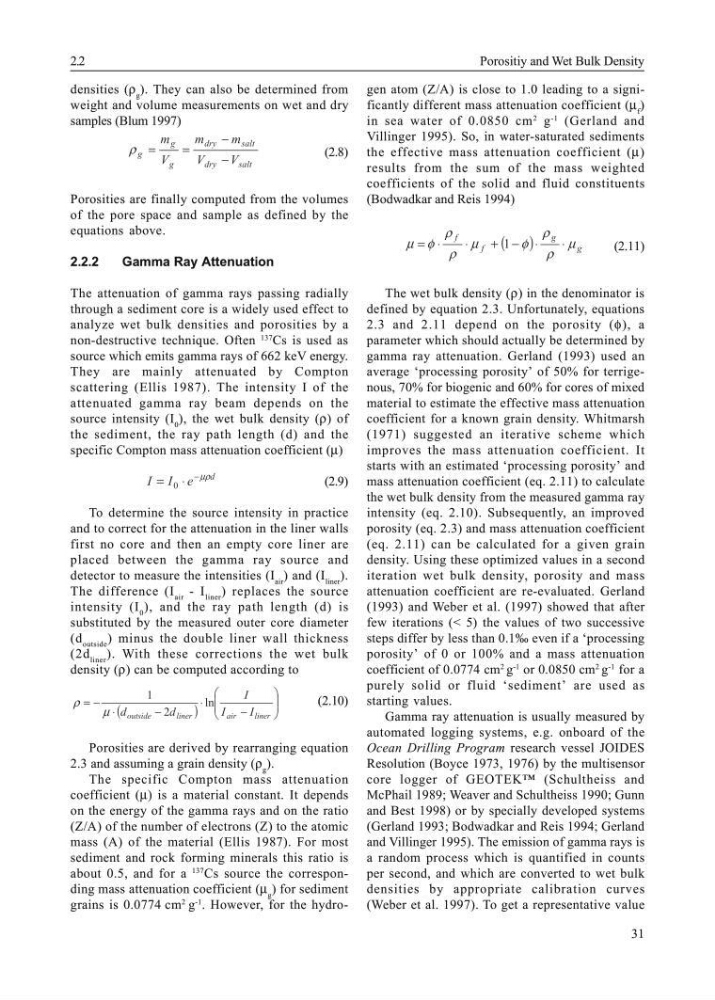
Porosities are finally computed from the volumes
of the pore space and sample as defined by the
equations above.
2.2.2
Gamma Ray Attenuation
The attenuation of gamma rays passing radially
through a sediment core is a widely used effect to
analyze wet bulk densities and porosities by a
non-destructive technique. Often
137
Cs is used as
source which emits gamma rays of 662 keV energy.
They are mainly attenuated by Compton
scattering (Ellis 1987). The intensity I of the
attenuated gamma ray beam depends on the
source intensity (I 0 ), the wet bulk density (ρ) of
the sediment, the ray path length (d) and the
specific Compton mass attenuation coefficient (µ)
d
e
I
I
µρ
−
⋅
= 0
(2.9)
To determine the source intensity in practice
and to correct for the attenuation in the liner walls
first no core and then an empty core liner are
placed between the gamma ray source and
detector to measure the intensities (I air ) and (I liner ).
The difference (I air - I liner ) replaces the source
intensity (I 0 ), and the ray path length (d) is
substituted by the measured outer core diameter
(d outside ) minus the double liner wall thickness
(2d liner ). With these corrections the wet bulk
density (ρ) can be computed according to
(
)
⎟
⎟
⎠
⎞
⎜
⎜
⎝
⎛
−
⋅
−
⋅
−
=
liner
air
liner
outside
I
I
I
d
d
ln
2
1
µ
ρ
(2.10)
Porosities are derived by rearranging equation
2.3 and assuming a grain density (ρ g ).
The specific Compton mass attenuation
coefficient (µ) is a material constant. It depends
on the energy of the gamma rays and on the ratio
(Z/A) of the number of electrons (Z) to the atomic
mass (A) of the material (Ellis 1987). For most
sediment and rock forming minerals this ratio is
about 0.5, and for a
137
Cs source the corresponding mass attenuation coefficient (µ g ) for sediment
grains is 0.0774 cm
2
g
-1
. However, for the hydrogen atom (Z/A) is close to 1.0 leading to a significantly different mass attenuation coefficient (µ f )
in sea water of 0.0850 cm
2
g
-1
(Gerland and
Villinger 1995). So, in water-saturated sediments
the effective mass attenuation coefficient (µ)
results from the sum of the mass weighted
coefficients of the solid and fluid constituents
(Bodwadkar and Reis 1994)
( )
g
g
f
f
µ
ρ
ρ
φ
µ
ρ
ρ
φ
µ
⋅
⋅
−
+
⋅
⋅
=
1
(2.11)
The wet bulk density (ρ) in the denominator is
defined by equation 2.3. Unfortunately, equations
2.3 and 2.11 depend on the porosity (φ), a
parameter which should actually be determined by
gamma ray attenuation. Gerland (1993) used an
average ‘processing porosity’ of 50% for terrigenous, 70% for biogenic and 60% for cores of mixed
material to estimate the effective mass attenuation
coefficient for a known grain density. Whitmarsh
(1971) suggested an iterative scheme which
improves the mass attenuation coefficient. It
starts with an estimated ‘processing porosity’ and
mass attenuation coefficient (eq. 2.11) to calculate
the wet bulk density from the measured gamma ray
intensity (eq. 2.10). Subsequently, an improved
porosity (eq. 2.3) and mass attenuation coefficient
(eq. 2.11) can be calculated for a given grain
density. Using these optimized values in a second
iteration wet bulk density, porosity and mass
attenuation coefficient are re-evaluated. Gerland
(1993) and Weber et al. (1997) showed that after
few iterations (< 5) the values of two successive
steps differ by less than 0.1‰ even if a ‘processing
porosity’ of 0 or 100% and a mass attenuation
coefficient of 0.0774 cm
2
g
-1
or 0.0850 cm
2
g
-1
for a
purely solid or fluid ‘sediment’ are used as
starting values.
Gamma ray attenuation is usually measured by
automated logging systems, e.g. onboard of the
Ocean Drilling Program research vessel JOIDES
Resolution (Boyce 1973, 1976) by the multisensor
core logger of GEOTEK™ (Schultheiss and
McPhail 1989; Weaver and Schultheiss 1990; Gunn
and Best 1998) or by specially developed systems
(Gerland 1993; Bodwadkar and Reis 1994; Gerland
and Villinger 1995). The emission of gamma rays is
a random process which is quantified in counts
per second, and which are converted to wet bulk
densities by appropriate calibration curves
(Weber et al. 1997). To get a representative value
2.2
Porositiy and Wet Bulk Density
densities (ρ g ). They can also be determined from
weight and volume measurements on wet and dry
samples (Blum 1997)
salt
dry
salt
dry
g
g
g
V
V
m
m
V
m
−
−
=
=
ρ
(2.8)
Porosities are finally computed from the volumes
of the pore space and sample as defined by the
equations above.
2.2.2
Gamma Ray Attenuation
The attenuation of gamma rays passing radially
through a sediment core is a widely used effect to
analyze wet bulk densities and porosities by a
non-destructive technique. Often
137
Cs is used as
source which emits gamma rays of 662 keV energy.
They are mainly attenuated by Compton
scattering (Ellis 1987). The intensity I of the
attenuated gamma ray beam depends on the
source intensity (I 0 ), the wet bulk density (ρ) of
the sediment, the ray path length (d) and the
specific Compton mass attenuation coefficient (µ)
d
e
I
I
µρ
−
⋅
= 0
(2.9)
To determine the source intensity in practice
and to correct for the attenuation in the liner walls
first no core and then an empty core liner are
placed between the gamma ray source and
detector to measure the intensities (I air ) and (I liner ).
The difference (I air - I liner ) replaces the source
intensity (I 0 ), and the ray path length (d) is
substituted by the measured outer core diameter
(d outside ) minus the double liner wall thickness
(2d liner ). With these corrections the wet bulk
density (ρ) can be computed according to
(
)
⎟
⎟
⎠
⎞
⎜
⎜
⎝
⎛
−
⋅
−
⋅
−
=
liner
air
liner
outside
I
I
I
d
d
ln
2
1
µ
ρ
(2.10)
Porosities are derived by rearranging equation
2.3 and assuming a grain density (ρ g ).
The specific Compton mass attenuation
coefficient (µ) is a material constant. It depends
on the energy of the gamma rays and on the ratio
(Z/A) of the number of electrons (Z) to the atomic
mass (A) of the material (Ellis 1987). For most
sediment and rock forming minerals this ratio is
about 0.5, and for a
137
Cs source the corresponding mass attenuation coefficient (µ g ) for sediment
grains is 0.0774 cm
2
g
-1
. However, for the hydrogen atom (Z/A) is close to 1.0 leading to a significantly different mass attenuation coefficient (µ f )
in sea water of 0.0850 cm
2
g
-1
(Gerland and
Villinger 1995). So, in water-saturated sediments
the effective mass attenuation coefficient (µ)
results from the sum of the mass weighted
coefficients of the solid and fluid constituents
(Bodwadkar and Reis 1994)
( )
g
g
f
f
µ
ρ
ρ
φ
µ
ρ
ρ
φ
µ
⋅
⋅
−
+
⋅
⋅
=
1
(2.11)
The wet bulk density (ρ) in the denominator is
defined by equation 2.3. Unfortunately, equations
2.3 and 2.11 depend on the porosity (φ), a
parameter which should actually be determined by
gamma ray attenuation. Gerland (1993) used an
average ‘processing porosity’ of 50% for terrigenous, 70% for biogenic and 60% for cores of mixed
material to estimate the effective mass attenuation
coefficient for a known grain density. Whitmarsh
(1971) suggested an iterative scheme which
improves the mass attenuation coefficient. It
starts with an estimated ‘processing porosity’ and
mass attenuation coefficient (eq. 2.11) to calculate
the wet bulk density from the measured gamma ray
intensity (eq. 2.10). Subsequently, an improved
porosity (eq. 2.3) and mass attenuation coefficient
(eq. 2.11) can be calculated for a given grain
density. Using these optimized values in a second
iteration wet bulk density, porosity and mass
attenuation coefficient are re-evaluated. Gerland
(1993) and Weber et al. (1997) showed that after
few iterations (< 5) the values of two successive
steps differ by less than 0.1‰ even if a ‘processing
porosity’ of 0 or 100% and a mass attenuation
coefficient of 0.0774 cm
2
g
-1
or 0.0850 cm
2
g
-1
for a
purely solid or fluid ‘sediment’ are used as
starting values.
Gamma ray attenuation is usually measured by
automated logging systems, e.g. onboard of the
Ocean Drilling Program research vessel JOIDES
Resolution (Boyce 1973, 1976) by the multisensor
core logger of GEOTEK™ (Schultheiss and
McPhail 1989; Weaver and Schultheiss 1990; Gunn
and Best 1998) or by specially developed systems
(Gerland 1993; Bodwadkar and Reis 1994; Gerland
and Villinger 1995). The emission of gamma rays is
a random process which is quantified in counts
per second, and which are converted to wet bulk
densities by appropriate calibration curves
(Weber et al. 1997). To get a representative value
2.2
Porositiy and Wet Bulk Density