

12 Quantification and Regionalization of Benthic Reflux
450
bution patterns are similar, but in detail significant
discrepancies exist, which likely arise from the
negligence of lateral transport processes.
12.5.3 Use of Numerical Models to
Investigate Benthic-Pelagic Coupling
The rapid development of field studies improving
our knowledge on benthic systems over the past
decade is strongly coupled to the growing understanding that benthic mineralization has a considerable effect on total ocean geochemistry.
Since the regionalization approaches outlined
above are difficult to use in order to forecast how
and to which extent the benthic reflux of e.g.
dissolved carbon and nutrients will affect ocean
productivity or atmospheric CO 2 -levels, there are
increasing efforts to construct coupled models,
which are capable of predicting dynamic changes
of the environmental conditions. Up to now these
models are far more limited in their regional
resolution (mainly caused by their internal
complexity and required calculation time) than
data-based regionalization approaches. However,
towards a better understanding of the interaction
of global biogeochemical cycles coupled benthicpelagic models are of outstanding significance in
order to address many important themes as the
CO 2 storage capacity of the ocean and marine
sediments and long-term productivity changes
and climate feedbacks. Since this is another vast
field of study we will only develop a brief overview with respect to the most important acquisitions of the past few years.
Stand-alone numerical models to simulate
various diagenetic processes in marine sediments
have been referred to in various chapters of this
book (i.e. Van Cappellen and Wang 1996;
Boudreau 1996; Pfeifer et al. 2002; Luff and
Wallmann 2003). Some of these models have been
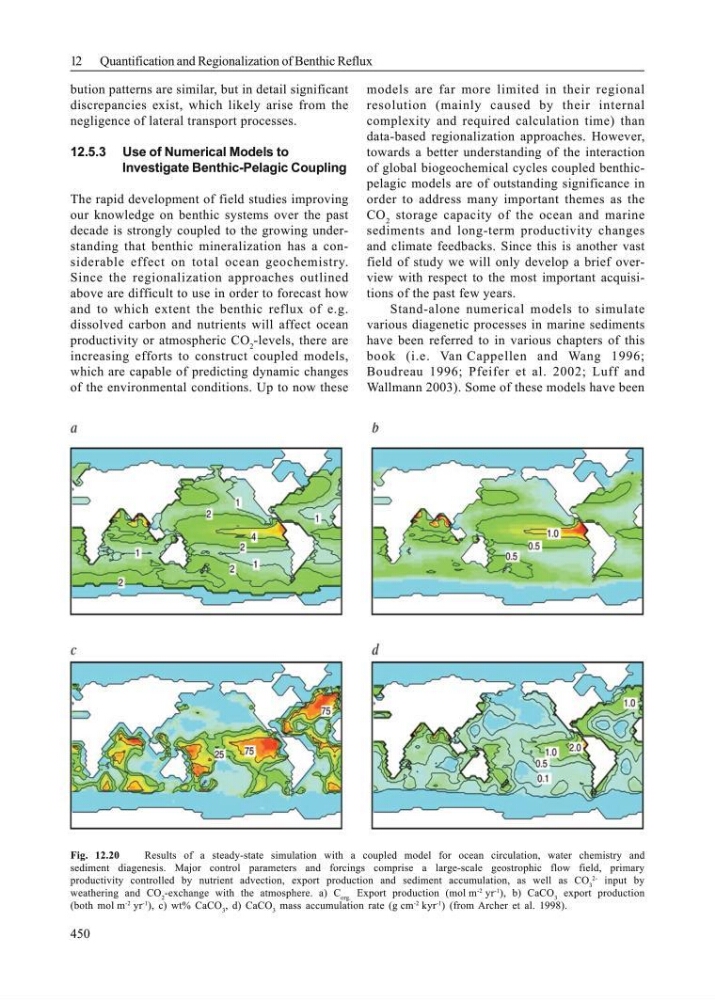
Fig. 12.20
Results of a steady-state simulation with a coupled model for ocean circulation, water chemistry and
sediment diagenesis. Major control parameters and forcings comprise a large-scale geostrophic flow field, primary
productivity controlled by nutrient advection, export production and sediment accumulation, as well as CO 3
2- input by
weathering and CO 2 -exchange with the atmosphere. a) C org. Export production (mol m
-2 yr
-1 ), b) CaCO 3 export production
(both mol m
-2 yr
-1 ), c) wt% CaCO 3 , d) CaCO 3 mass accumulation rate (g cm
-2 kyr
-1 ) (from Archer et al. 1998).
450
bution patterns are similar, but in detail significant
discrepancies exist, which likely arise from the
negligence of lateral transport processes.
12.5.3 Use of Numerical Models to
Investigate Benthic-Pelagic Coupling
The rapid development of field studies improving
our knowledge on benthic systems over the past
decade is strongly coupled to the growing understanding that benthic mineralization has a considerable effect on total ocean geochemistry.
Since the regionalization approaches outlined
above are difficult to use in order to forecast how
and to which extent the benthic reflux of e.g.
dissolved carbon and nutrients will affect ocean
productivity or atmospheric CO 2 -levels, there are
increasing efforts to construct coupled models,
which are capable of predicting dynamic changes
of the environmental conditions. Up to now these
models are far more limited in their regional
resolution (mainly caused by their internal
complexity and required calculation time) than
data-based regionalization approaches. However,
towards a better understanding of the interaction
of global biogeochemical cycles coupled benthicpelagic models are of outstanding significance in
order to address many important themes as the
CO 2 storage capacity of the ocean and marine
sediments and long-term productivity changes
and climate feedbacks. Since this is another vast
field of study we will only develop a brief overview with respect to the most important acquisitions of the past few years.
Stand-alone numerical models to simulate
various diagenetic processes in marine sediments
have been referred to in various chapters of this
book (i.e. Van Cappellen and Wang 1996;
Boudreau 1996; Pfeifer et al. 2002; Luff and
Wallmann 2003). Some of these models have been
Fig. 12.20
Results of a steady-state simulation with a coupled model for ocean circulation, water chemistry and
sediment diagenesis. Major control parameters and forcings comprise a large-scale geostrophic flow field, primary
productivity controlled by nutrient advection, export production and sediment accumulation, as well as CO 3
2- input by
weathering and CO 2 -exchange with the atmosphere. a) C org. Export production (mol m
-2 yr
-1 ), b) CaCO 3 export production
(both mol m
-2 yr
-1 ), c) wt% CaCO 3 , d) CaCO 3 mass accumulation rate (g cm
-2 kyr
-1 ) (from Archer et al. 1998).