

399
Rather, δMnO 2 may be considered to be a randomly
stacked Fe-Mn mineral. Some authors have suggested
that there is usually an intimate association of δMnO 2
and FeOOH · xH 2 O in deep-sea hydrogenous nodules
due to the transport of minerals as colloidal particles and
subsequent coagulation of these particles (Halbach et
al. 1981). Detrital minerals such as quartz and feldspar
normally give much stronger X-ray diffraction peaks
than the Mn and Fe oxides. Within various types of
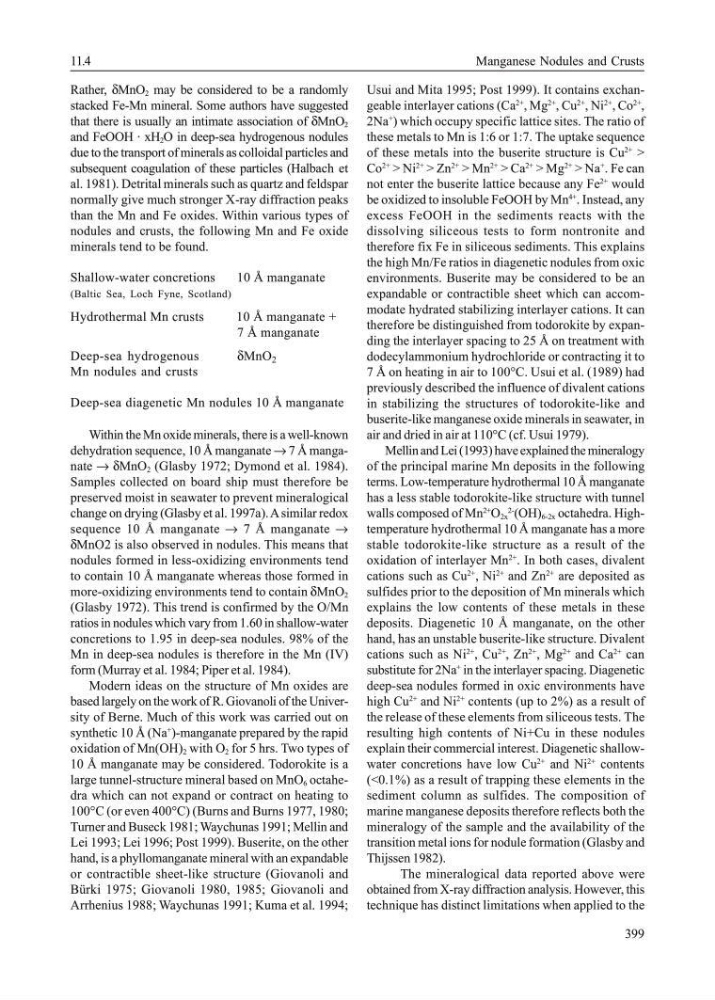
nodules and crusts, the following Mn and Fe oxide
minerals tend to be found.
Shallow-water concretions
10 Å manganate
(Baltic Sea, Loch Fyne, Scotland)
Hydrothermal Mn crusts
10 Å manganate +
7 Å manganate
Deep-sea hydrogenous
δMnO 2
Mn nodules and crusts
Deep-sea diagenetic Mn nodules 10 Å manganate
Within the Mn oxide minerals, there is a well-known
dehydration sequence, 10 Å manganate → 7 Å manganate → δMnO 2 (Glasby 1972; Dymond et al. 1984).
Samples collected on board ship must therefore be
preserved moist in seawater to prevent mineralogical
change on drying (Glasby et al. 1997a). A similar redox
sequence 10 Å manganate → 7 Å manganate →
δMnO2 is also observed in nodules. This means that
nodules formed in less-oxidizing environments tend
to contain 10 Å manganate whereas those formed in
more-oxidizing environments tend to contain δMnO 2
(Glasby 1972). This trend is confirmed by the O/Mn
ratios in nodules which vary from 1.60 in shallow-water
concretions to 1.95 in deep-sea nodules. 98% of the
Mn in deep-sea nodules is therefore in the Mn (IV)
form (Murray et al. 1984; Piper et al. 1984).
Modern ideas on the structure of Mn oxides are
based largely on the work of R. Giovanoli of the University of Berne. Much of this work was carried out on
synthetic 10 Å (Na
+
)-manganate prepared by the rapid
oxidation of Mn(OH) 2 with O 2 for 5 hrs. Two types of
10 Å manganate may be considered. Todorokite is a
large tunnel-structure mineral based on MnO 6 octahedra which can not expand or contract on heating to
100°C (or even 400°C) (Burns and Burns 1977, 1980;
Turner and Buseck 1981; Waychunas 1991; Mellin and
Lei 1993; Lei 1996; Post 1999). Buserite, on the other
hand, is a phyllomanganate mineral with an expandable
or contractible sheet-like structure (Giovanoli and
Bürki 1975; Giovanoli 1980, 1985; Giovanoli and
Arrhenius 1988; Waychunas 1991; Kuma et al. 1994;
Usui and Mita 1995; Post 1999). It contains exchangeable interlayer cations (Ca
2+
, Mg
2+
, Cu
2+
, Ni
2+
, Co
2+
,
2Na
+
) which occupy specific lattice sites. The ratio of
these metals to Mn is 1:6 or 1:7. The uptake sequence
of these metals into the buserite structure is Cu
2+
>
Co
2+
> Ni
2+
> Zn
2+
> Mn
2+
> Ca
2+
> Mg
2+
> Na
+
. Fe can
not enter the buserite lattice because any Fe
2+
would
be oxidized to insoluble FeOOH by Mn
4+
. Instead, any
excess FeOOH in the sediments reacts with the
dissolving siliceous tests to form nontronite and
therefore fix Fe in siliceous sediments. This explains
the high Mn/Fe ratios in diagenetic nodules from oxic
environments. Buserite may be considered to be an
expandable or contractible sheet which can accommodate hydrated stabilizing interlayer cations. It can
therefore be distinguished from todorokite by expanding the interlayer spacing to 25 Å on treatment with
dodecylammonium hydrochloride or contracting it to
7 Å on heating in air to 100°C. Usui et al. (1989) had
previously described the influence of divalent cations
in stabilizing the structures of todorokite-like and
buserite-like manganese oxide minerals in seawater, in
air and dried in air at 110°C (cf. Usui 1979).
Mellin and Lei (1993) have explained the mineralogy
of the principal marine Mn deposits in the following
terms. Low-temperature hydrothermal 10 Å manganate
has a less stable todorokite-like structure with tunnel
walls composed of Mn
2+
O 2x
2(OH) 6-2x octahedra. Hightemperature hydrothermal 10 Å manganate has a more
stable todorokite-like structure as a result of the
oxidation of interlayer Mn
2+
. In both cases, divalent
cations such as Cu
2+
, Ni
2+
and Zn
2+
are deposited as
sulfides prior to the deposition of Mn minerals which
explains the low contents of these metals in these
deposits. Diagenetic 10 Å manganate, on the other
hand, has an unstable buserite-like structure. Divalent
cations such as Ni
2+
, Cu
2+
, Zn
2+
, Mg
2+
and Ca
2+
can
substitute for 2Na
+
in the interlayer spacing. Diagenetic
deep-sea nodules formed in oxic environments have
high Cu
2+
and Ni
2+
contents (up to 2%) as a result of
the release of these elements from siliceous tests. The
resulting high contents of Ni+Cu in these nodules
explain their commercial interest. Diagenetic shallowwater concretions have low Cu
2+
and Ni
2+
contents
(<0.1%) as a result of trapping these elements in the
sediment column as sulfides. The composition of
marine manganese deposits therefore reflects both the
mineralogy of the sample and the availability of the
transition metal ions for nodule formation (Glasby and
Thijssen 1982).
The mineralogical data reported above were
obtained from X-ray diffraction analysis. However, this
technique has distinct limitations when applied to the
11.4
Manganese Nodules and Crusts
Rather, δMnO 2 may be considered to be a randomly
stacked Fe-Mn mineral. Some authors have suggested
that there is usually an intimate association of δMnO 2
and FeOOH · xH 2 O in deep-sea hydrogenous nodules
due to the transport of minerals as colloidal particles and
subsequent coagulation of these particles (Halbach et
al. 1981). Detrital minerals such as quartz and feldspar
normally give much stronger X-ray diffraction peaks
than the Mn and Fe oxides. Within various types of
nodules and crusts, the following Mn and Fe oxide
minerals tend to be found.
Shallow-water concretions
10 Å manganate
(Baltic Sea, Loch Fyne, Scotland)
Hydrothermal Mn crusts
10 Å manganate +
7 Å manganate
Deep-sea hydrogenous
δMnO 2
Mn nodules and crusts
Deep-sea diagenetic Mn nodules 10 Å manganate
Within the Mn oxide minerals, there is a well-known
dehydration sequence, 10 Å manganate → 7 Å manganate → δMnO 2 (Glasby 1972; Dymond et al. 1984).
Samples collected on board ship must therefore be
preserved moist in seawater to prevent mineralogical
change on drying (Glasby et al. 1997a). A similar redox
sequence 10 Å manganate → 7 Å manganate →
δMnO2 is also observed in nodules. This means that
nodules formed in less-oxidizing environments tend
to contain 10 Å manganate whereas those formed in
more-oxidizing environments tend to contain δMnO 2
(Glasby 1972). This trend is confirmed by the O/Mn
ratios in nodules which vary from 1.60 in shallow-water
concretions to 1.95 in deep-sea nodules. 98% of the
Mn in deep-sea nodules is therefore in the Mn (IV)
form (Murray et al. 1984; Piper et al. 1984).
Modern ideas on the structure of Mn oxides are
based largely on the work of R. Giovanoli of the University of Berne. Much of this work was carried out on
synthetic 10 Å (Na
+
)-manganate prepared by the rapid
oxidation of Mn(OH) 2 with O 2 for 5 hrs. Two types of
10 Å manganate may be considered. Todorokite is a
large tunnel-structure mineral based on MnO 6 octahedra which can not expand or contract on heating to
100°C (or even 400°C) (Burns and Burns 1977, 1980;
Turner and Buseck 1981; Waychunas 1991; Mellin and
Lei 1993; Lei 1996; Post 1999). Buserite, on the other
hand, is a phyllomanganate mineral with an expandable
or contractible sheet-like structure (Giovanoli and
Bürki 1975; Giovanoli 1980, 1985; Giovanoli and
Arrhenius 1988; Waychunas 1991; Kuma et al. 1994;
Usui and Mita 1995; Post 1999). It contains exchangeable interlayer cations (Ca
2+
, Mg
2+
, Cu
2+
, Ni
2+
, Co
2+
,
2Na
+
) which occupy specific lattice sites. The ratio of
these metals to Mn is 1:6 or 1:7. The uptake sequence
of these metals into the buserite structure is Cu
2+
>
Co
2+
> Ni
2+
> Zn
2+
> Mn
2+
> Ca
2+
> Mg
2+
> Na
+
. Fe can
not enter the buserite lattice because any Fe
2+
would
be oxidized to insoluble FeOOH by Mn
4+
. Instead, any
excess FeOOH in the sediments reacts with the
dissolving siliceous tests to form nontronite and
therefore fix Fe in siliceous sediments. This explains
the high Mn/Fe ratios in diagenetic nodules from oxic
environments. Buserite may be considered to be an
expandable or contractible sheet which can accommodate hydrated stabilizing interlayer cations. It can
therefore be distinguished from todorokite by expanding the interlayer spacing to 25 Å on treatment with
dodecylammonium hydrochloride or contracting it to
7 Å on heating in air to 100°C. Usui et al. (1989) had
previously described the influence of divalent cations
in stabilizing the structures of todorokite-like and
buserite-like manganese oxide minerals in seawater, in
air and dried in air at 110°C (cf. Usui 1979).
Mellin and Lei (1993) have explained the mineralogy
of the principal marine Mn deposits in the following
terms. Low-temperature hydrothermal 10 Å manganate
has a less stable todorokite-like structure with tunnel
walls composed of Mn
2+
O 2x
2(OH) 6-2x octahedra. Hightemperature hydrothermal 10 Å manganate has a more
stable todorokite-like structure as a result of the
oxidation of interlayer Mn
2+
. In both cases, divalent
cations such as Cu
2+
, Ni
2+
and Zn
2+
are deposited as
sulfides prior to the deposition of Mn minerals which
explains the low contents of these metals in these
deposits. Diagenetic 10 Å manganate, on the other
hand, has an unstable buserite-like structure. Divalent
cations such as Ni
2+
, Cu
2+
, Zn
2+
, Mg
2+
and Ca
2+
can
substitute for 2Na
+
in the interlayer spacing. Diagenetic
deep-sea nodules formed in oxic environments have
high Cu
2+
and Ni
2+
contents (up to 2%) as a result of
the release of these elements from siliceous tests. The
resulting high contents of Ni+Cu in these nodules
explain their commercial interest. Diagenetic shallowwater concretions have low Cu
2+
and Ni
2+
contents
(<0.1%) as a result of trapping these elements in the
sediment column as sulfides. The composition of
marine manganese deposits therefore reflects both the
mineralogy of the sample and the availability of the
transition metal ions for nodule formation (Glasby and
Thijssen 1982).
The mineralogical data reported above were
obtained from X-ray diffraction analysis. However, this
technique has distinct limitations when applied to the
11.4
Manganese Nodules and Crusts