

21
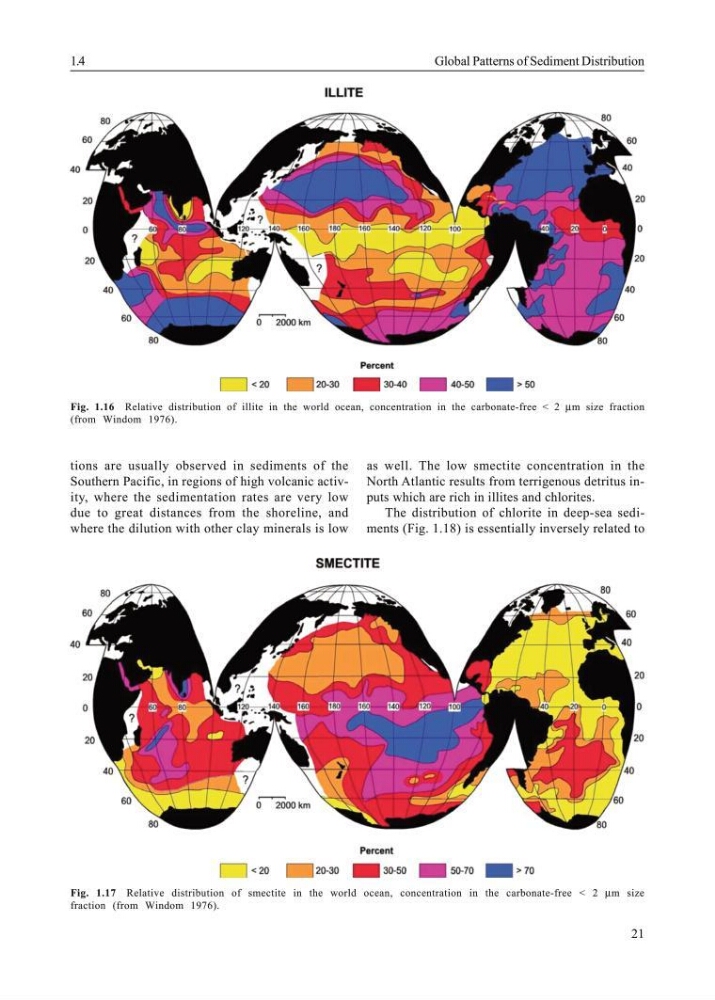
tions are usually observed in sediments of the
Southern Pacific, in regions of high volcanic activity, where the sedimentation rates are very low
due to great distances from the shoreline, and
where the dilution with other clay minerals is low
Fig. 1.16 Relative distribution of illite in the world ocean, concentration in the carbonate-free < 2 µm size fraction
(from Windom 1976).
Fig. 1.17 Relative distribution of smectite in the world ocean, concentration in the carbonate-free < 2 µm size
fraction (from Windom 1976).
1.4
Global Patterns of Sediment Distribution
as well. The low smectite concentration in the
North Atlantic results from terrigenous detritus inputs which are rich in illites and chlorites.
The distribution of chlorite in deep-sea sediments (Fig. 1.18) is essentially inversely related to
tions are usually observed in sediments of the
Southern Pacific, in regions of high volcanic activity, where the sedimentation rates are very low
due to great distances from the shoreline, and
where the dilution with other clay minerals is low
Fig. 1.16 Relative distribution of illite in the world ocean, concentration in the carbonate-free < 2 µm size fraction
(from Windom 1976).
Fig. 1.17 Relative distribution of smectite in the world ocean, concentration in the carbonate-free < 2 µm size
fraction (from Windom 1976).
1.4
Global Patterns of Sediment Distribution
as well. The low smectite concentration in the
North Atlantic results from terrigenous detritus inputs which are rich in illites and chlorites.
The distribution of chlorite in deep-sea sediments (Fig. 1.18) is essentially inversely related to