

10 Influence of Geochemical Processes on Stable Isotope Distribution in Marine Sediments
352
calcite previously attributed to global changes in
δ 13 C ΣCO2 of the ocean (see discussion in Spero et
al. 1997).
Carbonate Dissolution and Precipitation
Some aspects of the influence of diagenesis on
the isotopic composition of carbonate have already been discussed for oxygen isotopes (see
Sect. 10.3.2). The isotopic composition of a
carbonatic shell will remain unchanged until the
shell material dissolves and recrystallizes during
diagenesis. As stated above, diagenetic modification could begin immediately after deposition or
even in the water column due to corrosive deep
ocean or pore waters. McCorkle et al. (1995)
showed in shells of the benthic foraminifera C.
wuellerstorfi sampled in a depth profile in the
western equatorial Pacific that below the depth of
the modern lysocline the δ 13 C of this species decrease with water depth. Close to the modern
depth of calcium carbonate compensation, the
observed deviation reached a minimum value of
–0.35‰. Since the effect of differential dissolution would cause a preferential removal of the
light isotope 12 C, an increase would be expected
to occur with increasing dissolution. The opposite
is observed and requires therefore other explanations, beside the effect of carbonate ion concentration (Spero et al. 1997).
Under oxic porewater conditions, no further
change in the carbon isotopic composition of
shell material is expected, until dissolution occurs
under deep burial. But while a temperature-effect
is negligible (Emrich et al. 1970), an alteration of
the primary δ 13 C value may arise during mineral
transformations (aragonite → low Mg-calcite),
depending on the amount of carbon present in the
postdepositional solutions. Under suboxic conditions in sediments with high organic carbon
contents, the carbon isotope signal may be affected by early diagenesis (Nissenbaum et al. 1972;
Irwin et al. 1977). The degradation of organic matter will cause an intense degree of carbonate dissolution and the reprecipitation of authigenic calcite standing in equilibrium with porewater
δ 13 C ΣCO2 . Schneider et al. (1992) estimated for continental slope sediments off Angola that a precipitation of 5% authigenic calcite on foraminiferal
tests would produce a decrease of –1‰ in the
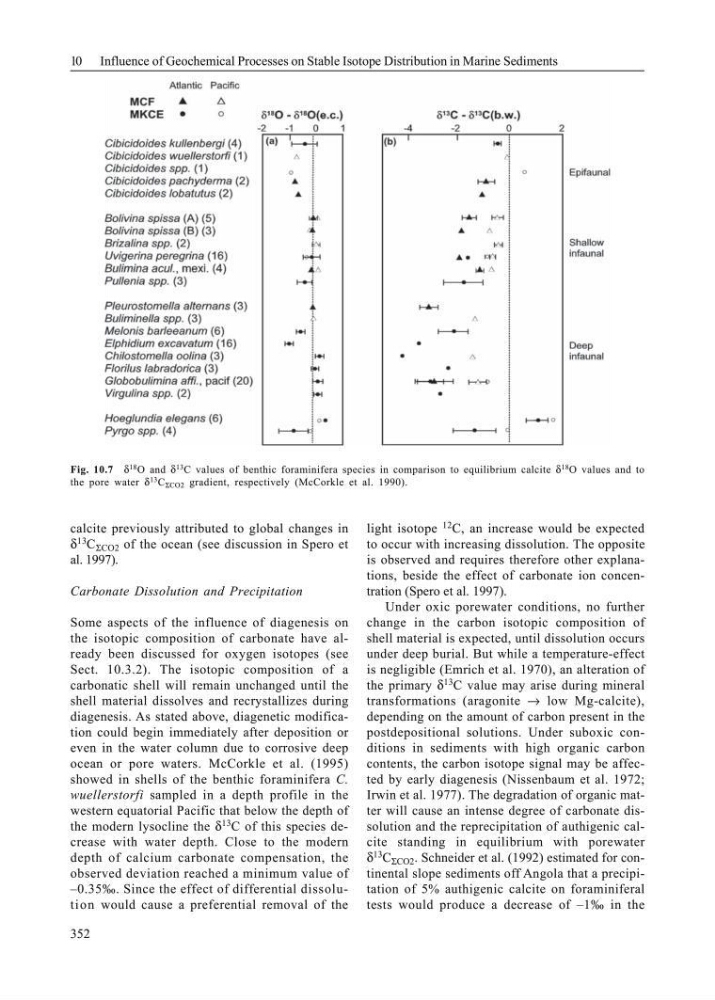
Fig. 10.7 δ 18 O and δ 13 C values of benthic foraminifera species in comparison to equilibrium calcite δ 18 O values and to
the pore water δ 13 C ΣCO2 gradient, respectively (McCorkle et al. 1990).
352
calcite previously attributed to global changes in
δ 13 C ΣCO2 of the ocean (see discussion in Spero et
al. 1997).
Carbonate Dissolution and Precipitation
Some aspects of the influence of diagenesis on
the isotopic composition of carbonate have already been discussed for oxygen isotopes (see
Sect. 10.3.2). The isotopic composition of a
carbonatic shell will remain unchanged until the
shell material dissolves and recrystallizes during
diagenesis. As stated above, diagenetic modification could begin immediately after deposition or
even in the water column due to corrosive deep
ocean or pore waters. McCorkle et al. (1995)
showed in shells of the benthic foraminifera C.
wuellerstorfi sampled in a depth profile in the
western equatorial Pacific that below the depth of
the modern lysocline the δ 13 C of this species decrease with water depth. Close to the modern
depth of calcium carbonate compensation, the
observed deviation reached a minimum value of
–0.35‰. Since the effect of differential dissolution would cause a preferential removal of the
light isotope 12 C, an increase would be expected
to occur with increasing dissolution. The opposite
is observed and requires therefore other explanations, beside the effect of carbonate ion concentration (Spero et al. 1997).
Under oxic porewater conditions, no further
change in the carbon isotopic composition of
shell material is expected, until dissolution occurs
under deep burial. But while a temperature-effect
is negligible (Emrich et al. 1970), an alteration of
the primary δ 13 C value may arise during mineral
transformations (aragonite → low Mg-calcite),
depending on the amount of carbon present in the
postdepositional solutions. Under suboxic conditions in sediments with high organic carbon
contents, the carbon isotope signal may be affected by early diagenesis (Nissenbaum et al. 1972;
Irwin et al. 1977). The degradation of organic matter will cause an intense degree of carbonate dissolution and the reprecipitation of authigenic calcite standing in equilibrium with porewater
δ 13 C ΣCO2 . Schneider et al. (1992) estimated for continental slope sediments off Angola that a precipitation of 5% authigenic calcite on foraminiferal
tests would produce a decrease of –1‰ in the
Fig. 10.7 δ 18 O and δ 13 C values of benthic foraminifera species in comparison to equilibrium calcite δ 18 O values and to
the pore water δ 13 C ΣCO2 gradient, respectively (McCorkle et al. 1990).