

19
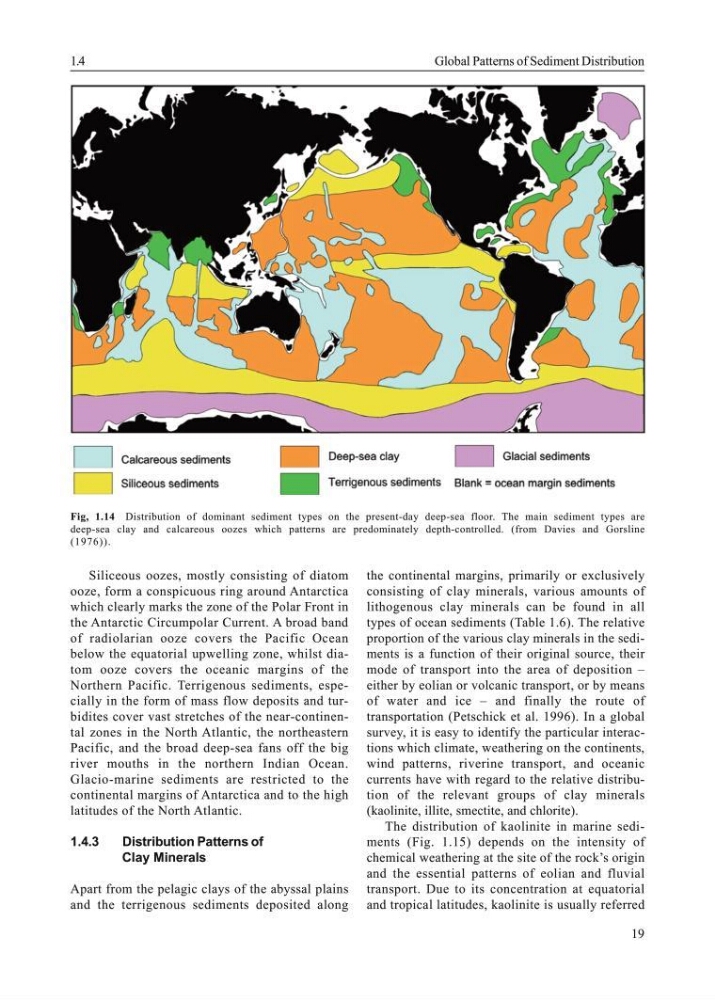
Siliceous oozes, mostly consisting of diatom
ooze, form a conspicuous ring around Antarctica
which clearly marks the zone of the Polar Front in
the Antarctic Circumpolar Current. A broad band
of radiolarian ooze covers the Pacific Ocean
below the equatorial upwelling zone, whilst diatom ooze covers the oceanic margins of the
Northern Pacific. Terrigenous sediments, especially in the form of mass flow deposits and turbidites cover vast stretches of the near-continental zones in the North Atlantic, the northeastern
Pacific, and the broad deep-sea fans off the big
river mouths in the northern Indian Ocean.
Glacio-marine sediments are restricted to the
continental margins of Antarctica and to the high
latitudes of the North Atlantic.
1.4.3
Distribution Patterns of
Clay Minerals
Apart from the pelagic clays of the abyssal plains
and the terrigenous sediments deposited along
the continental margins, primarily or exclusively
consisting of clay minerals, various amounts of
lithogenous clay minerals can be found in all
types of ocean sediments (Table 1.6). The relative
proportion of the various clay minerals in the sediments is a function of their original source, their
mode of transport into the area of deposition –
either by eolian or volcanic transport, or by means
of water and ice – and finally the route of
transportation (Petschick et al. 1996). In a global
survey, it is easy to identify the particular interactions which climate, weathering on the continents,
wind patterns, riverine transport, and oceanic
currents have with regard to the relative distribution of the relevant groups of clay minerals
(kaolinite, illite, smectite, and chlorite).
The distribution of kaolinite in marine sediments (Fig. 1.15) depends on the intensity of
chemical weathering at the site of the rock’s origin
and the essential patterns of eolian and fluvial
transport. Due to its concentration at equatorial
and tropical latitudes, kaolinite is usually referred
Fig, 1.14 Distribution of dominant sediment types on the present-day deep-sea floor. The main sediment types are
deep-sea clay and calcareous oozes which patterns are predominately depth-controlled. (from Davies and Gorsline
(1976)).
1.4
Global Patterns of Sediment Distribution
Siliceous oozes, mostly consisting of diatom
ooze, form a conspicuous ring around Antarctica
which clearly marks the zone of the Polar Front in
the Antarctic Circumpolar Current. A broad band
of radiolarian ooze covers the Pacific Ocean
below the equatorial upwelling zone, whilst diatom ooze covers the oceanic margins of the
Northern Pacific. Terrigenous sediments, especially in the form of mass flow deposits and turbidites cover vast stretches of the near-continental zones in the North Atlantic, the northeastern
Pacific, and the broad deep-sea fans off the big
river mouths in the northern Indian Ocean.
Glacio-marine sediments are restricted to the
continental margins of Antarctica and to the high
latitudes of the North Atlantic.
1.4.3
Distribution Patterns of
Clay Minerals
Apart from the pelagic clays of the abyssal plains
and the terrigenous sediments deposited along
the continental margins, primarily or exclusively
consisting of clay minerals, various amounts of
lithogenous clay minerals can be found in all
types of ocean sediments (Table 1.6). The relative
proportion of the various clay minerals in the sediments is a function of their original source, their
mode of transport into the area of deposition –
either by eolian or volcanic transport, or by means
of water and ice – and finally the route of
transportation (Petschick et al. 1996). In a global
survey, it is easy to identify the particular interactions which climate, weathering on the continents,
wind patterns, riverine transport, and oceanic
currents have with regard to the relative distribution of the relevant groups of clay minerals
(kaolinite, illite, smectite, and chlorite).
The distribution of kaolinite in marine sediments (Fig. 1.15) depends on the intensity of
chemical weathering at the site of the rock’s origin
and the essential patterns of eolian and fluvial
transport. Due to its concentration at equatorial
and tropical latitudes, kaolinite is usually referred
Fig, 1.14 Distribution of dominant sediment types on the present-day deep-sea floor. The main sediment types are
deep-sea clay and calcareous oozes which patterns are predominately depth-controlled. (from Davies and Gorsline
(1976)).
1.4
Global Patterns of Sediment Distribution