

10 Influence of Geochemical Processes on Stable Isotope Distribution in Marine Sediments
346
is controlled by a low-temperature alteration of
basement basalts (see also discussion in Sect.
10.3.1), which is slightly compensated by the
transformation of biogenic opal to quartz. Furthermore, detailed measurements on different generations of carbonate cements suggest that late
cements exhibit lower δ 18 O values compared to
early precipitates. This δ 18 O trend may be due to
the increasing temperatures with increasing burial
depth or to the isotopic evolution of pore waters
during precipitation (Hoefs 2004).
10.4 Geochemical Influences
on 13 C / 12 C Ratios
10.4.1 δ
δ δ
δ δ
13
C Σ
Σ Σ
Σ ΣCO2
of Seawater
Principles of Fractionation
The carbon isotopic composition of ΣCO 2 in
seawater is mainly controlled by two processes,
the biochemical fractionation due to the formation
and decay of organic matter, and the physical
fractionation during gas exchange at the air-sea
boundary (Broecker and Maier-Reimer 1992). Surface water is enriched in 13 C, because photosynthesis preferentially removes 12 C from the CO 2 .
Deeper water masses have lower δ 13 C values,
since nearly all of the organic matter that is
produced by photosynthesis is subsequently
remineralized in the water column. Broecker and
Maier-Reimer (1992) showed that if there were no
air-sea gas exchange, the relationship between
δ 13 C and PO 4 in the ocean would be
δ 13 C - δ 13 C m.o. =
ε p / ΣCO 2 m.o. · C / P org · (PO 4 – PO 4 m.o. )
(10.8)
where ε p (‰) is the isotopic effect associated with
the photosynthetic fixation of carbon, C/P org is the
Redfield Ratio, and the subscript m.o. stands for
mean ocean values. When reasonable values are
substituted (δ 13 C m.o. = 0.3‰, ε p = –19‰, ΣCO 2 m.o.
= 2200 µmol kg -1 , C/P org = 128, PO 4 m.o. = 2.2 µmol
kg -1 ), the predicted relationship closely matches the
relationship for waters in the deep Indian and Pacific Oceans (δ 13 C = 2.7 - 1.1·PO 4 ). This is to be expected, as the effect of air-sea exchange should be
constant for these deep water masses due to the
homogeneity of source waters for the deep Indian
and Pacific Oceans.
On the other hand, carbon isotope fractionation during air-sea gas exchange is also an important factor in determining the isotopic composition of carbon in surface water (Charles and
Fairbanks 1990; Broecker and Peng 1992; LynchStieglitz et al. 1995). If the CO 2 in the atmosphere
were in isotopic equilibrium with the dissolved
inorganic carbon in the ocean, the dissolved
inorganic carbon would be enriched in 13 C by
about 8‰ at 20°C relative to the atmosphere CO 2
(Zhang et al. 1995). This thermodynamic
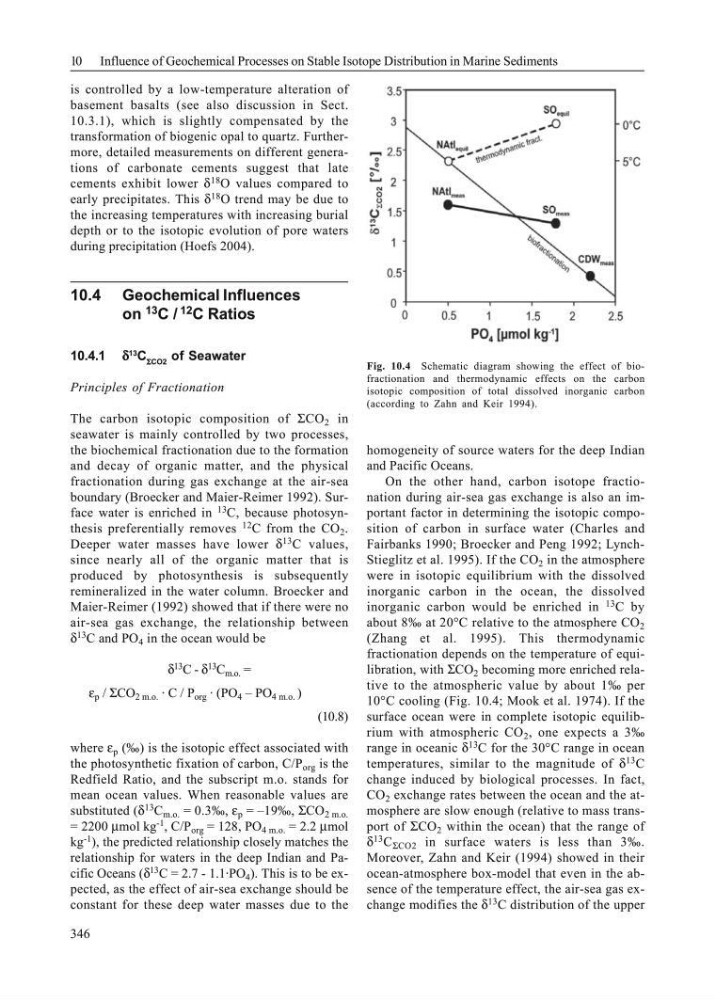
fractionation depends on the temperature of equilibration, with ΣCO 2 becoming more enriched relative to the atmospheric value by about 1‰ per
10°C cooling (Fig. 10.4; Mook et al. 1974). If the
surface ocean were in complete isotopic equilibrium with atmospheric CO 2 , one expects a 3‰
range in oceanic δ 13 C for the 30°C range in ocean
temperatures, similar to the magnitude of δ 13 C
change induced by biological processes. In fact,
CO 2 exchange rates between the ocean and the atmosphere are slow enough (relative to mass transport of ΣCO 2 within the ocean) that the range of
δ 13 C ΣCO2 in surface waters is less than 3‰.
Moreover, Zahn and Keir (1994) showed in their
ocean-atmosphere box-model that even in the absence of the temperature effect, the air-sea gas exchange modifies the δ 13 C distribution of the upper
Fig. 10.4 Schematic diagram showing the effect of biofractionation and thermodynamic effects on the carbon
isotopic composition of total dissolved inorganic carbon
(according to Zahn and Keir 1994).
346
is controlled by a low-temperature alteration of
basement basalts (see also discussion in Sect.
10.3.1), which is slightly compensated by the
transformation of biogenic opal to quartz. Furthermore, detailed measurements on different generations of carbonate cements suggest that late
cements exhibit lower δ 18 O values compared to
early precipitates. This δ 18 O trend may be due to
the increasing temperatures with increasing burial
depth or to the isotopic evolution of pore waters
during precipitation (Hoefs 2004).
10.4 Geochemical Influences
on 13 C / 12 C Ratios
10.4.1 δ
δ δ
δ δ
13
C Σ
Σ Σ
Σ ΣCO2
of Seawater
Principles of Fractionation
The carbon isotopic composition of ΣCO 2 in
seawater is mainly controlled by two processes,
the biochemical fractionation due to the formation
and decay of organic matter, and the physical
fractionation during gas exchange at the air-sea
boundary (Broecker and Maier-Reimer 1992). Surface water is enriched in 13 C, because photosynthesis preferentially removes 12 C from the CO 2 .
Deeper water masses have lower δ 13 C values,
since nearly all of the organic matter that is
produced by photosynthesis is subsequently
remineralized in the water column. Broecker and
Maier-Reimer (1992) showed that if there were no
air-sea gas exchange, the relationship between
δ 13 C and PO 4 in the ocean would be
δ 13 C - δ 13 C m.o. =
ε p / ΣCO 2 m.o. · C / P org · (PO 4 – PO 4 m.o. )
(10.8)
where ε p (‰) is the isotopic effect associated with
the photosynthetic fixation of carbon, C/P org is the
Redfield Ratio, and the subscript m.o. stands for
mean ocean values. When reasonable values are
substituted (δ 13 C m.o. = 0.3‰, ε p = –19‰, ΣCO 2 m.o.
= 2200 µmol kg -1 , C/P org = 128, PO 4 m.o. = 2.2 µmol
kg -1 ), the predicted relationship closely matches the
relationship for waters in the deep Indian and Pacific Oceans (δ 13 C = 2.7 - 1.1·PO 4 ). This is to be expected, as the effect of air-sea exchange should be
constant for these deep water masses due to the
homogeneity of source waters for the deep Indian
and Pacific Oceans.
On the other hand, carbon isotope fractionation during air-sea gas exchange is also an important factor in determining the isotopic composition of carbon in surface water (Charles and
Fairbanks 1990; Broecker and Peng 1992; LynchStieglitz et al. 1995). If the CO 2 in the atmosphere
were in isotopic equilibrium with the dissolved
inorganic carbon in the ocean, the dissolved
inorganic carbon would be enriched in 13 C by
about 8‰ at 20°C relative to the atmosphere CO 2
(Zhang et al. 1995). This thermodynamic
fractionation depends on the temperature of equilibration, with ΣCO 2 becoming more enriched relative to the atmospheric value by about 1‰ per
10°C cooling (Fig. 10.4; Mook et al. 1974). If the
surface ocean were in complete isotopic equilibrium with atmospheric CO 2 , one expects a 3‰
range in oceanic δ 13 C for the 30°C range in ocean
temperatures, similar to the magnitude of δ 13 C
change induced by biological processes. In fact,
CO 2 exchange rates between the ocean and the atmosphere are slow enough (relative to mass transport of ΣCO 2 within the ocean) that the range of
δ 13 C ΣCO2 in surface waters is less than 3‰.
Moreover, Zahn and Keir (1994) showed in their
ocean-atmosphere box-model that even in the absence of the temperature effect, the air-sea gas exchange modifies the δ 13 C distribution of the upper
Fig. 10.4 Schematic diagram showing the effect of biofractionation and thermodynamic effects on the carbon
isotopic composition of total dissolved inorganic carbon
(according to Zahn and Keir 1994).