

343
(1987), a range of +1.0‰ in the mid-latitude
surface Atlantic to –0.6‰ in the northern
surface Pacific is present. Deep water mass
δ 18 O w ranges from +0.3‰ in the core of North
Atlantic Deep Water to –0.1‰ in the Circumpolar Deep Water (for a recent compilation
search the Global Seawater Oxygen-18 Database, Schmidt et al. 1999). Since δ 18 O w exhibits
only a narrow range within open ocean conditions, this proxy is an excellent tracer for indicating the influence of freshwater input to
ocean water masses, since river discharge or
meltwater release is always depleted in 18 O
(Craig and Gordon 1965). For example,
Mackensen et al. (1996, 2001) showed isotopically light meltwaters of the Antarctic Peninsula
shelves to cascade down slopes the Weddell Sea
Basin and thereby contributing to bottom water
formation.
In geologic history, the δ 18 O w has been
shown to vary considerably. For the sea-level
low stand of -120 m during the last glacial
maximum, Fairbanks (1989) showed Barbados
coral oxygen isotopic composition to be enriched
by 1.2‰, which coincides with an isotopic
change of 0.10‰ corresponding to a 10 m sealevel change earlier estimated by Shackleton and
Opdyke (1973). A slightly lower glacial interglacial range of 0.7 to 1.1‰ has been reported
from porewater analyses of different drill holes in
the Atlantic (Adkins et al. 2002). In an ice-free
world, like in the Cretaceous, the global mean
should have been depleted by another -0.8‰. On
longer time scales, additional processes affecting
the δ 18 O w have to be considered. A compilation
of Phanerozoic δ 18 O w values showed an 5‰
increase in δ 18 O w since the Cambrian (Veizer et
al. 1999 with a recent update of the database in
2004). By mass balance calculations, Wallmann
(2001) demonstrated that this increase in δ 18 O w
is in agreement with the ocean’s 6-10% loss of
seawater over the last 600 mio years because the
subduction of water structurally bound in altered
oceanic crust exceeds the water emission by
mantle degassing. However, the large isotopic
shifts observed episodically in the Paleozoic, as
recorded in fossils (Veizer et al. 1999) and abiotic
marine calcites (Lohmann and Walker 1989;
Carpenter et al. 1991), exceed by far the variability in isotopes observed in Neogene and Quaternary times and are too fast to be explained
with ocean crust-seawater interactions. Those
changes must be attributed to changes in earth
climate systems, like ice volume and ocean
circulation (e.g. Railsback 1990; Bickert et al.
1997).
10.3.2 δ
δ δ
δ δ 18 O in Marine Carbonates
Principles of Fractionation
The oxygen isotope ratios in carbonates are a
function of both temperature and the δ 18 O w of the
surrounding seawater. Since the early equation
given by Epstein et al. (1953), many equations
have been published, which substantiated the potential of oxygen isotope paleothermometry for
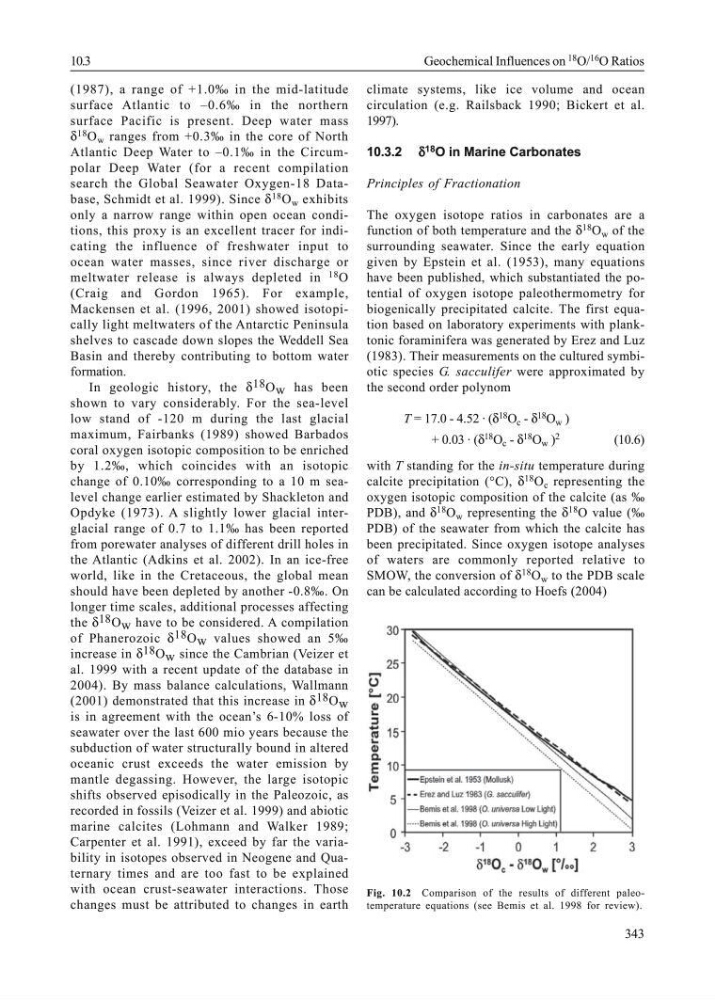
biogenically precipitated calcite. The first equation based on laboratory experiments with planktonic foraminifera was generated by Erez and Luz
(1983). Their measurements on the cultured symbiotic species G. sacculifer were approximated by
the second order polynom
T = 17.0 - 4.52 · (δ 18 O c - δ 18 O w )
+ 0.03 · (δ 18 O c - δ 18 O w ) 2
(10.6)
with T standing for the in-situ temperature during
calcite precipitation (°C), δ 18 O c representing the
oxygen isotopic composition of the calcite (as ‰
PDB), and δ 18 O w representing the δ 18 O value (‰
PDB) of the seawater from which the calcite has
been precipitated. Since oxygen isotope analyses
of waters are commonly reported relative to
SMOW, the conversion of δ 18 O w to the PDB scale
can be calculated according to Hoefs (2004)
Fig. 10.2 Comparison of the results of different paleotemperature equations (see Bemis et al. 1998 for review).
10.3
Geochemical Influences on 18 O/ 16 O Ratios
(1987), a range of +1.0‰ in the mid-latitude
surface Atlantic to –0.6‰ in the northern
surface Pacific is present. Deep water mass
δ 18 O w ranges from +0.3‰ in the core of North
Atlantic Deep Water to –0.1‰ in the Circumpolar Deep Water (for a recent compilation
search the Global Seawater Oxygen-18 Database, Schmidt et al. 1999). Since δ 18 O w exhibits
only a narrow range within open ocean conditions, this proxy is an excellent tracer for indicating the influence of freshwater input to
ocean water masses, since river discharge or
meltwater release is always depleted in 18 O
(Craig and Gordon 1965). For example,
Mackensen et al. (1996, 2001) showed isotopically light meltwaters of the Antarctic Peninsula
shelves to cascade down slopes the Weddell Sea
Basin and thereby contributing to bottom water
formation.
In geologic history, the δ 18 O w has been
shown to vary considerably. For the sea-level
low stand of -120 m during the last glacial
maximum, Fairbanks (1989) showed Barbados
coral oxygen isotopic composition to be enriched
by 1.2‰, which coincides with an isotopic
change of 0.10‰ corresponding to a 10 m sealevel change earlier estimated by Shackleton and
Opdyke (1973). A slightly lower glacial interglacial range of 0.7 to 1.1‰ has been reported
from porewater analyses of different drill holes in
the Atlantic (Adkins et al. 2002). In an ice-free
world, like in the Cretaceous, the global mean
should have been depleted by another -0.8‰. On
longer time scales, additional processes affecting
the δ 18 O w have to be considered. A compilation
of Phanerozoic δ 18 O w values showed an 5‰
increase in δ 18 O w since the Cambrian (Veizer et
al. 1999 with a recent update of the database in
2004). By mass balance calculations, Wallmann
(2001) demonstrated that this increase in δ 18 O w
is in agreement with the ocean’s 6-10% loss of
seawater over the last 600 mio years because the
subduction of water structurally bound in altered
oceanic crust exceeds the water emission by
mantle degassing. However, the large isotopic
shifts observed episodically in the Paleozoic, as
recorded in fossils (Veizer et al. 1999) and abiotic
marine calcites (Lohmann and Walker 1989;
Carpenter et al. 1991), exceed by far the variability in isotopes observed in Neogene and Quaternary times and are too fast to be explained
with ocean crust-seawater interactions. Those
changes must be attributed to changes in earth
climate systems, like ice volume and ocean
circulation (e.g. Railsback 1990; Bickert et al.
1997).
10.3.2 δ
δ δ
δ δ 18 O in Marine Carbonates
Principles of Fractionation
The oxygen isotope ratios in carbonates are a
function of both temperature and the δ 18 O w of the
surrounding seawater. Since the early equation
given by Epstein et al. (1953), many equations
have been published, which substantiated the potential of oxygen isotope paleothermometry for
biogenically precipitated calcite. The first equation based on laboratory experiments with planktonic foraminifera was generated by Erez and Luz
(1983). Their measurements on the cultured symbiotic species G. sacculifer were approximated by
the second order polynom
T = 17.0 - 4.52 · (δ 18 O c - δ 18 O w )
+ 0.03 · (δ 18 O c - δ 18 O w ) 2
(10.6)
with T standing for the in-situ temperature during
calcite precipitation (°C), δ 18 O c representing the
oxygen isotopic composition of the calcite (as ‰
PDB), and δ 18 O w representing the δ 18 O value (‰
PDB) of the seawater from which the calcite has
been precipitated. Since oxygen isotope analyses
of waters are commonly reported relative to
SMOW, the conversion of δ 18 O w to the PDB scale
can be calculated according to Hoefs (2004)
Fig. 10.2 Comparison of the results of different paleotemperature equations (see Bemis et al. 1998 for review).
10.3
Geochemical Influences on 18 O/ 16 O Ratios