

341
10.3
Geochemical Influences on 18 O/ 16 O Ratios
phosphates, and silicates with an external reproducibility of ±0.3‰.
In Earth sciences, the relative differences in
isotopic ratios between a sample and a standard
are mostly used for reporting stable isotope abundances and variations. The reason is that the absolute value of an isotopic ratio is difficult to determine with sufficient accuracy for geochemical
applications. The reporting notation employed is
the δ-value, defined as
δ in ‰ = (R sample - R standard ) / R standard · 1000
(10.5)
where R sample is the isotopic ratio of the sample
( 13 C/ 12 C, 18 O/ 16 O, 15 N/ 14 N, 34 S/ 32 S, etc.) and
R standard is the corresponding rate in a standard.
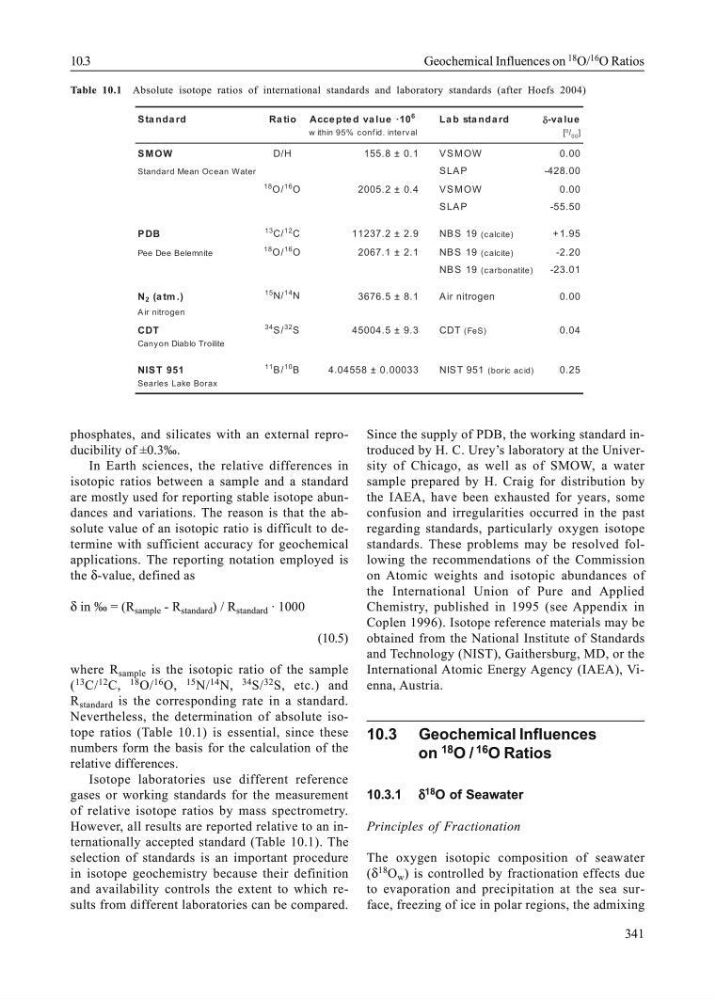
Nevertheless, the determination of absolute isotope ratios (Table 10.1) is essential, since these
numbers form the basis for the calculation of the
relative differences.
Isotope laboratories use different reference
gases or working standards for the measurement
of relative isotope ratios by mass spectrometry.
However, all results are reported relative to an internationally accepted standard (Table 10.1). The
selection of standards is an important procedure
in isotope geochemistry because their definition
and availability controls the extent to which results from different laboratories can be compared.
Since the supply of PDB, the working standard introduced by H. C. Urey’s laboratory at the University of Chicago, as well as of SMOW, a water
sample prepared by H. Craig for distribution by
the IAEA, have been exhausted for years, some
confusion and irregularities occurred in the past
regarding standards, particularly oxygen isotope
standards. These problems may be resolved following the recommendations of the Commission
on Atomic weights and isotopic abundances of
the International Union of Pure and Applied
Chemistry, published in 1995 (see Appendix in
Coplen 1996). Isotope reference materials may be
obtained from the National Institute of Standards
and Technology (NIST), Gaithersburg, MD, or the
International Atomic Energy Agency (IAEA), Vienna, Austria.
10.3 Geochemical Influences
on 18 O / 16 O Ratios
10.3.1 δ
δ δ
δ δ 18 O of Seawater
Principles of Fractionation
The oxygen isotopic composition of seawater
(δ 18 O w ) is controlled by fractionation effects due
to evaporation and precipitation at the sea surface, freezing of ice in polar regions, the admixing
Table 10.1 Absolute isotope ratios of international standards and laboratory standards (after Hoefs 2004)
S ta nda rd
Ra tio Acce pte d va lue ·10
6
La b sta nda rd
δ-va lue
w ithin 95% c onf id. interv al
[
0 / 00 ]
S M OW
D/H
155.8 ± 0.1
V S M OW
0.00
Standard Mean Oc ean Water
SLA P
-428.00
18 O/
16 O
2005.2 ± 0.4
VS M OW
0.00
SLA P
-55.50
P DB
13 C/
12 C
11237.2 ± 2.9
NB S 19 (calcite)
+1.95
Pee Dee Belemnite
18 O/
16 O
2067.1 ± 2.1
NB S 19 (calcite)
-2.20
NB S 19 (carbonatite)
-23.01
N 2 (a tm .)
15 N/
14 N
3676.5 ± 8.1
Air nitrogen
0.00
A ir nitrogen
CDT
34 S/
32 S
45004.5 ± 9.3
CDT (FeS)
0.04
Canyon Diablo Troilite
NIS T 951
11 B/
10 B
4.04558 ± 0.00033
NIS T 951 (boric ac id)
0.25
Searles Lake Borax
10.3
Geochemical Influences on 18 O/ 16 O Ratios
phosphates, and silicates with an external reproducibility of ±0.3‰.
In Earth sciences, the relative differences in
isotopic ratios between a sample and a standard
are mostly used for reporting stable isotope abundances and variations. The reason is that the absolute value of an isotopic ratio is difficult to determine with sufficient accuracy for geochemical
applications. The reporting notation employed is
the δ-value, defined as
δ in ‰ = (R sample - R standard ) / R standard · 1000
(10.5)
where R sample is the isotopic ratio of the sample
( 13 C/ 12 C, 18 O/ 16 O, 15 N/ 14 N, 34 S/ 32 S, etc.) and
R standard is the corresponding rate in a standard.
Nevertheless, the determination of absolute isotope ratios (Table 10.1) is essential, since these
numbers form the basis for the calculation of the
relative differences.
Isotope laboratories use different reference
gases or working standards for the measurement
of relative isotope ratios by mass spectrometry.
However, all results are reported relative to an internationally accepted standard (Table 10.1). The
selection of standards is an important procedure
in isotope geochemistry because their definition
and availability controls the extent to which results from different laboratories can be compared.
Since the supply of PDB, the working standard introduced by H. C. Urey’s laboratory at the University of Chicago, as well as of SMOW, a water
sample prepared by H. Craig for distribution by
the IAEA, have been exhausted for years, some
confusion and irregularities occurred in the past
regarding standards, particularly oxygen isotope
standards. These problems may be resolved following the recommendations of the Commission
on Atomic weights and isotopic abundances of
the International Union of Pure and Applied
Chemistry, published in 1995 (see Appendix in
Coplen 1996). Isotope reference materials may be
obtained from the National Institute of Standards
and Technology (NIST), Gaithersburg, MD, or the
International Atomic Energy Agency (IAEA), Vienna, Austria.
10.3 Geochemical Influences
on 18 O / 16 O Ratios
10.3.1 δ
δ δ
δ δ 18 O of Seawater
Principles of Fractionation
The oxygen isotopic composition of seawater
(δ 18 O w ) is controlled by fractionation effects due
to evaporation and precipitation at the sea surface, freezing of ice in polar regions, the admixing
Table 10.1 Absolute isotope ratios of international standards and laboratory standards (after Hoefs 2004)
S ta nda rd
Ra tio Acce pte d va lue ·10
6
La b sta nda rd
δ-va lue
w ithin 95% c onf id. interv al
[
0 / 00 ]
S M OW
D/H
155.8 ± 0.1
V S M OW
0.00
Standard Mean Oc ean Water
SLA P
-428.00
18 O/
16 O
2005.2 ± 0.4
VS M OW
0.00
SLA P
-55.50
P DB
13 C/
12 C
11237.2 ± 2.9
NB S 19 (calcite)
+1.95
Pee Dee Belemnite
18 O/
16 O
2067.1 ± 2.1
NB S 19 (calcite)
-2.20
NB S 19 (carbonatite)
-23.01
N 2 (a tm .)
15 N/
14 N
3676.5 ± 8.1
Air nitrogen
0.00
A ir nitrogen
CDT
34 S/
32 S
45004.5 ± 9.3
CDT (FeS)
0.04
Canyon Diablo Troilite
NIS T 951
11 B/
10 B
4.04558 ± 0.00033
NIS T 951 (boric ac id)
0.25
Searles Lake Borax