

9
Marine Carbonates: Their Formation and Destruction
332
field of bottom water ∆CO 3
2data (Archer 1996a)
has been used and C org -mineralization rates from
the grid of oxygen consumption rates after Jahnke
(1996) have been calculated, assuming a Redfield
ratio of decomposed organic material. The global
sea floor area above the lysocline was estimated
to about 7.4 · 10
7
km
2
(corresponding to ~20 % of
the total ocean area) and the dissolution flux sums
up to about 5.7 · 10
12
mol CaCO 3 .
Taking into account more recent estimates for
the global oxygen demand of the seafloor (i.e.
Wenzhöfer and Glud 2002) respiratory driven
calcite dissolution can be expected to be 50 %
higher in total. Compared to Archer’s study in
1996 (see Table 9.7), this would add ~10-20 % to
the total estimate.
In comparison with the study of Archer
(1996b), the estimate of Milliman et al. (1999)
clearly underestimates the total benthic CaCO 3 -
dissolution. Actually, simply using the Archerflux would help to resolve a long lasting debate
and balances – more or less – the overall budget
shown in Fig 9.5.
Milliman et al. (1999) postulated an enormous
loss of CaCO 3 in the upper water column for, to
date, unknown reasons. Jansen et al. (2002)
used a numerical model in order to investigate and
predict, whether such a loss could be attributed to
respiration-driven dissolution of skeletal material
in microenvironments of sinking detritus.
Although the efficiency of this process is largely
dependent on the sinking velocity and the size of
the sinking spheres or particles, these authors
could show that this pathway of carbonate
dissolution does not account significantly to the
overall loss as observed by Milliman et al. (1999).
Applying Equation 9.22 for the total sea floor
area should give a reasonable estimate for the
metabolically induced CaCO 3 -dissolution on a
global scale, even though this must be less than
the total dissolution flux from respiration and
bottom water undersaturation. The application
C org -mineralization rates derived from various
estimates of the global oxygen consumption in
deep-sea sediments (Jahnke 1996; Christensen
2000; Wenzhöfer and Glud 2002; Seiter et al. 2005)
results in global fluxes of CaCO 3 -dissolution
between 14.8 · 10
12
and 47.2 · 10
12
mol yr
-1
. These
comparatively low efficiencies of CaCO 3 dissolution in combination with a wide range of estimates are the result of the significant threshold
value of about 8 µmol cm
-2
yr
-1
before CaCO 3
dissolution is initiated (Fig. 9.9). More precisely,
the low average mineralization rates of 12.9 µmol
cm
-2
yr
-1
as derived from the lowest estimate by
Jahnke (1996) would proportionally be much less
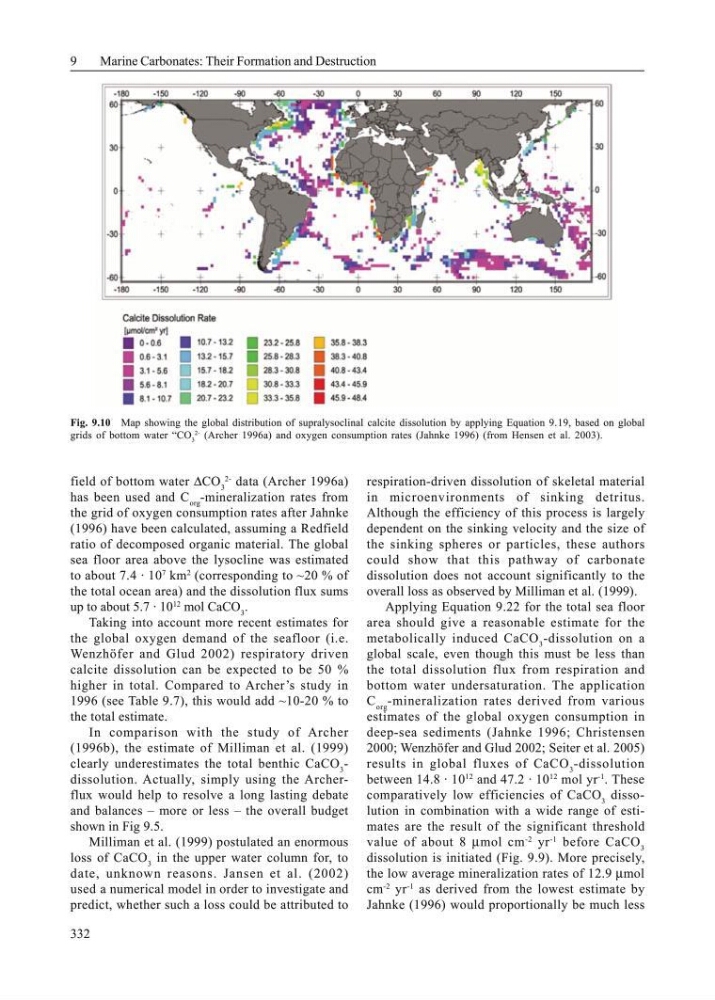
Fig. 9.10 Map showing the global distribution of supralysoclinal calcite dissolution by applying Equation 9.19, based on global
grids of bottom water “CO 3
2- (Archer 1996a) and oxygen consumption rates (Jahnke 1996) (from Hensen et al. 2003).
Marine Carbonates: Their Formation and Destruction
332
field of bottom water ∆CO 3
2data (Archer 1996a)
has been used and C org -mineralization rates from
the grid of oxygen consumption rates after Jahnke
(1996) have been calculated, assuming a Redfield
ratio of decomposed organic material. The global
sea floor area above the lysocline was estimated
to about 7.4 · 10
7
km
2
(corresponding to ~20 % of
the total ocean area) and the dissolution flux sums
up to about 5.7 · 10
12
mol CaCO 3 .
Taking into account more recent estimates for
the global oxygen demand of the seafloor (i.e.
Wenzhöfer and Glud 2002) respiratory driven
calcite dissolution can be expected to be 50 %
higher in total. Compared to Archer’s study in
1996 (see Table 9.7), this would add ~10-20 % to
the total estimate.
In comparison with the study of Archer
(1996b), the estimate of Milliman et al. (1999)
clearly underestimates the total benthic CaCO 3 -
dissolution. Actually, simply using the Archerflux would help to resolve a long lasting debate
and balances – more or less – the overall budget
shown in Fig 9.5.
Milliman et al. (1999) postulated an enormous
loss of CaCO 3 in the upper water column for, to
date, unknown reasons. Jansen et al. (2002)
used a numerical model in order to investigate and
predict, whether such a loss could be attributed to
respiration-driven dissolution of skeletal material
in microenvironments of sinking detritus.
Although the efficiency of this process is largely
dependent on the sinking velocity and the size of
the sinking spheres or particles, these authors
could show that this pathway of carbonate
dissolution does not account significantly to the
overall loss as observed by Milliman et al. (1999).
Applying Equation 9.22 for the total sea floor
area should give a reasonable estimate for the
metabolically induced CaCO 3 -dissolution on a
global scale, even though this must be less than
the total dissolution flux from respiration and
bottom water undersaturation. The application
C org -mineralization rates derived from various
estimates of the global oxygen consumption in
deep-sea sediments (Jahnke 1996; Christensen
2000; Wenzhöfer and Glud 2002; Seiter et al. 2005)
results in global fluxes of CaCO 3 -dissolution
between 14.8 · 10
12
and 47.2 · 10
12
mol yr
-1
. These
comparatively low efficiencies of CaCO 3 dissolution in combination with a wide range of estimates are the result of the significant threshold
value of about 8 µmol cm
-2
yr
-1
before CaCO 3
dissolution is initiated (Fig. 9.9). More precisely,
the low average mineralization rates of 12.9 µmol
cm
-2
yr
-1
as derived from the lowest estimate by
Jahnke (1996) would proportionally be much less
Fig. 9.10 Map showing the global distribution of supralysoclinal calcite dissolution by applying Equation 9.19, based on global
grids of bottom water “CO 3
2- (Archer 1996a) and oxygen consumption rates (Jahnke 1996) (from Hensen et al. 2003).