

9
Marine Carbonates: Their Formation and Destruction
330
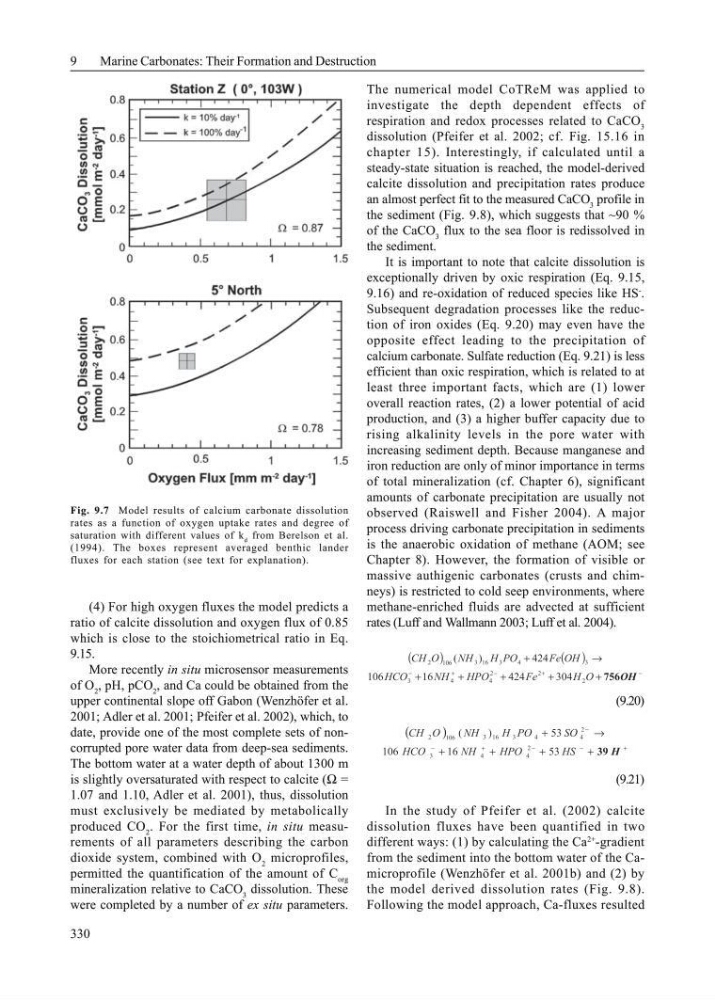
(4) For high oxygen fluxes the model predicts a
ratio of calcite dissolution and oxygen flux of 0.85
which is close to the stoichiometrical ratio in Eq.
9.15.
More recently in situ microsensor measurements
of O 2 , pH, pCO 2 , and Ca could be obtained from the
upper continental slope off Gabon (Wenzhöfer et al.
2001; Adler et al. 2001; Pfeifer et al. 2002), which, to
date, provide one of the most complete sets of noncorrupted pore water data from deep-sea sediments.
The bottom water at a water depth of about 1300 m
is slightly oversaturated with respect to calcite (Ω =
1.07 and 1.10, Adler et al. 2001), thus, dissolution
must exclusively be mediated by metabolically
produced CO 2 . For the first time, in situ measurements of all parameters describing the carbon
dioxide system, combined with O 2 microprofiles,
permitted the quantification of the amount of C org
mineralization relative to CaCO 3 dissolution. These
were completed by a number of ex situ parameters.
The numerical model CoTReM was applied to
investigate the depth dependent effects of
respiration and redox processes related to CaCO 3
dissolution (Pfeifer et al. 2002; cf. Fig. 15.16 in
chapter 15). Interestingly, if calculated until a
steady-state situation is reached, the model-derived
calcite dissolution and precipitation rates produce
an almost perfect fit to the measured CaCO 3 profile in
the sediment (Fig. 9.8), which suggests that ~90 %
of the CaCO 3 flux to the sea floor is redissolved in
the sediment.
It is important to note that calcite dissolution is
exceptionally driven by oxic respiration (Eq. 9.15,
9.16) and re-oxidation of reduced species like HS
-
.
Subsequent degradation processes like the reduction of iron oxides (Eq. 9.20) may even have the
opposite effect leading to the precipitation of
calcium carbonate. Sulfate reduction (Eq. 9.21) is less
efficient than oxic respiration, which is related to at
least three important facts, which are (1) lower
overall reaction rates, (2) a lower potential of acid
production, and (3) a higher buffer capacity due to
rising alkalinity levels in the pore water with
increasing sediment depth. Because manganese and
iron reduction are only of minor importance in terms
of total mineralization (cf. Chapter 6), significant
amounts of carbonate precipitation are usually not
observed (Raiswell and Fisher 2004). A major
process driving carbonate precipitation in sediments
is the anaerobic oxidation of methane (AOM; see
Chapter 8). However, the formation of visible or
massive authigenic carbonates (crusts and chimneys) is restricted to cold seep environments, where
methane-enriched fluids are advected at sufficient
rates (Luff and Wallmann 2003; Luff et al. 2004).
(9.20)
(9.21)
In the study of Pfeifer et al. (2002) calcite
dissolution fluxes have been quantified in two
different ways: (1) by calculating the Ca
2+
-gradient
from the sediment into the bottom water of the Camicroprofile (Wenzhöfer et al. 2001b) and (2) by
the model derived dissolution rates (Fig. 9.8).
Following the model approach, Ca-fluxes resulted
Fig. 9.7 Model results of calcium carbonate dissolution
rates as a function of oxygen uptake rates and degree of
saturation with different values of k d from Berelson et al.
(1994). The boxes represent averaged benthic lander
fluxes for each station (see text for explanation).
(
)
( )
−
+
−
+
−
+
+
+
+
+
→
+
OH
756
O
H
Fe
HPO
NH
HCO
OH
Fe
PO
H
NH
O
CH
2
2
2
4
4
3
3
4
3
16
3
106
2
304
424
16
106
424
)
(
(
)
+
−
−
+
−
−
+
+
+
+
→
+
H
39
HS
HPO
NH
HCO
SO
PO
H
NH
O
CH
53
16
106
53
)
(
2
4
4
3
2
4
4
3
16
3
106
2
Marine Carbonates: Their Formation and Destruction
330
(4) For high oxygen fluxes the model predicts a
ratio of calcite dissolution and oxygen flux of 0.85
which is close to the stoichiometrical ratio in Eq.
9.15.
More recently in situ microsensor measurements
of O 2 , pH, pCO 2 , and Ca could be obtained from the
upper continental slope off Gabon (Wenzhöfer et al.
2001; Adler et al. 2001; Pfeifer et al. 2002), which, to
date, provide one of the most complete sets of noncorrupted pore water data from deep-sea sediments.
The bottom water at a water depth of about 1300 m
is slightly oversaturated with respect to calcite (Ω =
1.07 and 1.10, Adler et al. 2001), thus, dissolution
must exclusively be mediated by metabolically
produced CO 2 . For the first time, in situ measurements of all parameters describing the carbon
dioxide system, combined with O 2 microprofiles,
permitted the quantification of the amount of C org
mineralization relative to CaCO 3 dissolution. These
were completed by a number of ex situ parameters.
The numerical model CoTReM was applied to
investigate the depth dependent effects of
respiration and redox processes related to CaCO 3
dissolution (Pfeifer et al. 2002; cf. Fig. 15.16 in
chapter 15). Interestingly, if calculated until a
steady-state situation is reached, the model-derived
calcite dissolution and precipitation rates produce
an almost perfect fit to the measured CaCO 3 profile in
the sediment (Fig. 9.8), which suggests that ~90 %
of the CaCO 3 flux to the sea floor is redissolved in
the sediment.
It is important to note that calcite dissolution is
exceptionally driven by oxic respiration (Eq. 9.15,
9.16) and re-oxidation of reduced species like HS
-
.
Subsequent degradation processes like the reduction of iron oxides (Eq. 9.20) may even have the
opposite effect leading to the precipitation of
calcium carbonate. Sulfate reduction (Eq. 9.21) is less
efficient than oxic respiration, which is related to at
least three important facts, which are (1) lower
overall reaction rates, (2) a lower potential of acid
production, and (3) a higher buffer capacity due to
rising alkalinity levels in the pore water with
increasing sediment depth. Because manganese and
iron reduction are only of minor importance in terms
of total mineralization (cf. Chapter 6), significant
amounts of carbonate precipitation are usually not
observed (Raiswell and Fisher 2004). A major
process driving carbonate precipitation in sediments
is the anaerobic oxidation of methane (AOM; see
Chapter 8). However, the formation of visible or
massive authigenic carbonates (crusts and chimneys) is restricted to cold seep environments, where
methane-enriched fluids are advected at sufficient
rates (Luff and Wallmann 2003; Luff et al. 2004).
(9.20)
(9.21)
In the study of Pfeifer et al. (2002) calcite
dissolution fluxes have been quantified in two
different ways: (1) by calculating the Ca
2+
-gradient
from the sediment into the bottom water of the Camicroprofile (Wenzhöfer et al. 2001b) and (2) by
the model derived dissolution rates (Fig. 9.8).
Following the model approach, Ca-fluxes resulted
Fig. 9.7 Model results of calcium carbonate dissolution
rates as a function of oxygen uptake rates and degree of
saturation with different values of k d from Berelson et al.
(1994). The boxes represent averaged benthic lander
fluxes for each station (see text for explanation).
(
)
( )
−
+
−
+
−
+
+
+
+
+
→
+
OH
756
O
H
Fe
HPO
NH
HCO
OH
Fe
PO
H
NH
O
CH
2
2
2
4
4
3
3
4
3
16
3
106
2
304
424
16
106
424
)
(
(
)
+
−
−
+
−
−
+
+
+
+
→
+
H
39
HS
HPO
NH
HCO
SO
PO
H
NH
O
CH
53
16
106
53
)
(
2
4
4
3
2
4
4
3
16
3
106
2