

9
Marine Carbonates: Their Formation and Destruction
328
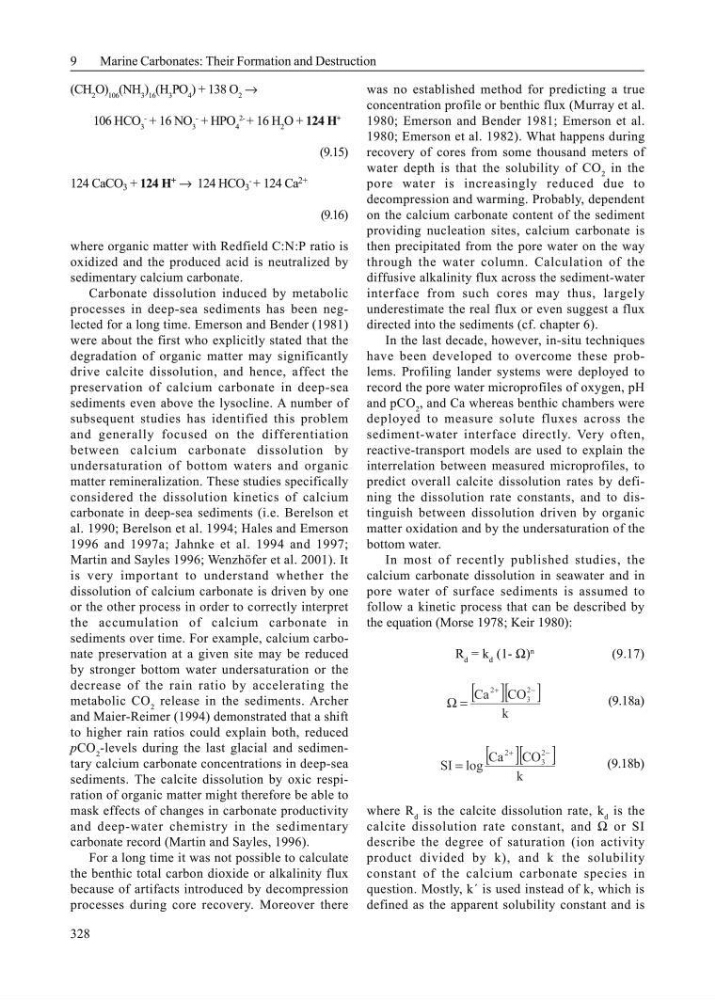
(CH 2 O) 106 (NH 3 ) 16 (H 3 PO 4 ) + 138 O 2 →
106 HCO 3
-
+ 16 NO 3
-
+ HPO 4
2+ 16 H 2 O + 124 H
+
(9.15)
124 CaCO 3 + 124 H + → 124 HCO 3
-
+ 124 Ca 2+
(9.16)
where organic matter with Redfield C:N:P ratio is
oxidized and the produced acid is neutralized by
sedimentary calcium carbonate.
Carbonate dissolution induced by metabolic
processes in deep-sea sediments has been neglected for a long time. Emerson and Bender (1981)
were about the first who explicitly stated that the
degradation of organic matter may significantly
drive calcite dissolution, and hence, affect the
preservation of calcium carbonate in deep-sea
sediments even above the lysocline. A number of
subsequent studies has identified this problem
and generally focused on the differentiation
between calcium carbonate dissolution by
undersaturation of bottom waters and organic
matter remineralization. These studies specifically
considered the dissolution kinetics of calcium
carbonate in deep-sea sediments (i.e. Berelson et
al. 1990; Berelson et al. 1994; Hales and Emerson
1996 and 1997a; Jahnke et al. 1994 and 1997;
Martin and Sayles 1996; Wenzhöfer et al. 2001). It
is very important to understand whether the
dissolution of calcium carbonate is driven by one
or the other process in order to correctly interpret
the accumulation of calcium carbonate in
sediments over time. For example, calcium carbonate preservation at a given site may be reduced
by stronger bottom water undersaturation or the
decrease of the rain ratio by accelerating the
metabolic CO 2 release in the sediments. Archer
and Maier-Reimer (1994) demonstrated that a shift
to higher rain ratios could explain both, reduced
pCO 2 -levels during the last glacial and sedimentary calcium carbonate concentrations in deep-sea
sediments. The calcite dissolution by oxic respiration of organic matter might therefore be able to
mask effects of changes in carbonate productivity
and deep-water chemistry in the sedimentary
carbonate record (Martin and Sayles, 1996).
For a long time it was not possible to calculate
the benthic total carbon dioxide or alkalinity flux
because of artifacts introduced by decompression
processes during core recovery. Moreover there
was no established method for predicting a true
concentration profile or benthic flux (Murray et al.
1980; Emerson and Bender 1981; Emerson et al.
1980; Emerson et al. 1982). What happens during
recovery of cores from some thousand meters of
water depth is that the solubility of CO 2 in the
pore water is increasingly reduced due to
decompression and warming. Probably, dependent
on the calcium carbonate content of the sediment
providing nucleation sites, calcium carbonate is
then precipitated from the pore water on the way
through the water column. Calculation of the
diffusive alkalinity flux across the sediment-water
interface from such cores may thus, largely
underestimate the real flux or even suggest a flux
directed into the sediments (cf. chapter 6).
In the last decade, however, in-situ techniques
have been developed to overcome these problems. Profiling lander systems were deployed to
record the pore water microprofiles of oxygen, pH
and pCO 2 , and Ca whereas benthic chambers were
deployed to measure solute fluxes across the
sediment-water interface directly. Very often,
reactive-transport models are used to explain the
interrelation between measured microprofiles, to
predict overall calcite dissolution rates by defining the dissolution rate constants, and to distinguish between dissolution driven by organic
matter oxidation and by the undersaturation of the
bottom water.
In most of recently published studies, the
calcium carbonate dissolution in seawater and in
pore water of surface sediments is assumed to
follow a kinetic process that can be described by
the equation (Morse 1978; Keir 1980):
R d = k d (1- Ω)
n
(9.17)
(9.18a)
(9.18b)
where R d is the calcite dissolution rate, k d is the
calcite dissolution rate constant, and Ω or SI
describe the degree of saturation (ion activity
product divided by k), and k the solubility
constant of the calcium carbonate species in
question. Mostly, k´ is used instead of k, which is
defined as the apparent solubility constant and is
[ ][ ]
k
CO
Ca
log
SI
2
3
2
−
+
=
[ ][ ]
k
CO
Ca
2
3
2
−
+
=
Ω
Marine Carbonates: Their Formation and Destruction
328
(CH 2 O) 106 (NH 3 ) 16 (H 3 PO 4 ) + 138 O 2 →
106 HCO 3
-
+ 16 NO 3
-
+ HPO 4
2+ 16 H 2 O + 124 H
+
(9.15)
124 CaCO 3 + 124 H + → 124 HCO 3
-
+ 124 Ca 2+
(9.16)
where organic matter with Redfield C:N:P ratio is
oxidized and the produced acid is neutralized by
sedimentary calcium carbonate.
Carbonate dissolution induced by metabolic
processes in deep-sea sediments has been neglected for a long time. Emerson and Bender (1981)
were about the first who explicitly stated that the
degradation of organic matter may significantly
drive calcite dissolution, and hence, affect the
preservation of calcium carbonate in deep-sea
sediments even above the lysocline. A number of
subsequent studies has identified this problem
and generally focused on the differentiation
between calcium carbonate dissolution by
undersaturation of bottom waters and organic
matter remineralization. These studies specifically
considered the dissolution kinetics of calcium
carbonate in deep-sea sediments (i.e. Berelson et
al. 1990; Berelson et al. 1994; Hales and Emerson
1996 and 1997a; Jahnke et al. 1994 and 1997;
Martin and Sayles 1996; Wenzhöfer et al. 2001). It
is very important to understand whether the
dissolution of calcium carbonate is driven by one
or the other process in order to correctly interpret
the accumulation of calcium carbonate in
sediments over time. For example, calcium carbonate preservation at a given site may be reduced
by stronger bottom water undersaturation or the
decrease of the rain ratio by accelerating the
metabolic CO 2 release in the sediments. Archer
and Maier-Reimer (1994) demonstrated that a shift
to higher rain ratios could explain both, reduced
pCO 2 -levels during the last glacial and sedimentary calcium carbonate concentrations in deep-sea
sediments. The calcite dissolution by oxic respiration of organic matter might therefore be able to
mask effects of changes in carbonate productivity
and deep-water chemistry in the sedimentary
carbonate record (Martin and Sayles, 1996).
For a long time it was not possible to calculate
the benthic total carbon dioxide or alkalinity flux
because of artifacts introduced by decompression
processes during core recovery. Moreover there
was no established method for predicting a true
concentration profile or benthic flux (Murray et al.
1980; Emerson and Bender 1981; Emerson et al.
1980; Emerson et al. 1982). What happens during
recovery of cores from some thousand meters of
water depth is that the solubility of CO 2 in the
pore water is increasingly reduced due to
decompression and warming. Probably, dependent
on the calcium carbonate content of the sediment
providing nucleation sites, calcium carbonate is
then precipitated from the pore water on the way
through the water column. Calculation of the
diffusive alkalinity flux across the sediment-water
interface from such cores may thus, largely
underestimate the real flux or even suggest a flux
directed into the sediments (cf. chapter 6).
In the last decade, however, in-situ techniques
have been developed to overcome these problems. Profiling lander systems were deployed to
record the pore water microprofiles of oxygen, pH
and pCO 2 , and Ca whereas benthic chambers were
deployed to measure solute fluxes across the
sediment-water interface directly. Very often,
reactive-transport models are used to explain the
interrelation between measured microprofiles, to
predict overall calcite dissolution rates by defining the dissolution rate constants, and to distinguish between dissolution driven by organic
matter oxidation and by the undersaturation of the
bottom water.
In most of recently published studies, the
calcium carbonate dissolution in seawater and in
pore water of surface sediments is assumed to
follow a kinetic process that can be described by
the equation (Morse 1978; Keir 1980):
R d = k d (1- Ω)
n
(9.17)
(9.18a)
(9.18b)
where R d is the calcite dissolution rate, k d is the
calcite dissolution rate constant, and Ω or SI
describe the degree of saturation (ion activity
product divided by k), and k the solubility
constant of the calcium carbonate species in
question. Mostly, k´ is used instead of k, which is
defined as the apparent solubility constant and is
[ ][ ]
k
CO
Ca
log
SI
2
3
2
−
+
=
[ ][ ]
k
CO
Ca
2
3
2
−
+
=
Ω