

317
(15 to 20 %; see Table 9.1, or Archer 1996b,
Wollast 1994) of the total amount of pelagic
carbonates produced in the upper ocean is
buried in deep-sea sediments. Different estimates
for mean global calcium carbonate accumulation
rates from various authors (Milliman 1993; Morse
and Mackenzie 1990; Wollast and Mackenzie
1987) are in good agreement for the deep sea, all
ranging between 10⋅10
12
mol yr
-1
and 12⋅10
12
mol
yr
-1
(1 to 1.2 bt CaCO 3 yr
-1
).
Essentially all the above mentioned factors
have the potential to change the calcite-carbonate
equilibrium in the ocean over time and thus exert
major control on the distribution and amount of
calcareous sediments in the deep sea. On the
other hand, given the 60 times greater carbon reservoir of the ocean compared to that of the atmosphere, changes in the oceanic calcite-carbonate
equilibrium can modify the oceanic CO 2 uptake/release balance with respect to the atmosphere (Archer and Maier-Reimer 1994; Berger 1982; Broecker
and Peng 1987; Maier-Reimer and Bacastow 1990;
Opdyke and Walker 1992; Siegenthaler and Wenk
1984; Wolf-Gladrow 1994; see also review in Dittert
et al. 1999). Therefore, the principles of the calcitecarbonate system will be re-examined in the
following Section 9.3 and examples will be given for
modeling this system under specific boundary
conditions typical for the modern ocean. As we
know from the geological record of calcareous
sediment distribution, this system has changed
dramatically in the past and definitely will change in
the future, leaving us with the questions of how
much, how fast and in which direction the ocean
carbonate system will respond to anthropogenic
disturbances of the carbon cycle in the future, which
may result in a more acid ocean (Feely et al. 2004, Orr
et al. 2005).
9.3
The Calcite-CarbonateEquilibrium in Marine Aquatic
Systems
The calcite-carbonate-equilibrium is of particular
importance in aquatic systems wherever carbon
dioxide is released into water by various processes, and wherever a concurrent contact with
calcite (or other carbonate minerals) buffers the
system by processes of dissolution/precipitation.
Carbon dioxide may either originate from the gaseous exchange with the atmosphere, or is formed
during the oxidation of organic matter. In such a
system this equilibrium controls the pH-value - an
essential system parameter which, directly or
indirectly, influences a number of secondary processes, e.g. on iron (cf. Chap. 7) and on manganese (cf. Chap. 11). In the following, the calcitecarbonate equilibrium will be described in more
detail and with special attention given to its relevant primary reactions.
The description of Sections 9.3.1 and 9.3.2 will
assume in principle a solution at infinite dilution
in order to reduce the system to really important
reactions. The Sections 9.3.3 and 9.3.4 provide
examples calculated for seawater, including all
constituents of quantitative importance. In such
calculations, two different approaches are possible:
The use of measured concentrations (calcium,
carbonate, pH) together with so-called 'apparent'
equilibrium constants. These apparent constants
(e.g. Goyet and Poisson 1989; Roy et al. 1993;
Millero 1995) take the difference between activities and concentrations into account, as well as
9.3
The Calcite-Carbonate-Equilibrium in Marine Aquatic Systems
Depth [km]
1
2
3
4
5
6
7
Depth [km]
0
1
2
3
4
5
6
7
NA
SA
AA
SI
SP
NI
NP
NA
SA
AA
SI SP
NI
NP
2250
2300
2350
2400
2450
2000
2100
2200
2300
2400
ΣCO 2 [µM/kg]
A t [µeq/kg]
a)
b)
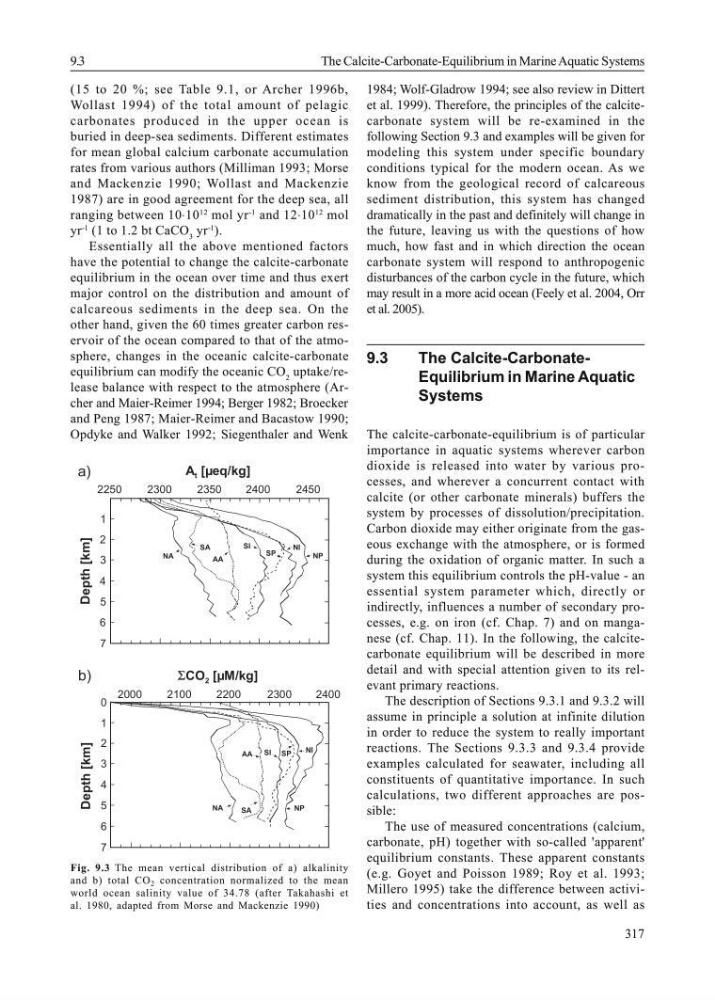
Fig. 9.3 The mean vertical distribution of a) alkalinity
and b) total CO 2 concentration normalized to the mean
world ocean salinity value of 34.78 (after Takahashi et
al. 1980, adapted from Morse and Mackenzie 1990)
(15 to 20 %; see Table 9.1, or Archer 1996b,
Wollast 1994) of the total amount of pelagic
carbonates produced in the upper ocean is
buried in deep-sea sediments. Different estimates
for mean global calcium carbonate accumulation
rates from various authors (Milliman 1993; Morse
and Mackenzie 1990; Wollast and Mackenzie
1987) are in good agreement for the deep sea, all
ranging between 10⋅10
12
mol yr
-1
and 12⋅10
12
mol
yr
-1
(1 to 1.2 bt CaCO 3 yr
-1
).
Essentially all the above mentioned factors
have the potential to change the calcite-carbonate
equilibrium in the ocean over time and thus exert
major control on the distribution and amount of
calcareous sediments in the deep sea. On the
other hand, given the 60 times greater carbon reservoir of the ocean compared to that of the atmosphere, changes in the oceanic calcite-carbonate
equilibrium can modify the oceanic CO 2 uptake/release balance with respect to the atmosphere (Archer and Maier-Reimer 1994; Berger 1982; Broecker
and Peng 1987; Maier-Reimer and Bacastow 1990;
Opdyke and Walker 1992; Siegenthaler and Wenk
1984; Wolf-Gladrow 1994; see also review in Dittert
et al. 1999). Therefore, the principles of the calcitecarbonate system will be re-examined in the
following Section 9.3 and examples will be given for
modeling this system under specific boundary
conditions typical for the modern ocean. As we
know from the geological record of calcareous
sediment distribution, this system has changed
dramatically in the past and definitely will change in
the future, leaving us with the questions of how
much, how fast and in which direction the ocean
carbonate system will respond to anthropogenic
disturbances of the carbon cycle in the future, which
may result in a more acid ocean (Feely et al. 2004, Orr
et al. 2005).
9.3
The Calcite-CarbonateEquilibrium in Marine Aquatic
Systems
The calcite-carbonate-equilibrium is of particular
importance in aquatic systems wherever carbon
dioxide is released into water by various processes, and wherever a concurrent contact with
calcite (or other carbonate minerals) buffers the
system by processes of dissolution/precipitation.
Carbon dioxide may either originate from the gaseous exchange with the atmosphere, or is formed
during the oxidation of organic matter. In such a
system this equilibrium controls the pH-value - an
essential system parameter which, directly or
indirectly, influences a number of secondary processes, e.g. on iron (cf. Chap. 7) and on manganese (cf. Chap. 11). In the following, the calcitecarbonate equilibrium will be described in more
detail and with special attention given to its relevant primary reactions.
The description of Sections 9.3.1 and 9.3.2 will
assume in principle a solution at infinite dilution
in order to reduce the system to really important
reactions. The Sections 9.3.3 and 9.3.4 provide
examples calculated for seawater, including all
constituents of quantitative importance. In such
calculations, two different approaches are possible:
The use of measured concentrations (calcium,
carbonate, pH) together with so-called 'apparent'
equilibrium constants. These apparent constants
(e.g. Goyet and Poisson 1989; Roy et al. 1993;
Millero 1995) take the difference between activities and concentrations into account, as well as
9.3
The Calcite-Carbonate-Equilibrium in Marine Aquatic Systems
Depth [km]
1
2
3
4
5
6
7
Depth [km]
0
1
2
3
4
5
6
7
NA
SA
AA
SI
SP
NI
NP
NA
SA
AA
SI SP
NI
NP
2250
2300
2350
2400
2450
2000
2100
2200
2300
2400
ΣCO 2 [µM/kg]
A t [µeq/kg]
a)
b)
Fig. 9.3 The mean vertical distribution of a) alkalinity
and b) total CO 2 concentration normalized to the mean
world ocean salinity value of 34.78 (after Takahashi et
al. 1980, adapted from Morse and Mackenzie 1990)