

299
radiotracer experiment generally lasts for only a
few hours to a day and little reoxidation of
produced
35
S-sulfide takes place during this time
interval, unless the sediment is rich in reactive
oxidized iron which may be the case in the suboxic
zone near the sediment surface. The measurement
should be kept short in order to minimize changes
in the chemistry or microbial activity of the
sediment under the laboratory conditions used.
This is an important criterion for the use of
radiotracer instead of just following the gradual
disappearence of pore water sulfate over time as
has been used earlier and is still applied when
safety considerations prohibit the use of radiotracer. Tracking the sulfate concentration over
time is, however, a rather insensitive method that
mostly requires incubations over many days or
weeks during which significant changes in measured rates occur.
Another approach is based on the experiment
that nature has already done, namely by generating decreasing sulfate concentrations down
through the sediment column due to sulfate
reduction acting over many years. The resulting
pore water profile of sulfate reflects the rate of net
SRR, which represents the gross SRR minus the
(long-term) rate of reoxidation of reduced sulfur
species back to sulfate. Such profiles, combined
with solid-phase data on the sulfur chemistry and
organic carbon content, have been used to
calculate the distribution of sulfate reduction over
longer periods by 1-dimensional reactiontransport modeling (e.g., Berner 1980; Canfield
1991; Schulz et al. 1994). Modeling of the net SRR
generally assumes steady state conditions of
reduction rate, transport and sedimentation and
requires qualified information on the transport
coefficients of pore water species down through
the sediment column. Since disturbing factors
such as burrow irrigation by the benthic macrofauna or current-induced advective pore water
flow may strongly enhance transport in addition
to molecular diffusion, it is mostly difficult to
provide accurate transport coefficients in the
near-surface sediment. At depth in the sediment,
however, molecular diffusion and steady state are
more likely to prevail. Here the modeling approach
has its obvious strength relative to the radiotracer
measurements that are increasingly prone to
disturbance artifacts the deeper in the sediment
the samples are taken.
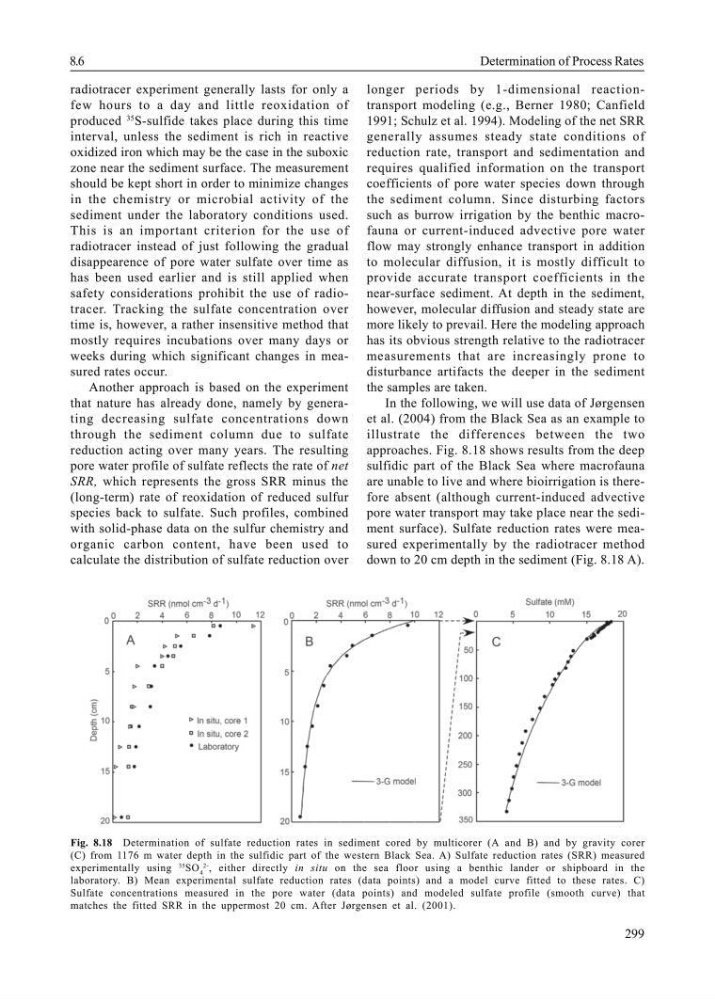
In the following, we will use data of Jørgensen
et al. (2004) from the Black Sea as an example to
illustrate the differences between the two
approaches. Fig. 8.18 shows results from the deep
sulfidic part of the Black Sea where macrofauna
are unable to live and where bioirrigation is therefore absent (although current-induced advective
pore water transport may take place near the sediment surface). Sulfate reduction rates were measured experimentally by the radiotracer method
down to 20 cm depth in the sediment (Fig. 8.18 A).
Fig. 8.18 Determination of sulfate reduction rates in sediment cored by multicorer (A and B) and by gravity corer
(C) from 1176 m water depth in the sulfidic part of the western Black Sea. A) Sulfate reduction rates (SRR) measured
experimentally using
35 SO 4
2- , either directly in situ on the sea floor using a benthic lander or shipboard in the
laboratory. B) Mean experimental sulfate reduction rates (data points) and a model curve fitted to these rates. C)
Sulfate concentrations measured in the pore water (data points) and modeled sulfate profile (smooth curve) that
matches the fitted SRR in the uppermost 20 cm. After Jørgensen et al. (2001).
8.6
Determination of Process Rates
radiotracer experiment generally lasts for only a
few hours to a day and little reoxidation of
produced
35
S-sulfide takes place during this time
interval, unless the sediment is rich in reactive
oxidized iron which may be the case in the suboxic
zone near the sediment surface. The measurement
should be kept short in order to minimize changes
in the chemistry or microbial activity of the
sediment under the laboratory conditions used.
This is an important criterion for the use of
radiotracer instead of just following the gradual
disappearence of pore water sulfate over time as
has been used earlier and is still applied when
safety considerations prohibit the use of radiotracer. Tracking the sulfate concentration over
time is, however, a rather insensitive method that
mostly requires incubations over many days or
weeks during which significant changes in measured rates occur.
Another approach is based on the experiment
that nature has already done, namely by generating decreasing sulfate concentrations down
through the sediment column due to sulfate
reduction acting over many years. The resulting
pore water profile of sulfate reflects the rate of net
SRR, which represents the gross SRR minus the
(long-term) rate of reoxidation of reduced sulfur
species back to sulfate. Such profiles, combined
with solid-phase data on the sulfur chemistry and
organic carbon content, have been used to
calculate the distribution of sulfate reduction over
longer periods by 1-dimensional reactiontransport modeling (e.g., Berner 1980; Canfield
1991; Schulz et al. 1994). Modeling of the net SRR
generally assumes steady state conditions of
reduction rate, transport and sedimentation and
requires qualified information on the transport
coefficients of pore water species down through
the sediment column. Since disturbing factors
such as burrow irrigation by the benthic macrofauna or current-induced advective pore water
flow may strongly enhance transport in addition
to molecular diffusion, it is mostly difficult to
provide accurate transport coefficients in the
near-surface sediment. At depth in the sediment,
however, molecular diffusion and steady state are
more likely to prevail. Here the modeling approach
has its obvious strength relative to the radiotracer
measurements that are increasingly prone to
disturbance artifacts the deeper in the sediment
the samples are taken.
In the following, we will use data of Jørgensen
et al. (2004) from the Black Sea as an example to
illustrate the differences between the two
approaches. Fig. 8.18 shows results from the deep
sulfidic part of the Black Sea where macrofauna
are unable to live and where bioirrigation is therefore absent (although current-induced advective
pore water transport may take place near the sediment surface). Sulfate reduction rates were measured experimentally by the radiotracer method
down to 20 cm depth in the sediment (Fig. 8.18 A).
Fig. 8.18 Determination of sulfate reduction rates in sediment cored by multicorer (A and B) and by gravity corer
(C) from 1176 m water depth in the sulfidic part of the western Black Sea. A) Sulfate reduction rates (SRR) measured
experimentally using
35 SO 4
2- , either directly in situ on the sea floor using a benthic lander or shipboard in the
laboratory. B) Mean experimental sulfate reduction rates (data points) and a model curve fitted to these rates. C)
Sulfate concentrations measured in the pore water (data points) and modeled sulfate profile (smooth curve) that
matches the fitted SRR in the uppermost 20 cm. After Jørgensen et al. (2001).
8.6
Determination of Process Rates