

8
Sulfur Cycling and Methane Oxidation
272
sediments are (1) the bacterial reduction of sulfate
to hydrogen sulfide, which subsequently reacts
with iron to form sulfide minerals, particularly
pyrite (FeS 2 ), (2) the formation of organic sulfur,
i.e. the incorporation of sulfur into sedimentary
organic matter during early diagenesis, and (3) the
precipitation of calcium sulfate minerals in
evaporites (Vairavamurthy et al. 1995). With
respect to the relative importance of each
pathway, Vairavamurthy et al. (1995) point out that
although marine evaporites were important sinks
for sulfate from the Late Precambrian to the late
Tertiary, their rate of formation in today’s oceans,
over the last few million years, is quantitatively
insignificant. Thus, they conclude that the burial
of sulfide minerals and, to a less extent, of organic
sulfur represents the major sink for oceanic sulfur
in the modern ocean.
8.2
Sulfate Reduction and the
Degradation of Organic Matter
Throughout the water column of the ocean, ten
billion tons of organic particles derived from
plankton production in the photic surface layer
steadily sink towards the sea floor. The annual
deposition of organic material on the sea floor is
also about ten billion tons, i.e. of the same magnitude as the total organic particle pool in the
ocean. As the particles sink through the water
column, the organic material is gradually degraded
and respired back to CO 2 and nutrients by
zooplankton and by microorganisms. Thus, with
increasing distance from the coast and with
increasing water depth, a gradually decreasing
fraction of the sinking particles remains to
ultimately land on the sea floor. On the shallow
continental shelves this fraction is generally in
the range of 20-50% of the phytoplankton
productivity in the overlying water (Jørgensen
1983). In the deep sea the fraction is only 1-2%
(Jahnke 1996). Deep sea sediments, therefore, play
only a minor quantitative role in the oceanic
carbon and nutrient cycles, as the following discussion will show.
As the particulate organic matter is deposited
on the sea floor it is immediately attacked by a
broad range of organisms that all contribute to its
degradation and gradual mineralization. At the sediment surface, macrofauna plays a particular role by
mechanically disintegrating the detritus and by
mixing of the upper sediment layer through their
burrowing and feeding activity (bioturbation),
whereby the organic material becomes repeatedly
exposed to oxygen. The benthic fauna also irrigates
the burrows in order to transport oxygen down for
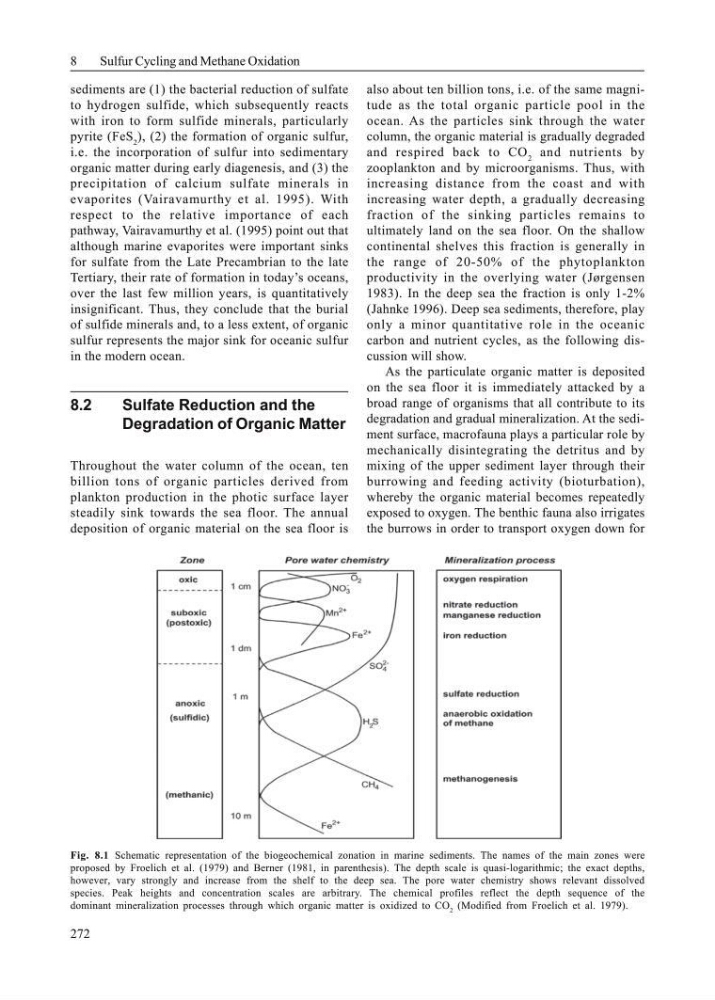
Fig. 8.1 Schematic representation of the biogeochemical zonation in marine sediments. The names of the main zones were
proposed by Froelich et al. (1979) and Berner (1981, in parenthesis). The depth scale is quasi-logarithmic; the exact depths,
however, vary strongly and increase from the shelf to the deep sea. The pore water chemistry shows relevant dissolved
species. Peak heights and concentration scales are arbitrary. The chemical profiles reflect the depth sequence of the
dominant mineralization processes through which organic matter is oxidized to CO 2 (Modified from Froelich et al. 1979).
Sulfur Cycling and Methane Oxidation
272
sediments are (1) the bacterial reduction of sulfate
to hydrogen sulfide, which subsequently reacts
with iron to form sulfide minerals, particularly
pyrite (FeS 2 ), (2) the formation of organic sulfur,
i.e. the incorporation of sulfur into sedimentary
organic matter during early diagenesis, and (3) the
precipitation of calcium sulfate minerals in
evaporites (Vairavamurthy et al. 1995). With
respect to the relative importance of each
pathway, Vairavamurthy et al. (1995) point out that
although marine evaporites were important sinks
for sulfate from the Late Precambrian to the late
Tertiary, their rate of formation in today’s oceans,
over the last few million years, is quantitatively
insignificant. Thus, they conclude that the burial
of sulfide minerals and, to a less extent, of organic
sulfur represents the major sink for oceanic sulfur
in the modern ocean.
8.2
Sulfate Reduction and the
Degradation of Organic Matter
Throughout the water column of the ocean, ten
billion tons of organic particles derived from
plankton production in the photic surface layer
steadily sink towards the sea floor. The annual
deposition of organic material on the sea floor is
also about ten billion tons, i.e. of the same magnitude as the total organic particle pool in the
ocean. As the particles sink through the water
column, the organic material is gradually degraded
and respired back to CO 2 and nutrients by
zooplankton and by microorganisms. Thus, with
increasing distance from the coast and with
increasing water depth, a gradually decreasing
fraction of the sinking particles remains to
ultimately land on the sea floor. On the shallow
continental shelves this fraction is generally in
the range of 20-50% of the phytoplankton
productivity in the overlying water (Jørgensen
1983). In the deep sea the fraction is only 1-2%
(Jahnke 1996). Deep sea sediments, therefore, play
only a minor quantitative role in the oceanic
carbon and nutrient cycles, as the following discussion will show.
As the particulate organic matter is deposited
on the sea floor it is immediately attacked by a
broad range of organisms that all contribute to its
degradation and gradual mineralization. At the sediment surface, macrofauna plays a particular role by
mechanically disintegrating the detritus and by
mixing of the upper sediment layer through their
burrowing and feeding activity (bioturbation),
whereby the organic material becomes repeatedly
exposed to oxygen. The benthic fauna also irrigates
the burrows in order to transport oxygen down for
Fig. 8.1 Schematic representation of the biogeochemical zonation in marine sediments. The names of the main zones were
proposed by Froelich et al. (1979) and Berner (1981, in parenthesis). The depth scale is quasi-logarithmic; the exact depths,
however, vary strongly and increase from the shelf to the deep sea. The pore water chemistry shows relevant dissolved
species. Peak heights and concentration scales are arbitrary. The chemical profiles reflect the depth sequence of the
dominant mineralization processes through which organic matter is oxidized to CO 2 (Modified from Froelich et al. 1979).