

263
7.5
The Assay for Ferric and Ferrous Iron
great variety of the quantitatively most important
iron bearing minerals / mineral groups is present
in marine sediments a series of different extractions is necessary in order to achieve a complete
distribution of ferrous and ferric iron. In general,
the extraction conditions applied to natural
sediments result from experiments conducted in
advance proving the dissolution of individual
minerals or mineral groups. Because the grain
size, degree of crystallinity, ionic substitution
within minerals and varying matrix constituents
influence the dissolution kinetics during the
extraction a clear-cut mineral specific determination is usually not possible with this approach.
Yet, extractions have been successfully applied to
show patterns of mineral (group) dissolution and
precipitation and to deduce reaction rates. For a
comparison with results of other studies exactly
Mineral
Oxalate
(1)
Ascorbate
(2)
Dithionite
(3)
HCl
(4)
HF/H2SO4
(5)
Cr(II)/ HCl
(6)
am. Fe(OH)3
+
(a)
34 - 72
(a)
+
(b)
Ferrihydrite
+
(b)
+
(c)
+
(b,c,d)
+
(b,c)
Lepidocrocite
+
(b)
+
(b)
7
(b)
Goethite
-
(a,b)
-
(c)
91
(c)
-
(a,b,c)
+
(g)
+
(b)
Hematite
-
(a,b)
-
(c)
63
(c)
-
(a,b,c)
+
(g)
+
(b,d,e)
Magnetite
60
(c)
-
(c)
90
(c)
-
(a,b,c)
+
(g)
-
(b)
(am.) FeS
+
(c)
+
(f )
+
(h)
Pyrite (FeS2)
-
(b,f )
+
(h)
Chlorite
-
(b,c)
-
(c)
5 - 7
(c,b)
27
(c)
10 - 100
(g)
32
(b)
Nontronite
-
(b)
27
(b)
7
(b)
Glauconite
-
(b)
10
(b)
10
(b)
Garnet
-
(b)
-
(b)
-
(b)
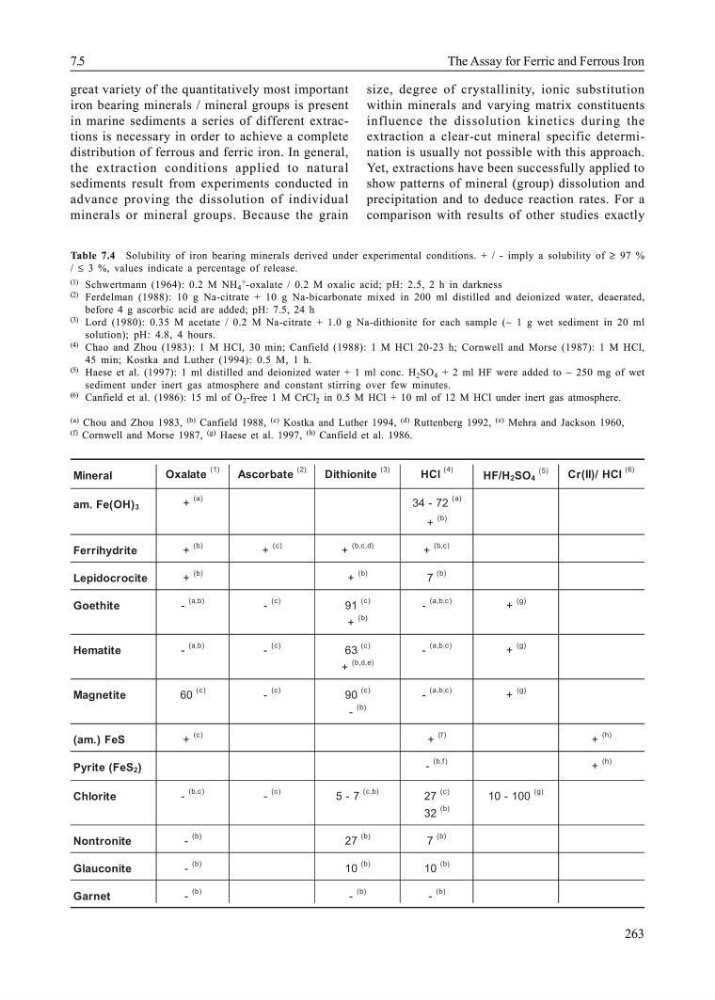
Table 7.4 Solubility of iron bearing minerals derived under experimental conditions. + / - imply a solubility of ≥ 97 %
/ ≤ 3 %, values indicate a percentage of release.
(1) Schwertmann (1964): 0.2 M NH 4
+ -oxalate / 0.2 M oxalic acid; pH: 2.5, 2 h in darkness
(2) Ferdelman (1988): 10 g Na-citrate + 10 g Na-bicarbonate mixed in 200 ml distilled and deionized water, deaerated,
before 4 g ascorbic acid are added; pH: 7.5, 24 h
(3) Lord (1980): 0.35 M acetate / 0.2 M Na-citrate + 1.0 g Na-dithionite for each sample (∼ 1 g wet sediment in 20 ml
solution); pH: 4.8, 4 hours.
(4) Chao and Zhou (1983): 1 M HCl, 30 min; Canfield (1988): 1 M HCl 20-23 h; Cornwell and Morse (1987): 1 M HCl,
45 min; Kostka and Luther (1994): 0.5 M, 1 h.
(5) Haese et al. (1997): 1 ml distilled and deionized water + 1 ml conc. H 2 SO 4 + 2 ml HF were added to ∼ 250 mg of wet
sediment under inert gas atmosphere and constant stirring over few minutes.
(6) Canfield et al. (1986): 15 ml of O 2 -free 1 M CrCl 2 in 0.5 M HCl + 10 ml of 12 M HCl under inert gas atmosphere.
(a) Chou and Zhou 1983, (b) Canfield 1988, (c) Kostka and Luther 1994, (d) Ruttenberg 1992, (e) Mehra and Jackson 1960,
(f) Cornwell and Morse 1987, (g) Haese et al. 1997, (h) Canfield et al. 1986.
7.5
The Assay for Ferric and Ferrous Iron
great variety of the quantitatively most important
iron bearing minerals / mineral groups is present
in marine sediments a series of different extractions is necessary in order to achieve a complete
distribution of ferrous and ferric iron. In general,
the extraction conditions applied to natural
sediments result from experiments conducted in
advance proving the dissolution of individual
minerals or mineral groups. Because the grain
size, degree of crystallinity, ionic substitution
within minerals and varying matrix constituents
influence the dissolution kinetics during the
extraction a clear-cut mineral specific determination is usually not possible with this approach.
Yet, extractions have been successfully applied to
show patterns of mineral (group) dissolution and
precipitation and to deduce reaction rates. For a
comparison with results of other studies exactly
Mineral
Oxalate
(1)
Ascorbate
(2)
Dithionite
(3)
HCl
(4)
HF/H2SO4
(5)
Cr(II)/ HCl
(6)
am. Fe(OH)3
+
(a)
34 - 72
(a)
+
(b)
Ferrihydrite
+
(b)
+
(c)
+
(b,c,d)
+
(b,c)
Lepidocrocite
+
(b)
+
(b)
7
(b)
Goethite
-
(a,b)
-
(c)
91
(c)
-
(a,b,c)
+
(g)
+
(b)
Hematite
-
(a,b)
-
(c)
63
(c)
-
(a,b,c)
+
(g)
+
(b,d,e)
Magnetite
60
(c)
-
(c)
90
(c)
-
(a,b,c)
+
(g)
-
(b)
(am.) FeS
+
(c)
+
(f )
+
(h)
Pyrite (FeS2)
-
(b,f )
+
(h)
Chlorite
-
(b,c)
-
(c)
5 - 7
(c,b)
27
(c)
10 - 100
(g)
32
(b)
Nontronite
-
(b)
27
(b)
7
(b)
Glauconite
-
(b)
10
(b)
10
(b)
Garnet
-
(b)
-
(b)
-
(b)
Table 7.4 Solubility of iron bearing minerals derived under experimental conditions. + / - imply a solubility of ≥ 97 %
/ ≤ 3 %, values indicate a percentage of release.
(1) Schwertmann (1964): 0.2 M NH 4
+ -oxalate / 0.2 M oxalic acid; pH: 2.5, 2 h in darkness
(2) Ferdelman (1988): 10 g Na-citrate + 10 g Na-bicarbonate mixed in 200 ml distilled and deionized water, deaerated,
before 4 g ascorbic acid are added; pH: 7.5, 24 h
(3) Lord (1980): 0.35 M acetate / 0.2 M Na-citrate + 1.0 g Na-dithionite for each sample (∼ 1 g wet sediment in 20 ml
solution); pH: 4.8, 4 hours.
(4) Chao and Zhou (1983): 1 M HCl, 30 min; Canfield (1988): 1 M HCl 20-23 h; Cornwell and Morse (1987): 1 M HCl,
45 min; Kostka and Luther (1994): 0.5 M, 1 h.
(5) Haese et al. (1997): 1 ml distilled and deionized water + 1 ml conc. H 2 SO 4 + 2 ml HF were added to ∼ 250 mg of wet
sediment under inert gas atmosphere and constant stirring over few minutes.
(6) Canfield et al. (1986): 15 ml of O 2 -free 1 M CrCl 2 in 0.5 M HCl + 10 ml of 12 M HCl under inert gas atmosphere.
(a) Chou and Zhou 1983, (b) Canfield 1988, (c) Kostka and Luther 1994, (d) Ruttenberg 1992, (e) Mehra and Jackson 1960,
(f) Cornwell and Morse 1987, (g) Haese et al. 1997, (h) Canfield et al. 1986.