

7
The Biogeochemistry of Iron
256
In fully marine systems siderite formation is
probable to occur below the sulfate reduction
zone where dissolved sulfide is absent, if reactive
iron is still present and the Fe/Ca-ratio of pore
water is high enough to stabilize siderite over
calcite (Berner 1971). The coexistence of siderite
and pyrite in anoxic marine sediments was shown
by Ellwood et al. (1988) and Haese et al. (1997).
Both studies attribute this observation to the
presence of microenvironments resulting in
different characteristic early diagenetic reactions
next to each other within the same sediment
depth. It appears that in one microenvironment
sulfate reduction and the formation of pyrite is
predominant, whereas at another site dissimilatory
iron reduction and local supersaturation with
respect to siderite occurs. Similarly, the importance
of microenvironments has been pointed out for
various other processes (Jørgensen 1977; Bell et al.
1987; Canfield 1989; Gingele 1992).
Apart from microenvironments, an explanation for
the concurrent dissimilatory sulfate and iron
reduction was provided by Postma and Jakobsen
(1996). They demonstrated that the stabilities of iron
oxides are decisive with respect to iron and/or sulfate
reduction assuming that the fermentative step and not
the overall energy yield is overall rate limiting.
Additionally, it shall be noted that the typical sulfate
reducing bacteria Desulfovibrio desulfuricans was
found to reduce iron oxide enzymatically contemporarily or optionally (Coleman et al. 1993). When only
very small concentrations of H 2 as sole electron donor
were available iron oxide instead of sulfate was used
as electron acceptor by D. desulfuricans.
7.4.3.5 The Formation of Iron Bearing
Aluminosilicates
In 1966 the formation of aluminosilicates in marine
environments was hypothesized by Mackenzie and
Garrels (1966) who pointed out the potential significance of this process with respect to the oceanic
chemistry and for global elemental cycles. As
elements are transferred into solid phase and thus
become insoluble this process is referred to ‘reverse
weathering’. Within the scope of this textbook only
a brief overview of the major processes and
conditions of formation is intended to be outlined.
Four major pathways for the formation of iron
bearing aluminosilicates can be distinguished:
1. Formation from weathered basalt and
volcanic ashes
2. Glauconite formation
3. Formation in the vicinity of hydrothermal
vents
4. Formation under low temperature conditions
The first two pathways of formation will not be
discussed here as they were found to be only of
local/regional importance and are not considered
to be of major importance for early diagenetic
reactions. Iron bearing clay mineral formation
under high-temperature conditions near a hydrothermal system of the Red Sea was studied by
Bischoff (1972). A direct precipitation of an ironrich smectite (nontronite) within the metalliferous
sediments was found. This pathway of clay mineral formation was shown to occur at temperatures
Organic Matter
Bottom water
Sediment
Bioturbation
Redox-boundary
Fe(III) / Mn(IV)
Fe(II) / Mn(II)
Advection
dissolved
particulate
Diffusion Bioirrigation
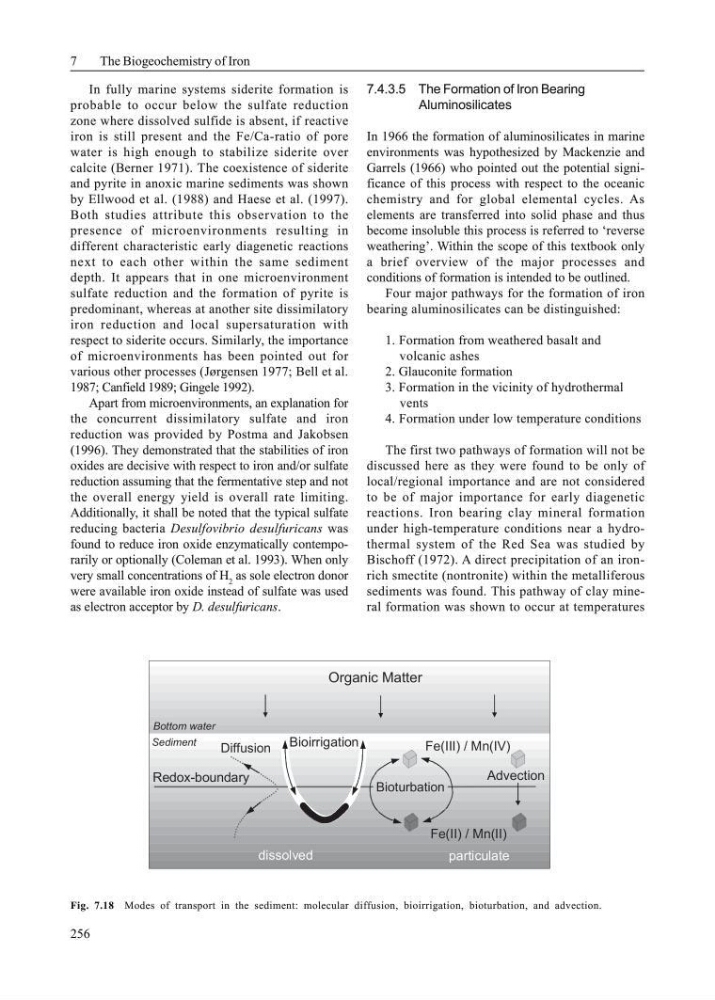
Fig. 7.18 Modes of transport in the sediment: molecular diffusion, bioirrigation, bioturbation, and advection.
The Biogeochemistry of Iron
256
In fully marine systems siderite formation is
probable to occur below the sulfate reduction
zone where dissolved sulfide is absent, if reactive
iron is still present and the Fe/Ca-ratio of pore
water is high enough to stabilize siderite over
calcite (Berner 1971). The coexistence of siderite
and pyrite in anoxic marine sediments was shown
by Ellwood et al. (1988) and Haese et al. (1997).
Both studies attribute this observation to the
presence of microenvironments resulting in
different characteristic early diagenetic reactions
next to each other within the same sediment
depth. It appears that in one microenvironment
sulfate reduction and the formation of pyrite is
predominant, whereas at another site dissimilatory
iron reduction and local supersaturation with
respect to siderite occurs. Similarly, the importance
of microenvironments has been pointed out for
various other processes (Jørgensen 1977; Bell et al.
1987; Canfield 1989; Gingele 1992).
Apart from microenvironments, an explanation for
the concurrent dissimilatory sulfate and iron
reduction was provided by Postma and Jakobsen
(1996). They demonstrated that the stabilities of iron
oxides are decisive with respect to iron and/or sulfate
reduction assuming that the fermentative step and not
the overall energy yield is overall rate limiting.
Additionally, it shall be noted that the typical sulfate
reducing bacteria Desulfovibrio desulfuricans was
found to reduce iron oxide enzymatically contemporarily or optionally (Coleman et al. 1993). When only
very small concentrations of H 2 as sole electron donor
were available iron oxide instead of sulfate was used
as electron acceptor by D. desulfuricans.
7.4.3.5 The Formation of Iron Bearing
Aluminosilicates
In 1966 the formation of aluminosilicates in marine
environments was hypothesized by Mackenzie and
Garrels (1966) who pointed out the potential significance of this process with respect to the oceanic
chemistry and for global elemental cycles. As
elements are transferred into solid phase and thus
become insoluble this process is referred to ‘reverse
weathering’. Within the scope of this textbook only
a brief overview of the major processes and
conditions of formation is intended to be outlined.
Four major pathways for the formation of iron
bearing aluminosilicates can be distinguished:
1. Formation from weathered basalt and
volcanic ashes
2. Glauconite formation
3. Formation in the vicinity of hydrothermal
vents
4. Formation under low temperature conditions
The first two pathways of formation will not be
discussed here as they were found to be only of
local/regional importance and are not considered
to be of major importance for early diagenetic
reactions. Iron bearing clay mineral formation
under high-temperature conditions near a hydrothermal system of the Red Sea was studied by
Bischoff (1972). A direct precipitation of an ironrich smectite (nontronite) within the metalliferous
sediments was found. This pathway of clay mineral formation was shown to occur at temperatures
Organic Matter
Bottom water
Sediment
Bioturbation
Redox-boundary
Fe(III) / Mn(IV)
Fe(II) / Mn(II)
Advection
dissolved
particulate
Diffusion Bioirrigation
Fig. 7.18 Modes of transport in the sediment: molecular diffusion, bioirrigation, bioturbation, and advection.