

1
The Solid Phase of Marine Sediments
4
“drop stones”, which represent characteristic signals in the sediments and are of extremely high
importance in paleoclimate reconstructions.
In certain regions, the transport and the distribution carried out by sea ice are important processes. This is especially true for the Arctic Ocean
where specific processes in the shallow coastal
areas of the Eurasian shelf induce the ice, in the
course of its formation, to incorporate sediment
material from the ocean floor and the water
column. The Transpolar Drift distributes the sediment material across the Arctic Ocean all the way
to the North Atlantic. Glacio-marine sedimentation
covers one-fifth of present day’s ocean floor
(Lisitzin 1996).
Terrigenous material can be carried from the
continents to the oceans in the form of mineral
dust over great distances measuring hundreds to
up to thousands of kilometers. This is accomplished by eolian transport. Wind, in contrast to
ice and water, only carries particles of finer grain
size, such as the silt and clay fraction. A grain size
of approximately 80 µm is assumed to mark the
highest degree of coarseness transportable by
wind. Along wind trajectories, coarser grains such
as fine sand and particles which as to their sizes
are characteristic of continental loess soil (20-50
µm) usually fall out in the coastal areas, whereas
the finer grains come to settle much farther away.
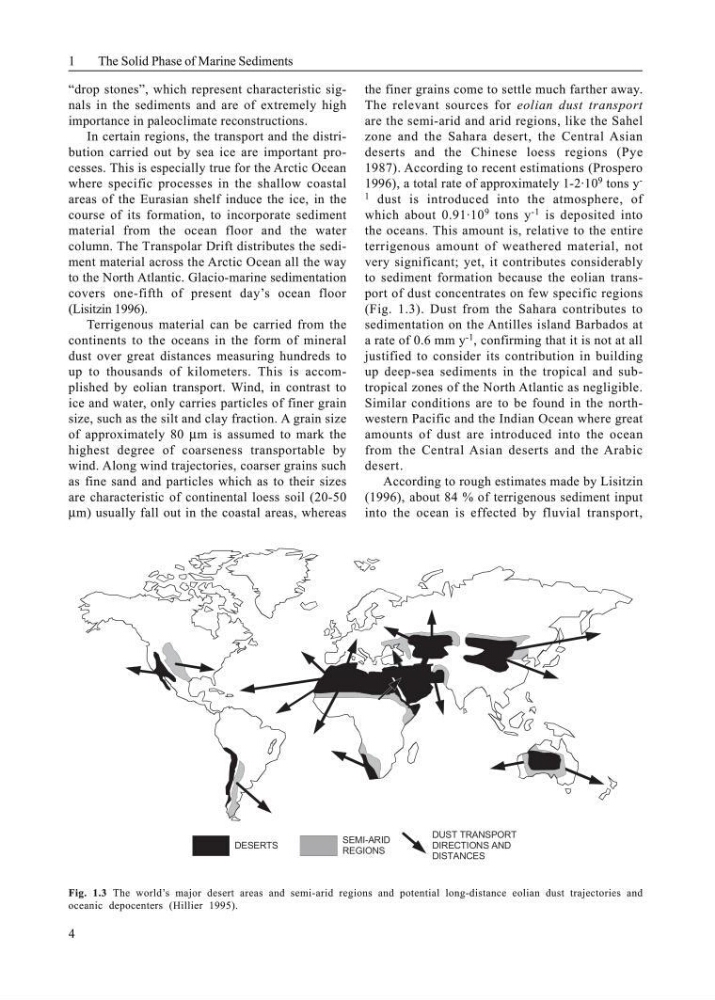
The relevant sources for eolian dust transport
are the semi-arid and arid regions, like the Sahel
zone and the Sahara desert, the Central Asian
deserts and the Chinese loess regions (Pye
1987). According to recent estimations (Prospero
1996), a total rate of approximately 1-2·10 9 tons y -
1 dust is introduced into the atmosphere, of
which about 0.91·10 9 tons y -1 is deposited into
the oceans. This amount is, relative to the entire
terrigenous amount of weathered material, not
very significant; yet, it contributes considerably
to sediment formation because the eolian transport of dust concentrates on few specific regions
(Fig. 1.3). Dust from the Sahara contributes to
sedimentation on the Antilles island Barbados at
a rate of 0.6 mm y -1 , confirming that it is not at all
justified to consider its contribution in building
up deep-sea sediments in the tropical and subtropical zones of the North Atlantic as negligible.
Similar conditions are to be found in the northwestern Pacific and the Indian Ocean where great
amounts of dust are introduced into the ocean
from the Central Asian deserts and the Arabic
desert.
According to rough estimates made by Lisitzin
(1996), about 84 % of terrigenous sediment input
into the ocean is effected by fluvial transport,
DESERTS
SEMI-ARID
REGIONS
DUST TRANSPORT
DIRECTIONS AND
DISTANCES
Fig. 1.3 The world’s major desert areas and semi-arid regions and potential long-distance eolian dust trajectories and
oceanic depocenters (Hillier 1995).
The Solid Phase of Marine Sediments
4
“drop stones”, which represent characteristic signals in the sediments and are of extremely high
importance in paleoclimate reconstructions.
In certain regions, the transport and the distribution carried out by sea ice are important processes. This is especially true for the Arctic Ocean
where specific processes in the shallow coastal
areas of the Eurasian shelf induce the ice, in the
course of its formation, to incorporate sediment
material from the ocean floor and the water
column. The Transpolar Drift distributes the sediment material across the Arctic Ocean all the way
to the North Atlantic. Glacio-marine sedimentation
covers one-fifth of present day’s ocean floor
(Lisitzin 1996).
Terrigenous material can be carried from the
continents to the oceans in the form of mineral
dust over great distances measuring hundreds to
up to thousands of kilometers. This is accomplished by eolian transport. Wind, in contrast to
ice and water, only carries particles of finer grain
size, such as the silt and clay fraction. A grain size
of approximately 80 µm is assumed to mark the
highest degree of coarseness transportable by
wind. Along wind trajectories, coarser grains such
as fine sand and particles which as to their sizes
are characteristic of continental loess soil (20-50
µm) usually fall out in the coastal areas, whereas
the finer grains come to settle much farther away.
The relevant sources for eolian dust transport
are the semi-arid and arid regions, like the Sahel
zone and the Sahara desert, the Central Asian
deserts and the Chinese loess regions (Pye
1987). According to recent estimations (Prospero
1996), a total rate of approximately 1-2·10 9 tons y -
1 dust is introduced into the atmosphere, of
which about 0.91·10 9 tons y -1 is deposited into
the oceans. This amount is, relative to the entire
terrigenous amount of weathered material, not
very significant; yet, it contributes considerably
to sediment formation because the eolian transport of dust concentrates on few specific regions
(Fig. 1.3). Dust from the Sahara contributes to
sedimentation on the Antilles island Barbados at
a rate of 0.6 mm y -1 , confirming that it is not at all
justified to consider its contribution in building
up deep-sea sediments in the tropical and subtropical zones of the North Atlantic as negligible.
Similar conditions are to be found in the northwestern Pacific and the Indian Ocean where great
amounts of dust are introduced into the ocean
from the Central Asian deserts and the Arabic
desert.
According to rough estimates made by Lisitzin
(1996), about 84 % of terrigenous sediment input
into the ocean is effected by fluvial transport,
DESERTS
SEMI-ARID
REGIONS
DUST TRANSPORT
DIRECTIONS AND
DISTANCES
Fig. 1.3 The world’s major desert areas and semi-arid regions and potential long-distance eolian dust trajectories and
oceanic depocenters (Hillier 1995).